
What happens after dark in a museum? The award winning Syrian filmmaker, and personal favorite, answers that question her own way, in a film that is all magical realism with a touch of hybrid documentary thrown in.
Yes, we’ve all watched Night at the Museum and loved seeing Ben Stiller interact with the artifacts of the Museum of Natural History in NYC once they came alive after dark. But while that film, less so the subsequent chapters, proved highly entertaining, it hardly explained the soul of Objects d’Art which hail from foreign lands and come to be preserved for posterity inside the many museums around the world.
In her latest film, a return to short form for the Venice and Sundance winning Syrian filmmaker, Soudade Kaadan imagines the tiles inside Leighton House, the former London home and studio of Victorian artist Frederic Leighton, speaking to one another. Speaking to us, the audience are three tiles in particular — a fish, voiced by stage, film, TV and radio actress Souad Faress, a parrot, voiced by film actor Khalid Abdalla and a siren, voiced by TV and film actress Leem Lubany. Along with composer Rob Manning who made up a beautiful score, they take the audience on a journey through memory, the result of displacement — spoiler alert, it may not always be simply bad! — and what it means to belong in a multicultural setting.
See how the film could really be a much needed lesson for us all right now? Kaadan does that often, and well in her work.
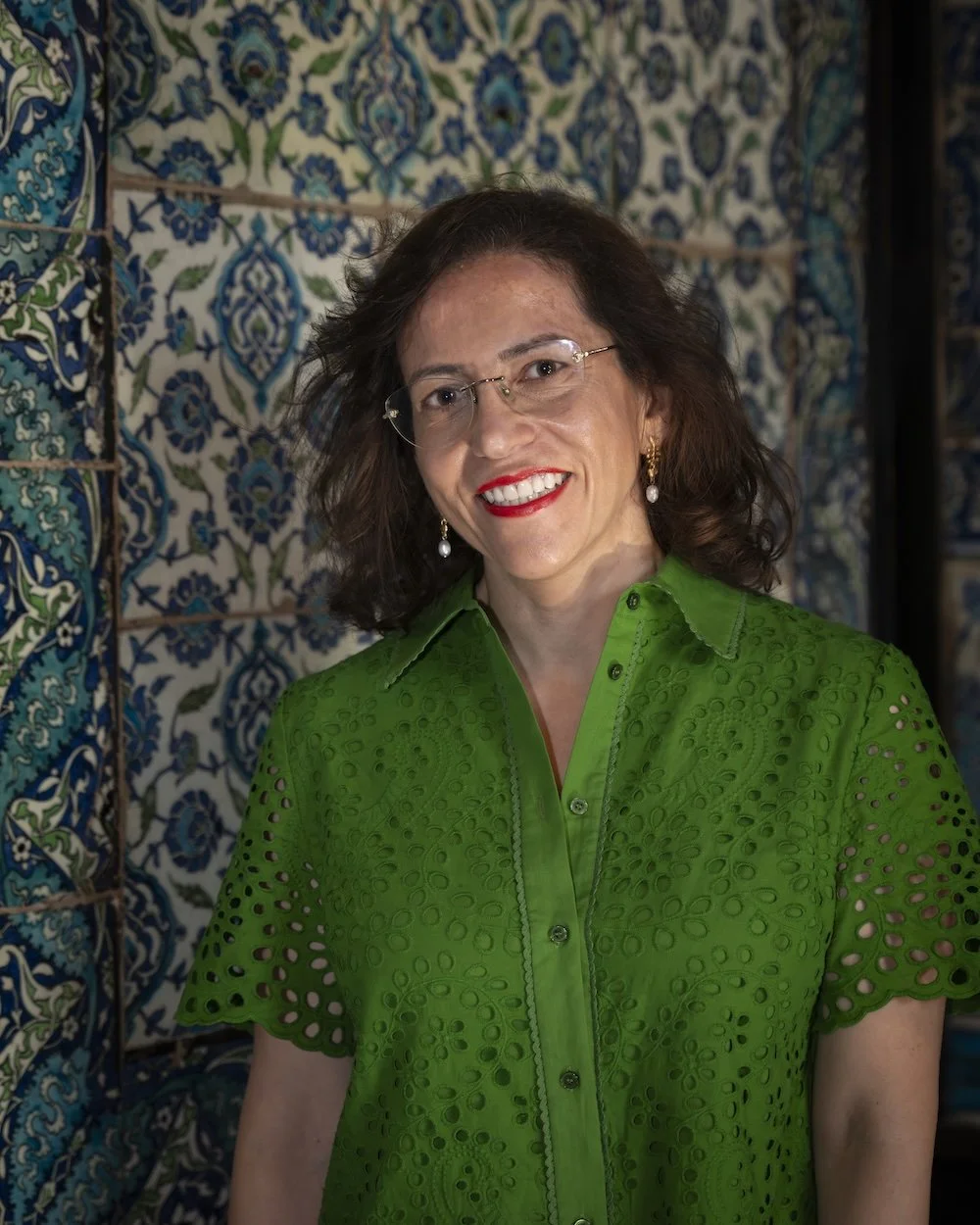
Soudade Kaadan, photo courtesy of © RBKC by Jaron James
About her choice to use of a hybrid documentary plus magical realism fiction format for her film, which also involves some beautiful animation produced by Ayse Unal, Kaadan said: “The film moves between documentary and dream because memory itself moves that way, shifting between fact and longing, between preservation and displacement. The film is an open invitation to think together, to sit with the questions the tiles ask. What happens after hours, when tiles from Damascus, Cairo, Istanbul, and beyond begin to murmur their memories?”
When the Tiles Spoke was commissioned by Leighton House as part of the museum’s centenary programming, The Arab Hall: Past and Present (21 March - 4 October), a project that also includes contemporary art and a publication.
Alongside When the Tiles Spoke in fact, three newly commissioned installations will offer contemporary perspectives on the Arab Hall, each engaging with its architecture, materials and layered histories.
From 21 March to 15 May 2026, ‘Atlas of An Entangled Gaze’, by London-based Lebanese artist Ramzi Mallat explores the subtle power dynamics in the Arab Hall. Comprised of thousands of blue-glazed ceramic Syriac evil-eye charms, the piece will appear suspended from the room’s central chandelier hanging over the fountain.
From 15 May to 31 July 2026, British Bangladeshi artist Kamilah Ahmed will present ‘Facets in Resonance’, a mixed-media embroidered textile arch, which will sit over the fountain in the Arab Hall, framing a new view on the space.
The final installation will be ‘From Water, Every Living Thing’ by calligrapher and artist Soraya Syed, the first Briton to be awarded an icazetname, a traditional license certifying mastery in Islamic calligraphy. Her exhibition will be on display at Leighton House from 31 July to 4 October.
Alongside these contemporary artists, there will also be an exhibition in the museum’s Tavolozza Drawings Gallery which will trace the origins and creation of the Arab Hall (constructed between 1877 and 1881), revealing the influences, collaborations, and craftsmanship behind this iconic space. Featuring original designs by architect George Aitchison, ceramicist William De Morgan and illustrator Walter Crane, alongside works by Leighton and ceramics from his own collection, the exhibition offers visitors a window into the collaborative process that brought the Arab Hall to life.
All the above are in some way informed by the research of Dr Melanie Gibson, and so it only makes sense that the accompanying fully illustrated book The Arab Hall, Frederic Leighton: Traveller and Collector be a part of the festivities. Gibson’s study charts Leighton’s travels across southern Spain, Turkey, Egypt, Syria, and Sicily, revealing how these journeys informed his engagement with Islamic art and the design of the Arab Hall.
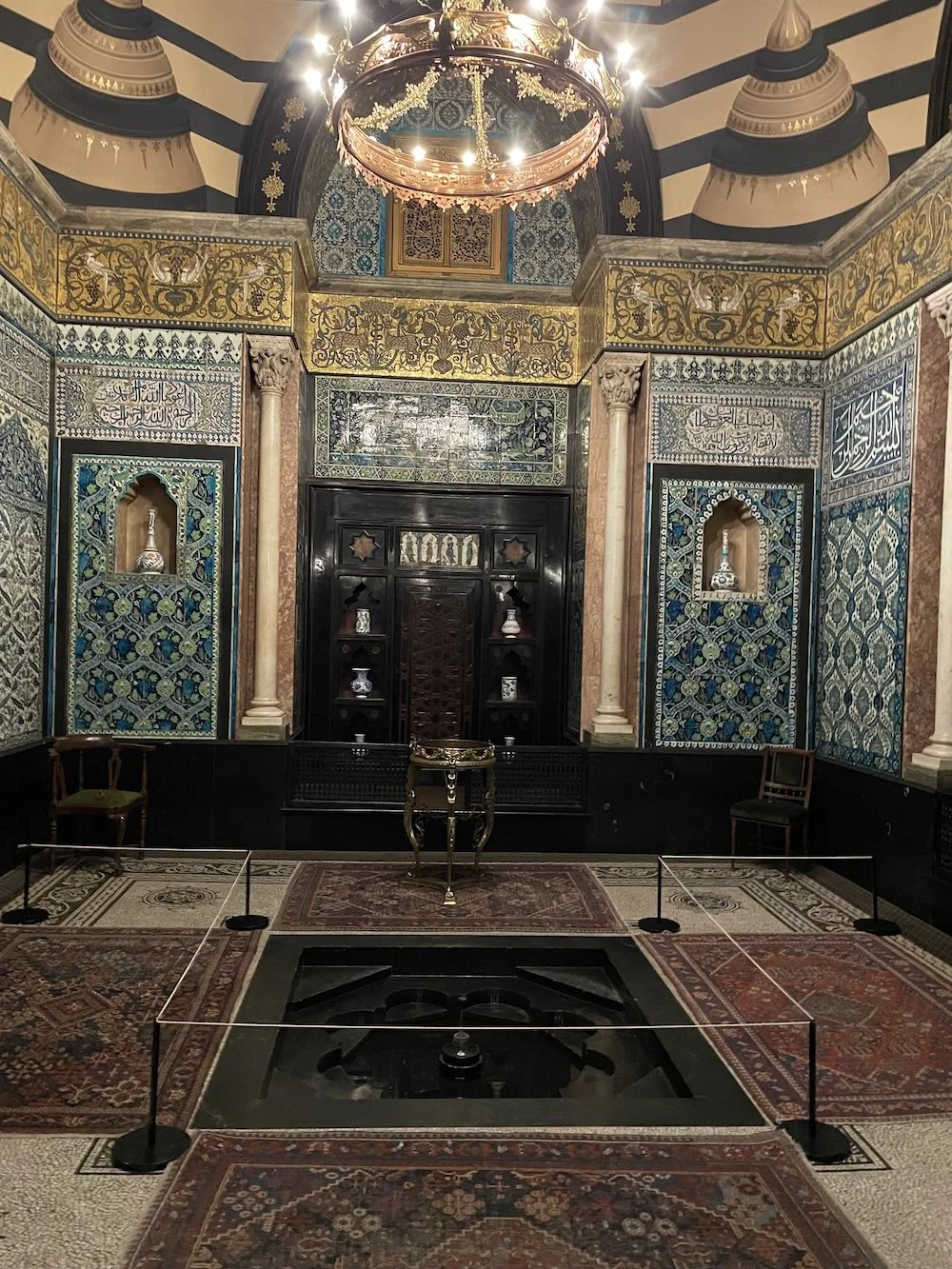
Arab Hall, photograph by E. Nina Rothe
Much of Kaadan’s film also references the book by Dr. Gibson, in that the fish tile is Syrian, while the parrot is a Byzantine tile and the Siren hails from Venice (probably imported there too).
Leighton House senior curator Daniel Robbins addressed the eager crowd before the presentation of the film, saying that of the ideas that were brought to him in preparation for the centennial celebration, Kaadan’s was “totally different” and felt “more personal to me, more moving.” Most of Kaadan’s work is about displacement as she herself has faced a past where she was not allowed to return to her native, and clearly beloved Damascus. “I felt uprooted, like a tree,” she admits in her director’s statement, where she talks about her connection to Leighton House and the stunning Arab Hall within it. “From the outside, Leighton House looked ordinary. A modest brick façade, like many others in London. Nothing announcing what it holds inside,” she continues, then concludes why the place felt familiar to her, because it “felt like entering a Damascene home — in Damascus, houses do not reveal themselves easily.” What is inside Leighton House should be on everyone’s radar and I myself discovered the place thanks to the evening and Kaadan’s invite. I can’t wait to go and spend quiet time by the Arab Hall fountain, immersed in thoughts of the Arab world I love so much and can’t visit at the moment because of the useless war initiated by the US and its dubious allies.
But back to cinema, which always heals my aching heart.
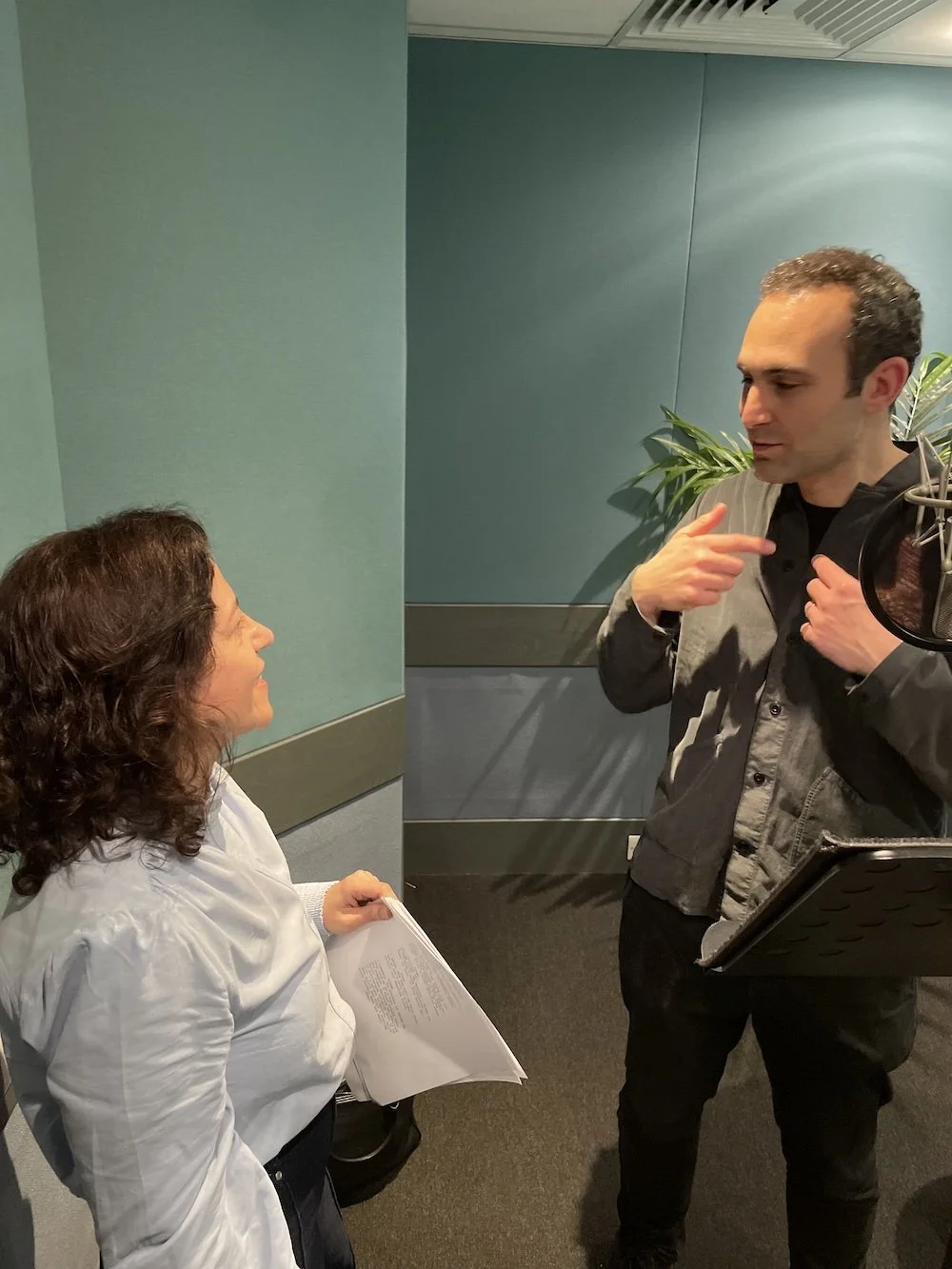
Kaadan with actor Khalid Abdalla, during the recording of the voices for ‘When the Tiles Spoke’
Following the premiere of her short film and during an insightful Q&A with producer Mia Bays, director of the BFI Filmmaking Fund, Kaadan talked about when she first came into Leighton House. “In 2023, I was asked for a photo that would represent me and I came here, as I had no photos of me in Damascus,” and thus discovered the beauty of the Arab Hall. “The film doesn’t give answers,” she also pointed out, which is always a great thing for cinema. “All of us filmmaker, we have a theme we don’t stop telling until we are completely satisfied,” she further explained when asked about the idea of displacement, which she has explored at length in her work, even calling her last feature Nezouh — which means “the displacement of people, water or souls.”
What I personally took away from the evening is a question. Should artifacts sometimes leave their place of origin? The usual answer is no, but a question is sometimes more powerful than any statement out there.
As Kaadan pointed out to me via email, some “important questions in the film [are] about orientalism, the gaze, religion and politics.” Plus the question asked at one point by the fish tile: "The house that held me crumbled. Fire, perhaps, or neglect? Perhaps I was taken, stripped from the wall, sold as a bargain. But tell me, should history ever be put up for sale?”
Now don’t get me wrong, no to looting art from its original place of origin and yes to returning artifacts that were looted by the powers of colonialism, I’m all for that. But could it be that sometimes, when art leaves its place of birth, it also takes takes flight?
And artists too, as Soudade Kaadan with her beautiful, spellbinding work has proven. Time and time again.
All images courtesy of the filmmaker, used with permission.