
The French filmmaker’s screen adaptation of Albert Camus’ written words translates and updates the story of Meursault and lifts it up to appeal to contemporary audiences by tackling our obsession with fitting in, at any cost.
If an alien ship were to touch down on earth today and watch our society at play, they would quickly deduce that humans lie, constantly, to fit in and also try to take down those who wish to live outside of conventions.
Cue examples, past and present, which often include unifying figures like Malcolm X who, post visit to Mecca, tried to tell his own Muslim American brothers and sisters that he’d seen unity, true unity on his pilgrimage and that balanced race relations could be achieved in the US too; but also Palestinian-Israeli actor and director Juliano Mer-Khamis, who was assassinated outside The Freedom Theatre in Jenin, where he would put on productions that brought together Israeli and Palestinian actors in an act of defiance. More recently of course, the various victims of ICE violence in the US, who have simply tried to stand up to power, and been on the side of “the Other”.
In his 1942 novella L’Étranger (The Outsider, in English) the character of Meursault, which is sometimes reputed to have been based on an acquaintance of Camus whom we would now categorize as “on the spectrum”, lives outside of conventions, foregoing niceties to an extreme. When his mother dies, in the care home for which he’d been footing the bill out of his meager wages, he attracts attention because he doesn’t cry at her funeral. Today, we would simply chuck that off to the adage “everyone grieves differently” but would probably still judge him for being insensitive. Back in Camus’ days, and in Ozon’s film also taking place towards the end of the French occupation of Algeria, social lies, niceties and various conventions were considered crucial to one’s survival and acceptance into society. And therein lies the brilliance of this story.
In casting the twenty-something, blond and lanky French actor Benjamin Voisin in the role of Meursault, Ozon immediately hooks his audience in and brings us over to his side. He may not act and react in a way that makes us, or those around him, comfortable but he sure gives us something spellbinding to look at. In fact, the two-hours long film seemed to fly by, as the camera focused on the quietly handsome actor and followed him around a recreated 1930s Algiers in Ozon’s beautiful black and white film.
Meursault is his own man, eating when and where he pleases, and that’s often in the sunlight of his sparsely decorated apartment in Algiers, a city he calls home, in which he is ‘the Other’, the settler. He also loves when and who he wishes, and that soon turns out to be Marie (Rebecca Marder) with whom he sleeps at the time of his mother’s death. Yet, at the same time, admits to her he doesn’t really love her, but not in so many words of course. It is this anhedonia experienced by Meursault, coupled with an unwillingness to play the game of life by telling small white lies and offering silly commonplace phrases to appease those around him that ultimately will prove his undoing in the story.
There is also a welcomed cameo in the film, played by Leos Carax frequent collaborator Denis Lavant who is Meursault’s neighbor, a man who proves essential to the main twist of the story and presents another angle of the story’s leading man which may help explain things to the audience.
While Orzon fixes what little was left out by Camus in his original story, by giving “the Arab” and his sister names — Moussa and Djemila — in a post-The Meursault Investigation by Kamel Daoud “woke” era, he also adds his own kind of trademark and weaves into the story a sense of homoeroticism. When the climax of the film arrives, on the beach in the unbearably bright sun of an Algerian summer, with the heat palpable to the audience through Manuel Dacosse’s stunning cinematography, we are left to wonder if the act by Meursault is done as a counteract to violence or, more probably, as a revolt against its protagonist’s own impulses, which he himself doesn’t know how to deal with. Or perhaps, this the first time ever that Meursault does something for the sake of convention? And it does go so horribly wrong for him, after that.
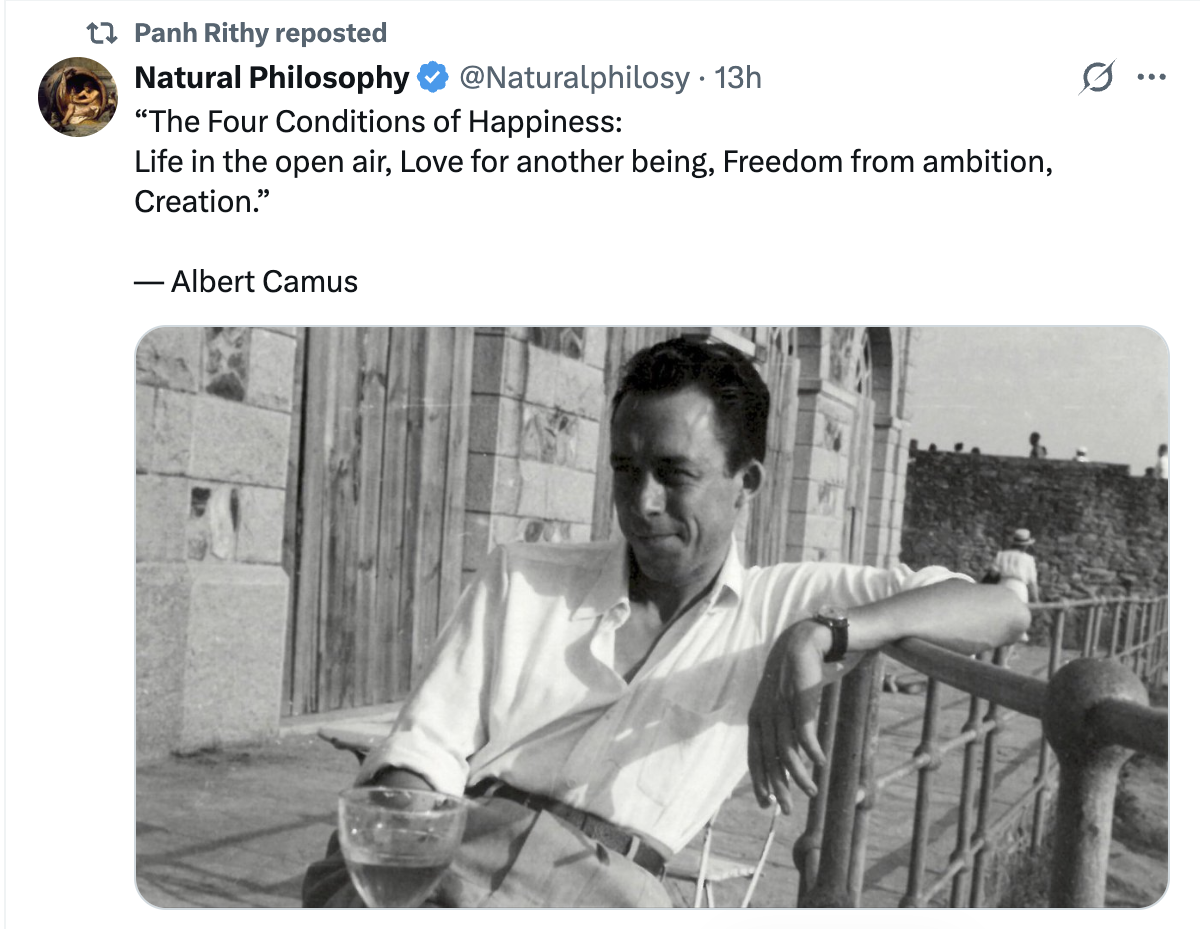
We should not forget while reading Camus that he was a philosopher and a political activist, which definitely color the story of The Stranger. He himself was born in French Algeria, himself a ‘pieds-noirs’ hailing from pieds-noirs parents — people of European descent who were born in North Africa during the colonial occupation. When he found himself back in France just as the Nazis invaded Paris and began the German occupation of the country, he joined the French Resistance. He was the second-youngest recipient of the Nobel Prize in Literature and died just a couple of years later under mysterious circumstances. His obituary by William Faulkner read: "When the door shut for him he had already written on this side of it that which every artist who also carries through life with him that one same foreknowledge and hatred of death is hoping to do: I was here."
Among his most read written works are L’Étranger, of course but also La Peste, Caligula and Le Premier Homme which was published posthumously. The themes of personal rebellion, one’s own connection to God even though living in a modern, faithless world and the perils of totalitarianism were never too hard to find for his readers and in fact, present themselves in Ozon’s film as well.
Personally, I found The Stranger a haunting, beautiful watch, one which offers a word of warning to all who wish to live truly free of conventions. And now, when I find myself uttering a little white lie to fit in, or comfort the person across from me, I try to think about the reasons I do that. And often, it’s a lack of courage which Meursault, as a character probably fashioned after Camus himself — as is often the case with writers and their subjects — possesses unabashedly and in great quantity. Does that make him a sociopath too? The answer is all yours, but after you promise to watch this wonderful film!
The Stranger will release in the UK and Ireland on April 10th 2026, thanks to Curzon, and is currently screening in US cinemas.
Images used with permission.