Near the beginning of Pawel Pawlikowski’s stunning film on novelist Thomas Mann’s return to Germany in 1949, the author and his daughter Erika drive through war-torn Frankfurt, the city reduced to rubble. It’s a scene which showcases in the first clip from the film, but it also features in current events, as I awoke on the morning to the news that multiple Russian-deployed drones had hit Kiev, bringing the haunting film home. In more ways than one.
Fatherland is the kind of film which gets more and more actual, the longer it sits with the viewer and the further our current world leaders dig us deeper into the ground as a human race. That’s at the core of Pawel Pawlikowski’s genius, even if the film is shot in shades of black and white and takes place during an era when men wore suits in everyday life, complete with ties and crisp white shirts. It is an actual, contemporary story of not knowing where “home” is, and through no fault of our own.
Fatherland, make no mistakes, is a must-watch. If just for the casting alone and more on that later. That MUBI owns the rights to it promises the film will get a wide audience, first in festivals and through a theatrical distribution — the film needs the full screen experience — later on the platform for everyone to stream at their leisure.
The day before the film screened — I’d watched it before coming to Cannes at a London screening — I sat next to the artistic director of a major European film festival inside the Palais. He pondered aloud, when I gushed about how wonderful Fatherland is, whether to screen the film in his upcoming festival’s main, larger arena or in a smaller cinema. His doubts, before watching Fatherland of course, had to do with the idea that perhaps its audience could be limited to those who know and love Thomas Mann’s work, or have a connection to his destiny dictated by fascism. I’d say today those doubt should have been put to rest with the news coming out of the Ukraine, and Iran, Lebanon, Gaza etc. and anyway, with the rise of right wing governments nearly everywhere, the wasteland those cabinets will leave as their legacies are only bound to get larger and larger, until all of us, worldwide, are involved.
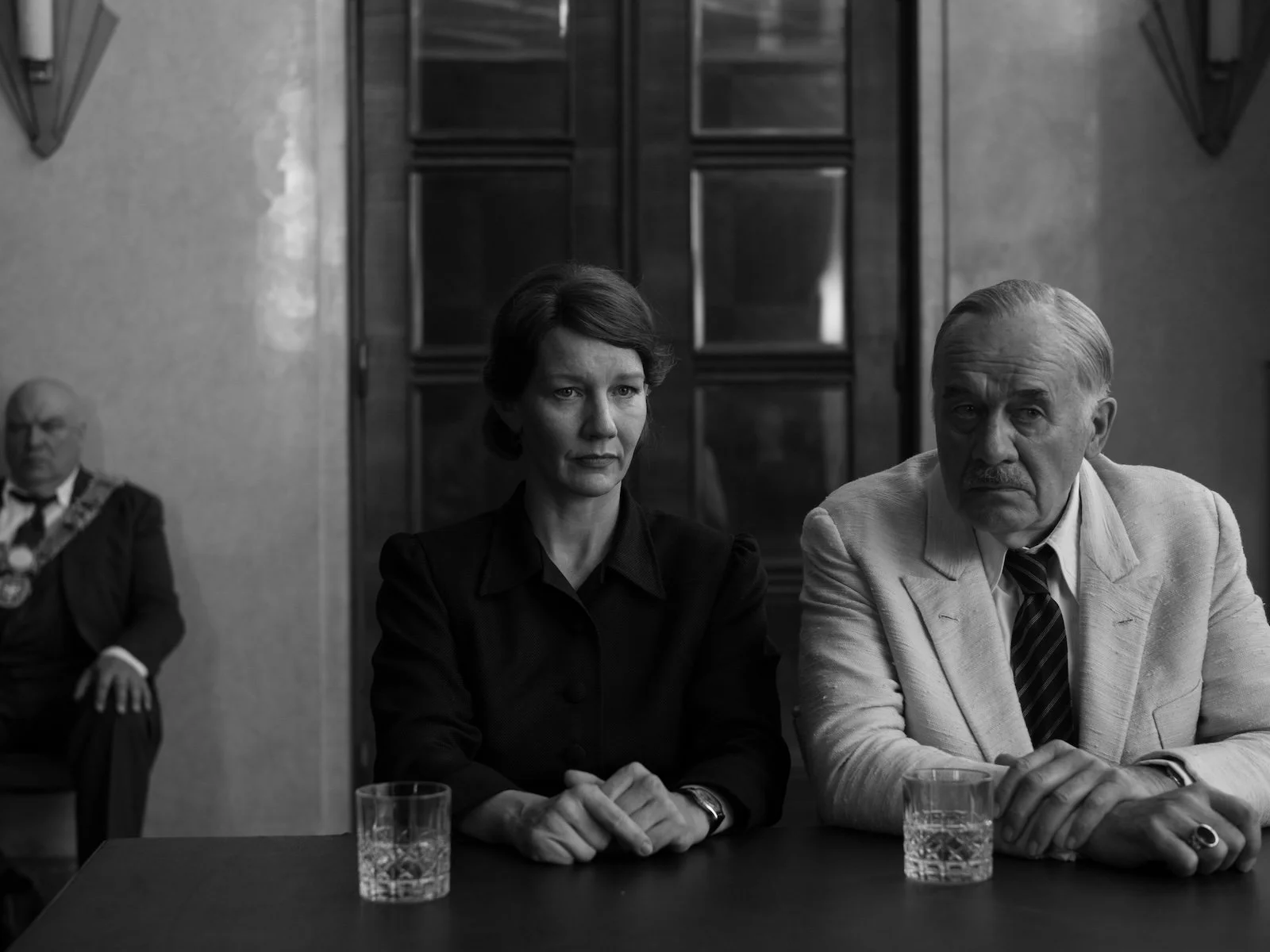
The story takes place during a journey back to Germany which Mann (played by the legendary German actor Hanns Zischler) and his daughter Erika (the ever spellbinding Sandra Hüller) took, she at the helm of the car, her father sitting in the passenger seat, on a voyage back into the land that had made it impossible to be an artist in the early 1930s because of their new fascist rules. But now the war is over and it is the summer of ‘49, at the height of the Cold War, because well, once an enemy is defeated, another must be immediately created for leaders to govern. At that time, Mann — both a renowned Nobel laureate novelist well known outside of Germany and a scholar of 18th century polymath Johann Wolfgang von Goethe — is due to receive an award for his reworking of Faust, titled Doctor Faustus. The novel ended up being the last one published for Mann and the most recent English translation has been published this year, in 2026. Famously, Doctor Faustus riffs on the legend of Faust in Goethe’s play, but instead of the title character selling his soul to the Devil, in Mann’s version it is Germany which has sold its soul to the Devil. For this, Mann is due to be awarded the Goethe Prize while on the trip, in part as a way to show the country’s New Germany era commencing.
During their journey, Mann and Erika experience heartbreak, a sense of not belonging anywhere, but also being at home everywhere. They travel from Frankfurt into the separated East Germany to visit Weimar, where Goethe lived most of his life, now in the hands of the Soviets. They meet old faces now trying to pass themselves off as reformed “good Germans” and reconnect as father and daughter, both headstrong and intelligent.
So I can understand how the film may not seem like a rollercoaster ride of entertainment on paper, but “on paper” is not why we go to the movies. If we wanted something cool sounding in writing, we would read a novel instead, something like Mann’s Death in Venice, which is one of the most beautiful works of the written art I’ve ever read. Instead, we go to the movies to be immersed in a world that isn’t ours, to feel transported to a place which engulfs us in feelings and thoughts and wraps us up in its atmospheric arms, from the comfort of our darkened screening room. And that’s exactly what Pawlikowski does, in all his films, and again in Fatherland. Himself a man forced to leave his country and now finally living there again, he calls himself a “European” and there are as many autobiographical elements in Fatherland for its director as there are for any of us who sit down to watch it.
My own connection to the film, and the reason I craved to watch what I imagined would be my favorite film in Cannes (spoiler alert: I was not disappointed at all!) has to do with my grandfather’s story. Hans Rothe left Germany at the very same time as Mann and wandered around Europe with companion, my grandmother Helen, until my father Andreas was born. While Mann went to Switzerland and then in 1939 left for the US, Hans and family kept moving from country to country — Italy to France, then Spain, then finally the US in the late 40s — while fascism caught up with them. Both Mann and granddad became naturalized Americans, after being stateless since the mid-1930s because the Nazi party had revoked their citizenships due to the intellectuals publicly denouncing their criminal government. The list goes on and on, but while the Rothe family settled in Connecticut while my grandfather taught there, Thomas Mann, his wife and some of their children moved to Pacific Palisades in California in the 1940s from where the author continued to fight extremism in all its ways, shape and form. My grandfather vowed to never set foot in Germany again, and followed through on his promise.
For me, Fatherland is an imagined journey back for Hans, with me in the driver’s seat, accompanying him along the way.
Fatherland was originally titled 1949, which as a fascinating aside is the year Pawlikowski’s own parents met. Their love story the filmmaker used as the “matrix” for the 2018 film Cold War, which won the Polish helmer the Best Director prize in Cannes that year and swept the 2018 European Film Awards.
Aside from the perfect directing, the film also benefits from the grand performances of everyone involved, from the leading figures to the extras, their faces still possessing the look of the old, Nazi Germany while promising to embody the new principles. Costumes are a standout for me, by frequent Pawlikowski collaborator Aleksandra “Ola” Staszko, and cinematography lifts the film to a deliriously beautiful level, thanks to Łukasz Żal. Co-writer Henk Handloegten brings his own brand of freshness to the story, and the editing by Pawlikowski along with Piotr Wójcik ensures there isn’t a single moment wasted in this masterpiece.
One walks out of the theater, after having watched Fatherland, still hearing the steps on the old creaky wooden floors and thinking we smell the cigar smoke coming out of the screen. And that’s what the magic of cinema is really about, to transport us by any means necessary, to world away from ours, for as long as possible, in our imagination.
Images courtesy of MUBI, used with permission.