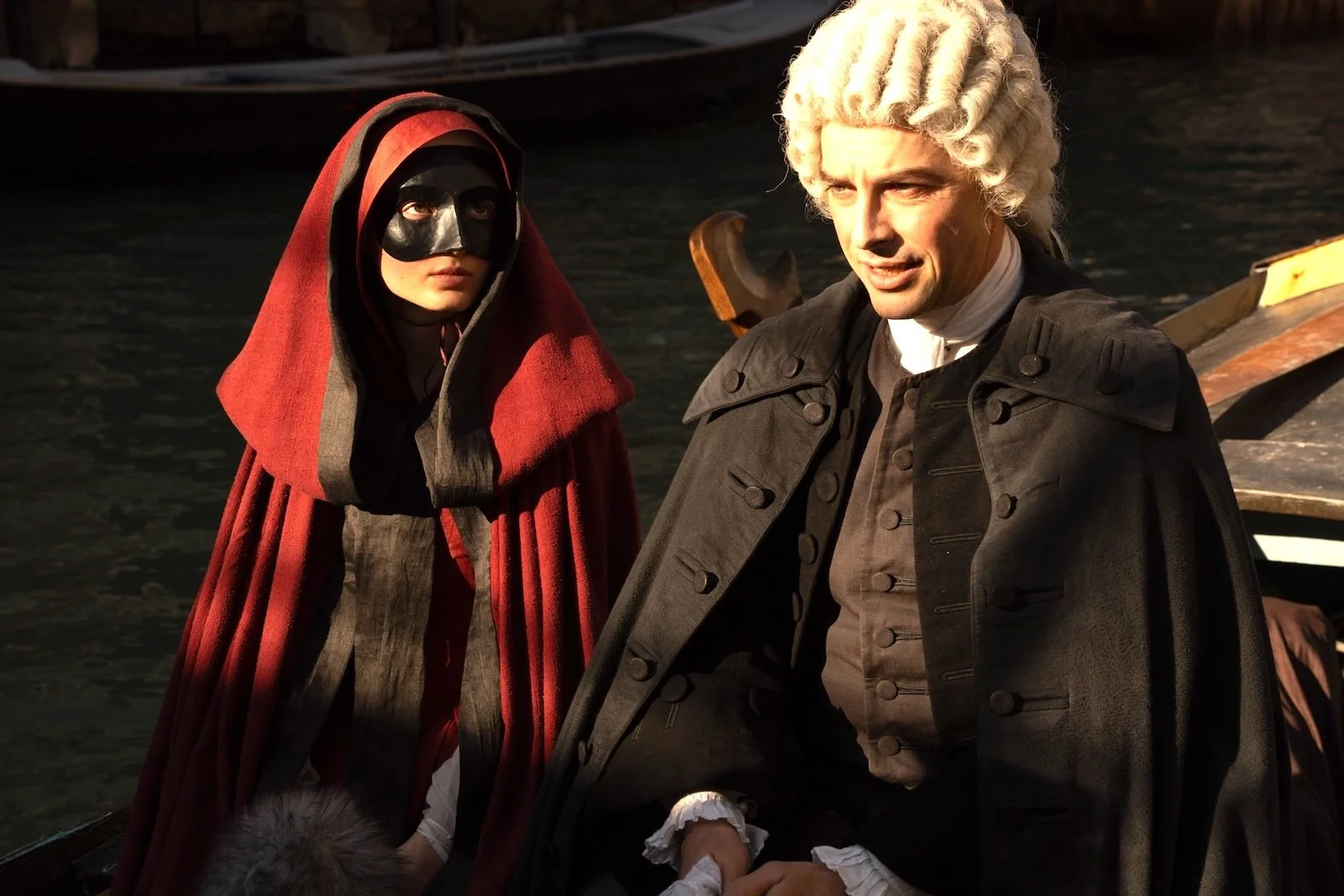
The award winning Italian director with more than twenty years of operatic productions under his belt has now ventured into film making and his first feature is a cinematic masterpiece of sight, feelings and sound.
“È primavera, svegliatevi bambine…” The lyrics of the popular 1940s hit Mattinata fiorentina by Italian singer Alberto Rabagliati hint at the power of the “primavera”, spring as we call the awakening season in English.
As the song continues, the refreshing and freedom-inducing powers of a springtime day, with its crisp air and brighter lighting, usually hold promise beyond our wildest dreams.
By that reasoning, it’s no accident that the most exciting, and probably best known of Antonio Vivaldi’s quartet of violin concerti ‘The Four Seasons’, composed by the priest turned music composer at the beginning of the 18th century, belongs to the Primavera.
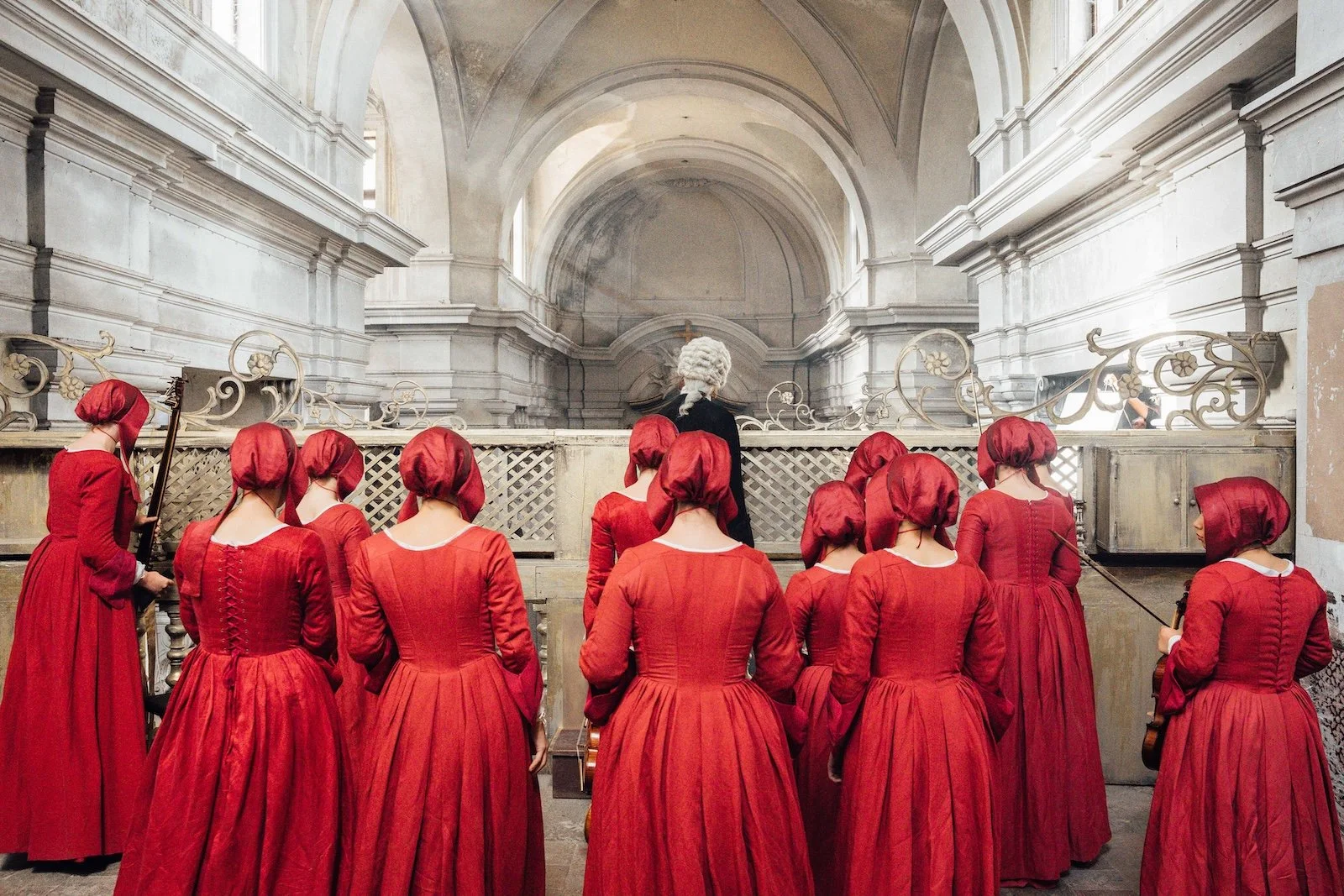
Primavera is also the title of Damiano Michieletto’s stunningly shot and perfectly told first cinematic venture, which unfurls Vivaldi’s collaboration with Venice’s L’Ospedale della Pietà, a refuge for orphaned and abandoned children. According to the film, at the time he was given the directorship of the unseen string orchestra of the Venetian orphanage, Vivaldi was considered a sickly has-been, a musician whose talents as a great violinist were overshadowed by the form of asthma which afflicted him since childhood and prevented him from becoming a practicing priest. Even if his greatest work still laid ahead of him, and was composed in the years after he stopped directing the orchestra of the Ospedale della Pietà.
A still from ‘Primavera’ photo © Kimberley Ross
While the film will open on April 24th in UK and Irish cinemas, thanks to a distribution deal with Curzon, Primavera screened earlier in March at the BFI Southbank, as the opening film of the Cinema Made in Italy festival, with Michieletto in attendance. It was during this London sojourn that I got a chance to speak with the Venetian director. “When you direct an opera, you deal with complexity of people and different artists involved in a project,” he confessed, as I inquired about the difference in directing a film and helming an opera. “So when you are in the set and you have the complexity of the situation, it's not that different from being on a stage,” he continued, conceding that “at the same time it is totally different because you use a camera, so the whole point of view comes from the camera and you have to think with the eye of the camera, not with the eye of the people sitting in the theatre. Then you work with actors, which are different from singers — they are two different animals.”
Yet Michieletto tackled a work of the seventh art which employed his expertise, music. “I wanted to face something new, something challenging for myself, I wanted to challenge myself with something that I didn't know,” admittedly was his reason for choosing to tell this story on the big screen, and the one difference, which in turn can make all the difference in a film, was the editing process. “[It] is a process that does not exist in the opera. And in theatre, it doesn't exist. But with editing, you can really change everything or even destroy or make it greater or even save some scenes that were not so strong.” He continued in his soothing voice, speaking impeccable English, “the editing, especially in this film where you have also music and a combination of music and images, then the editing becomes really important. All these things were new for me, but they were precisely what I was looking for to go in a dimension which was new for me, and which I didn't know what it could lead to, with a lot of question marks, but this is the reason why I did a film.”
The challenge of making a film and the risks he had to take were exactly what Michieletto needed to tackle for us, the audience, to enjoy this story it turns out. Primavera is a feast for the senses and brings together a love for music with a human touch and a clear understanding of the price of freedom a woman would have had to pay in 18th century Italy. Actually, some of the themes and ideas explored in the film are still pertinent to illuminate us on the toll women’s freedom takes on those unwilling to live by the rules. And possessing an inordinate amount of talent, as the both leading characters possess in the film.
At the center of the story of Primavera is 20-year-old Cecilia (played with wonderful nuances by relative newcomer Tecla Insolia). She is a violinist with an extraordinary talent and having been left as a child in the orphanage, with only half a postcard to identify her should her mother even have come back to claim her “parcel”, has never stopped her growth. As other orchestras around Venice gain popularity, at the expense of the all-women one at Ospedale della Pietà, the governor and prioress of the orphanage make the decision to hire a new violin teacher, Antonio Vivaldi (played with haunting intensity, and the necessary coughing fits by Michele Riondino).
Their encounter proves electric, as Vivaldi is inspired by Cecilia’s talent and she, in turn, finds a mentor and someone she is drawn to intellectually in Vivaldi. Until, she is promised in marriage to an influential (and not bad looking!) army commander, played chillingly by the wonderful Stefano Accorsi, who seals her fate. But you’ll have to watch Primavera on the big screen to know the rest. All I can add is that freedom always comes at a cost for women, and Cecilia’s payment is perhaps more than she can afford.
Primavera is based on the Strega Prize winning novel Stabat Mater by Tiziano Scarpa, with a screenplay written by renowned Italian writer and director Ludovica Rampoldi. The production came together thanks to the producers at Indigo Film, who are the team behind most of Paolo Sorrentino’s film including his Oscar-winning 2013 The Great Beauty, along with prestigious works by Mario Martone and Valeria Golino, to name just a few. “They have an office really close to the Opera theater in Rome and came to see a production,” Michieletto explained, “and told me, ‘your production in opera is quite cinematographic, cinematic, you move a lot of things on the stage. Have you ever thought of doing a film?’” This was one of the kind mannered director’s dreams, it turns out and when he read the book and came across the story of Vivaldi in the orphanage, that dream came true. “I think I know how to handle this and to make music a real ingredient in the storytelling,” is how Michieletto puts it and no one can argue with him.
Both music and Venezia are additional characters in the story, playing roles that are as important as the actors in Primavera. In order to achieve that, and because there are lots of scenes devoid of dialogue in the film, “you have to choose the right music and this was a personal choice,” Michieletto revealed, continuing “I was completely free to choose whatever music made sense to me and I thought it was good for the movie and then you have to make a journey with this music.” The director created a playlist of Vivaldi and waited until he knew what music he wished to have in the film, admittedly, “a long process because once you have chosen, you have already made a big statement for the film.” Contemporary Italian composer Fabio Capogrosso also contributed some of his creations “to create another musical level in the story, to mix these two levels, because this is not a biopic of Vivaldi,” as Michieletto explained, rather “it’s a story about two people, two different characters meetings, two souls coming together.” And that’s the magic of Primavera, that the story might have taken place in 1700’s Venice but also in London or Berlin in 2026. With some clothing and location adjustments, of course.
The central idea of the story is what Michieletto calls “Cecilia’s mistake,” in fact, and that “mistake is that she started to think as a modern person, as a modern woman ‘I don't want to have this marriage, I'd rather prefer to play music, I want to decide about my life’ — and then she fights for this freedom, she fight to have the possibility to choose what she wanted for her life. And in this sense, the movie becomes very contemporary.”
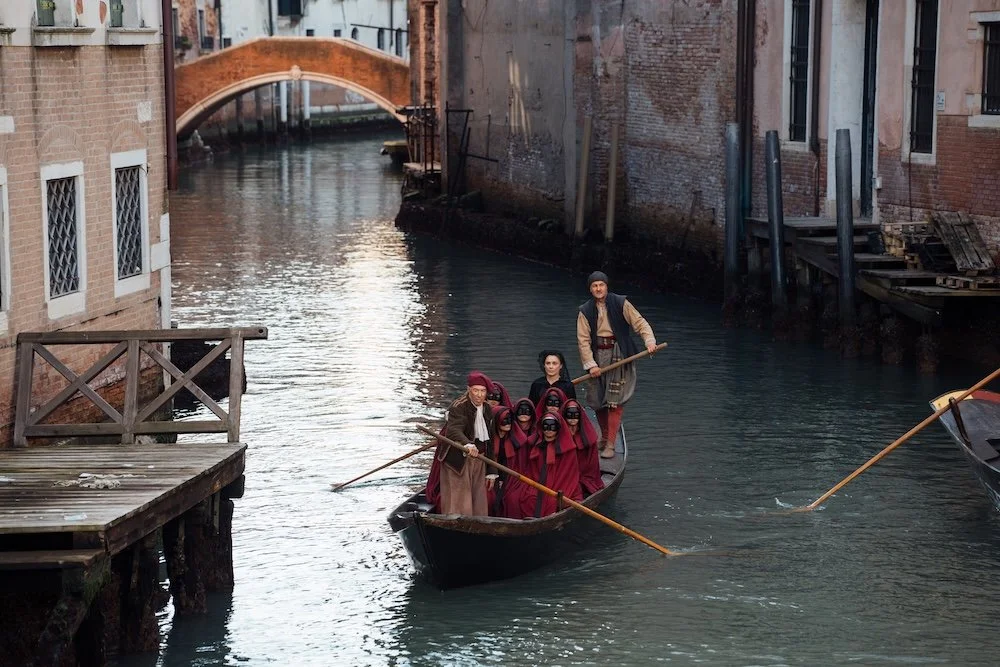
18th Century Venice recreated in ‘Primavera’ photo © Kimberley Ross
The resulting film is what I crave from in cinema: a lot of story, with quite a bit of great ambiance and beautiful costumes and talented people to pull it all together. That the production managed to recreate 18th century Venice mostly in and around Rome, as well as using some of the iconic Venetian locations it features, is a miracle — one which left a spectator at the Cinema Made in Italy Q&A quite disappointed when she found out. Up and coming production designer Gaspare De Pascali, who has been working with some of the best known names in contemporary Italian cinema, is responsible for the sets while the credit for those hauntingly beautiful costumes belongs to Maria Rita Barbera, whose work includes the iconic Nanni Moretti film Caro Diario, where his choice of clothing created a prototype of the Italian filmmaker-slash-actor I still revisit in my thoughts often.
All of the already mentioned talents, mixed with the cinematography of Daria D’Antonio, the editing by Walter Fasano and the art direction of Mattia Lorusso conspire to create a masterpiece of cinematic proportions not unlike what watching an Alfred Hitchcock film must have felt like in the ‘50’s or Luchino Visconti’s The Leopard in the early 1960’s.
If I gave stars to my reviews, I would give Primavera 10 stars.
To watch in UK and Irish cinemas this weekend, check out the film’s Curzon page here where you’ll find screenings near you.
All film stills by © Kimberley Ross, courtesy of Curzon and Indigo Film.