
And the one that singlehandedly decodes it all, including our present chaos, by presenting an image of the “enemy” in welcomed shades of grey — opening April 17th in UK & Irish cinemas.
I’m thankful that French helmer Olivier Assayas has never gone “Hollywood”. If he had, he might have been forced by the American studio system to do away with his wonderfully nuanced portrayals of men and women who live outside of the norm, an idea often dictated by an unhealthy diet of superhero films and fast everything.
Instead, the intelligent filmmaker — yes, you read that right, I purposely didn’t use “intellectual”, which would immediately turn us off to his brand of cinema, as critics sometimes attempt to do with Assayas — draws up characters that inhabit the wonderful shades of grey we often grapple with ourselves, in real life.
By that account, the prolific filmmaker’s cinematic retelling of the 2022 novel Le mage du Kremlin, penned by French-born Italian writer, politician and essayist, and Assayas’ neighbor in Tuscany Giuliano da Empoli employs a striking Jude Law to embody Vladimir Vladimirovich Putin. If we’re to believe European and American leaders, Putin is a basic villain, weird, unattractive and two dimensional at best, drawn in cartoonish black and white outlines. And yet, in the film Assayas casts a heartthrob actor of our times to embody him, and follows the human logic that no one is all good, or in this case, all bad. It’s childish and simplistic to think them black and white caricatures, even of our most disliked antagonists.
But Putin is a secondary character in The Wizard of the Kremlin, because the recounting of his rise to power is told through the words of Vadim Baranov — the extraordinary Paul Dano, an often under appreciated actor who has been cast to perfection here. Baranov is a stand-in, starting with da Empoli’s novel, for Russian politician and businessman Vladislav Yuryevich Surkov, about whom the author wrote the lines "he is so romantic that he freed me and pushed me to become a novelist."
In the shoes of his interviewer, there comes a New York journalist in the film, played by Jeffrey Wright. The moment his voiceover kicks off, telling us about “the new Rasputin” a man who has an obsession with the dystopian sci-fi novel We by Yevgeny Zamyatin and lives in a picturesque snow-filled countryside to give Wes Anderson a run for his scenic money, we the audience know this is going to be a cool, smooth and interesting journey. And Assayas’ film goes above and beyond all expectations down to its unpredictable ending.

Jeffrey Wright in ‘The Wizard of the Kremlin’
Once Vadim begins recounting the events of Putin’s rise to power, different characters come into the picture, starting with Ksenia, played perfectly by Alicia Wikander. Ksenia is the one constant in Vadim’s life, even though she comes and then goes, attracted by another man’s “vulgarity” and cash as Vadim says, only to reappear again sporting different color hair and in another part of the world. When he first runs into her at a party, while she performs a song dressed in skintight lamé, holding on to a naked man chained as her submissive “dog”, she describes herself as “a woman celebrated for doing what they did in New York fifteen years ago.” It’s a smart way to quickly give the viewer a complete picture of the newly capitalistic Russia of the 1990’s, where luxury companies like Voyage yearned to plant their flagship stores. It’s understandable the pull Vadim feels for Ksenia, who also adds a dose of glam to the look of the film, wearing furs and hats mixed with eclectic fashions, along with her evolution to donning western designer clothiers like Dolce & Gabbana. She is The Wizard of the Kremlin’s hip colorful voice, in a sea of beige and blue suits and profound thinkers. Ksenia represents to us, the audience, exactly what Vadim points to later in the story, when he visits the think tank of a political influencer the Putin administration thinks of hiring to cause social media chaos in the US. “Intelligence does not protect against anything, not even stupidity,” and the best way to get someone’s attention is often not the most linear, is the point being made.
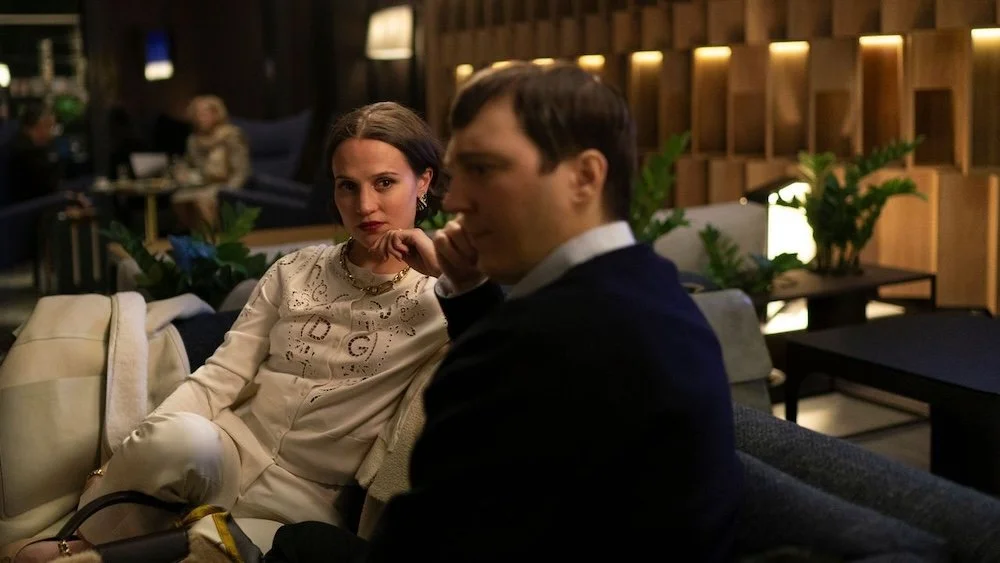
Alicia Wikander and Paul Dano in a still from Olivier Assayas’ film
With her beauty, her cool It Girl voice and ways, Ksenia is perhaps the most unexpected translator of a culture that seems so far from ours, and yet is just experiencing freedom in much the same way we did, in the US in particular, yet at a different time, through a different generation, for a different era. “The Americans may have won the Cold War, but we didn’t lose it,” says Putin in the film, and it’s a cold — pardon the pun — hard truth. Plus the particular shade of Ukraine’s Orange Revolution was designed by Madison Avenue, along with the clown, sorry I meant the actor-turned-politician! planted there to rule by the US and Europe.
Vadim’s rise from son of communist intellectuals, to theater director, to reality TV producer and then Putin advisor, as if he went “from horse and cart, to a Lamborghini,” he’s told, is dotted with encounters of real men, some renamed, some left as they are. The real, tragic figure of Putin associate turned critic Boris Berezovsky is played by dead ringer Will Keen, while Tom Sturridge’s character Dmitri Sidorov is a stand-in for Russian oligarch Mikhail Khodorkovsky who, in 2003 went from the richest man in Russia to landing in jail, charged with fraud, tax evasion, and other economic crimes.
What made the film so crucial for me was perhaps held in one line, one that best explains the power of making a film without feeding the audience your opinions, which I’m myself unable to do as a writer. When Putin says he wishes to be a good leader to his country, Law confirms, “I don’t wish to win a Nobel Peace Prize,” which makes him the anti-leader to our Jesus-obsessed current US president, who salivates after the Oslo award, to the point of irrationality.

In a film that proves Kafka-esque as well as Fellinian in many ways, Assayas allows us a glance into the making of a leader, one imperfect at best, but also one who followed through with his promise and premise, to rule a giant country like the former Soviet Union with an iron fist, and a vertical command of its people. Is he the villain we make him out to be, or simply good at his job, is the question raised in this brilliant must-watch.
What is that Winston Churchill quote? “The best argument against democracy is a five-minute conversation with the average voter.” I think Putin lives and rules by that credo and perhaps is not so wrong after all. As long as people vote as we did in the US, this world can only get worse and more chaotic, with each passing day.
Frequent Assayas collaborator Jürgen Doering serves as the film’s costume designer and does an outstanding job at bringing the different decades home for us, while also allowing the actors to shine through. Cinematography is expertly the work of Yorick Le Saux, known for the Jim Jarmusch title Father Mother Sister Brother, Luca Guadagnino’s A Bigger Splash and loads of Assayas’ films. And kudos to the film’s editor Marion Monnier, also a frequent Assayas collaborator, for still being able to stand up to her director and make the film shorter, even after its premiere.
An expert at quick witted, smart dialogue, here the French born filmmaker with Italian roots — and I’ll gladly claim Assayas as a fellow countryman — enlists the help of writer and filmmaker Emmanuel Carrère, a man whose expertise of Russian culture and studies into his own roots helps in making the film a complete and wonderful success. The removal of nearly twenty minutes in editing since its Venice Film Festival Competition premiere also make The Wizard of the Kremlin an extra captivating, fast moving and ingenious, fact-fillled watch during its 136 minutes runtime. Surprisingly, the film received no award in Venice and no nominations in the months that followed, even though to yours truly, this is a masterpiece.
The film is being released in the UK and Ireland from 17 April, by Signature Entertainment.
All images courtesy of Signature Entertainment, used with permission.