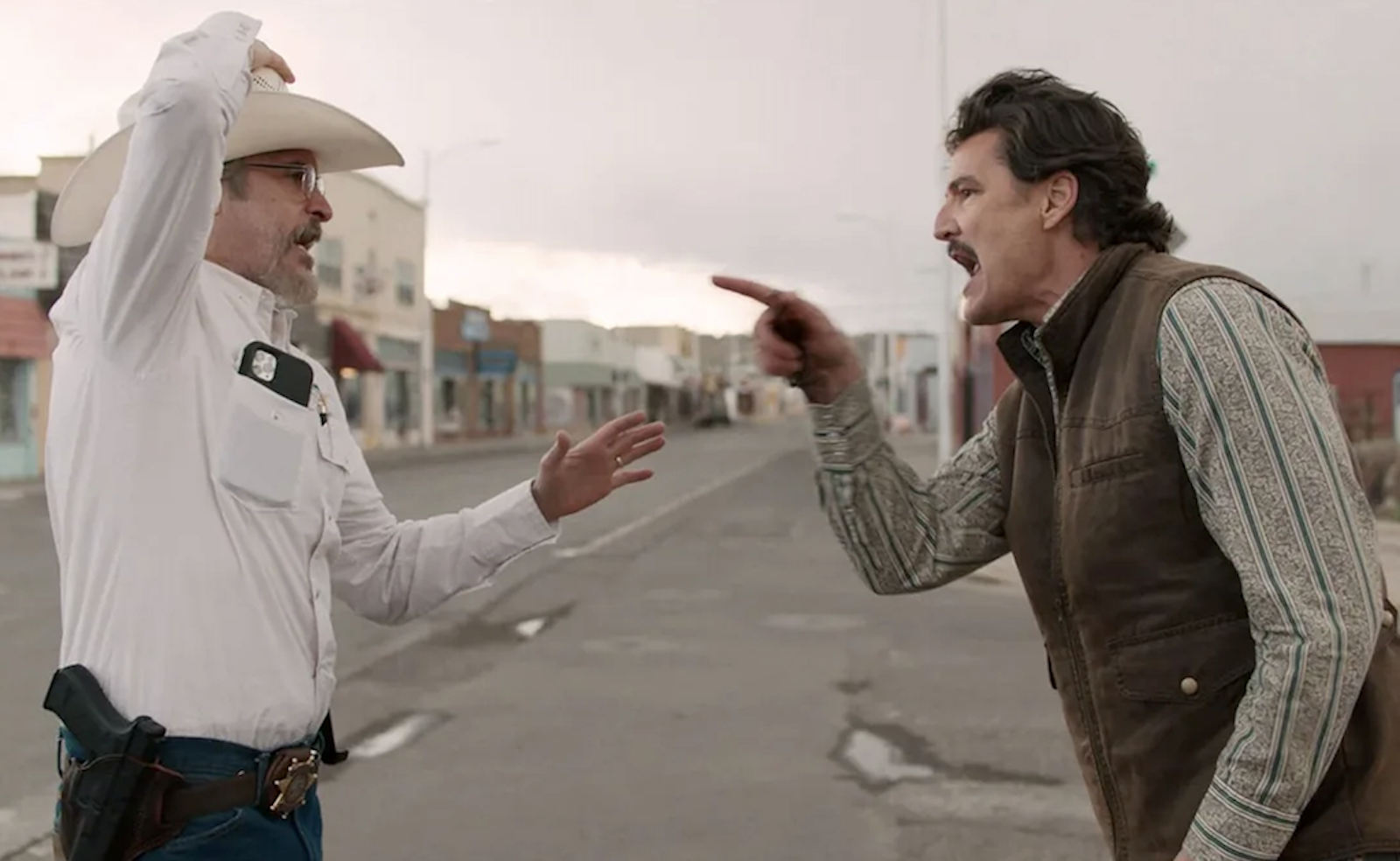
In spreading his message of lives often lived in shades of grey — not just good vs. bad — the American filmmaker enlists a quartet of actors who are redefining cinema as we know it.
Before I take you any further into the rabbit hole that is Eddington, currently in cinemas, I want to mention that quartet of actors: Joaquin Phoenix, Pedro Pascal, Emma Stone and Austin Butler. OK, now let’s analyze this quirky, wild kind of a ride film in all its beauty and bleakness.
In the tiny town of Eddington, New Mexico, three entities collide, in more ways than one. They are the Sheriff’s Office, run by sheriff Joe Cross (Phoenix, in all his understated yet ready-to-go-off-the-deep-end best), City Hall, headed by liberally progressive mayor Ted Garcia, played by Pascal and his hair making full use, finally, of his roots (pardon the pun!), both having to contend with the the indigenous tribal Pueblos authorities. At home, Cross has a conspiracy theorist wife Louise (Stone, playing against type, although does the actress even have a type anymore?) and her mother running the show. And just when it couldn’t get more crowded, Louise brings in cult leader dude Vernon Jefferson Peak, Butler in a role that proves he’s one of the most underrated actors (for his talent, not his beauty) in Hollywood today.
But the film doesn’t take place just anyday, in anytown USA. Nope, Eddington is set in the spring of 2020 when Covid-19 had hit our world and we all grappled with mask nazis, conspiracy theorists and liberal ideologies that included shutting us at home with limited human rights yet keeping the delivery men and women going at all hours of the day and night and facing danger — just so they could bring us food, drugs and anything else we wanted. And just when it couldn’t get any worse, in the midst of that Black Lives Matter exploded, the result of some violent acts of civil rights abuses by the police.
In Cannes, where Aster’s film premiered earlier this year in Competition, I was told by a male journalist, with no uncertain confidence, that “Eddington is the politically incorrect version of The Mysterious Gaze of the Flamingo,” a stunning neo-Western Chilean film set in a community of transvestites and transgenders. It was phrased differently, of course, by a guy who admitted to never having watched the Un Certain Regard winning film, but the idea stuck with me. When I watched Eddington, I realized the only thing tying the two stories, in any kind of plausible theme, story or thread, is a Chilean actor like Pascal in one, and the Chilean director of the other. Proving my theory that if you have nothing intelligent to bring to a conversation, you should probably keep quiet. I’m starting to sound like Sheriff Cross.
But I’ve digressed again. It’s something that Eddington will make you do. Think up all kinds of things that you believed forgotten, or put away in your life. I couldn’t believe how I found myself immersed in the outrage of Sheriff Cross, or how justified his campaign against Mayor Garcia felt, even though I’ve never considered myself someone on the right and I adore Pedro Pascal. Yet somehow, the words of Italian, Texas-based filmmaker Roberto Minervini reappeared on my mind, when he said “I realized that progressive America to which I belong, has accepted a level, a threshold of tolerance which includes inequality,” meaning that the liberal left is the issue in many of the things that are wrong with America.
A short synopsis of the film now might be in order. When Cross, who suffers from asthma, comes to the aid of a old man trying to shop in a local supermarket without a mask — both men find it difficult to breathe in masks — Mayor Garcia jumps in to condemn their choices and chastise the older man banishing him from the store, and tells Cross off in no uncertain terms. This inspires the Sheriff to run against Garcia in the next election and sets off a chain of events that ties together racial tensions, local bureaucracy and tribal rights in Western American lands. It is all so fantastically well written that Eddington will make your head spin while watching it, and even in the last third of it, when the editing felt sluggish and the film a bit, like ten minutes too long, your mind will be so preoccupied with what you just watched that by the end, you’ll find yourself a fan. Even if you never really loved anything like it ever before…
And the cinematography by the great Darius Khondji brings all the elements together, presenting the film like a grandiose John Ford Western, made by Orson Welles, in pastel shades of technicolor.
So what else makes Eddington so brilliant? It’s Aster’s perfect command of nuances, the light handed and carefully penned shades of grey that he writes his story in. There are no good guys, except maybe for Officer Butterfly Jimenez, played by William Belleau, in this story, and there are no bad guys. Even the smooth talking, “limousine liberalist” (I didn’t make up that great term but I’ll use it for sure!) Mayor of Eddington is not a good guy. And the MAGA, gun-loving Sheriff Cross and his gang aren’t just bad. And don’t even get me talking about Vernon Jefferson Peak, who may be winning in terms of fashionista points — courtesy of the film’s outstanding costume designer Anna Terrazas — but seems more of a snake oil salesman than a spiritual leader. Again, shades of grey there, you see…
All in all, even if you think a Western, mixed with elements of horror and tied up with strings of Tarantino-esque violence may not be your kind of movie, you need to watch Eddington. Now. And in UK cinemas.