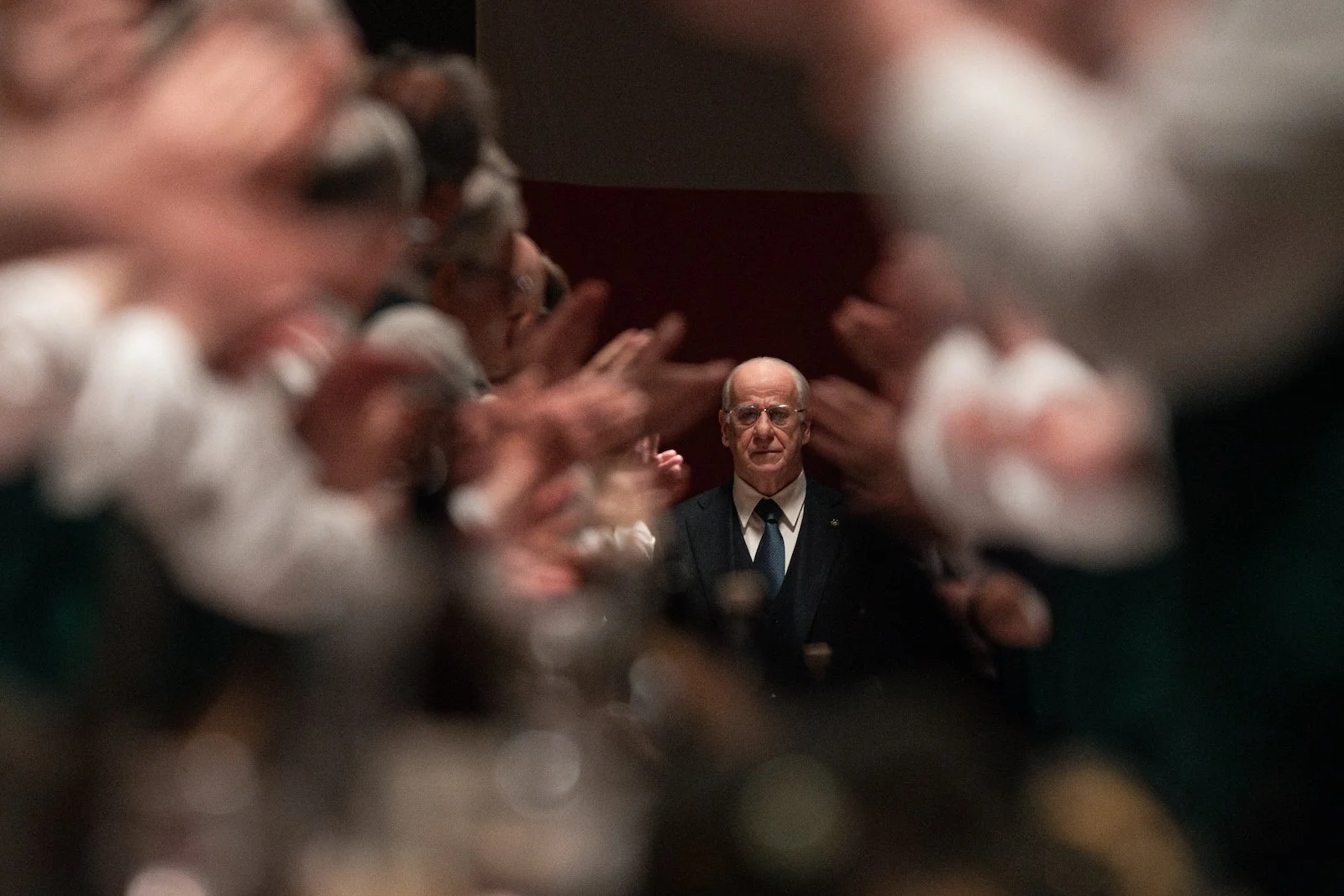
The Neapolitan Maestro’s perfect, awards-worthy Venice opener sees Toni Servillo playing an out-going Italian President of the Republic who, faced with several life-changing choices, allows us, the audience, to discover through him the true meaning of the word “grace”.
One of the most memorable character introductions in cinema belongs to Paolo Sorrentino, in his Oscar-winning La Grande Bellezza, where we discover life-of-the-party Jeb Gambardella (played by the filmmaker’s constant collaborator Toni Servillo) as he turns around to face the camera amidst a sea of guests, while a club mix of Raffaella Carrà’s ‘A far l’amore’ plays on.
This time around, Sorrentino has outdone himself, albeit in the more austere, somber tones of a man who has grown a few years since then and lives in an Italy that has been beaten and dragged around the block a few times.
The smoke of a tricolor flyover, red white and green as the colors of the Italian flag, blend with an electronic soundtrack to form a rave-like smoky atmosphere. Out of that shot, comes our protagonist Mariano De Santis, the fictitious, no relation to any person living or dead, President of the Italian Republic, as Sorrentino is quick to point out in his press notes. A little Sandro Pertini, who was the President of our (Sorrentino’s and mine) Italian generation, a little Sergio Mattarella, the current leader who is, like De Santis, a devout catholic, a widower and has a lawyer daughter, with bits of other presidents thrown in.
De Santis has six months left on his mandate as President of Italy and, while not particularly bothered about it, he should pardon at least one of two people whose cases have come up for a “grazia” — a grace — and should make a decision on a law his daughter Dorotea (Anna Ferzetti) is drafting on euthanasia, before leaving office. Known as “Cemento Armato” behind his back, a term that means “reinforced concrete”, so we take it not particularly good as moving but better apt at keeping things as they are, President De Santis is more bothered about a secret his best friend Coco Valori (played by Milvia Marigliano) has been keeping from him than about the pardons and the law.
Sorrentino’s La Grazia is to my current self what La Grande Bellezza was to my 2013 persona — a complete revolution.

Just when I thought the real world had done extraordinary things, like electing an American Pope, the Neapolitan auteur one ups the Church by putting in his latest film an African pontiff, complete with grey dreadlocks and an earring. Sorrentino has also gone and made a film about love, where no one kisses, there is one quick hug but it’s hidden from the camera by the angle in which it’s shot and yet, by the film’s end, I was sobbing big tears and ready to hug my fellow seat mates, in their tuxes and all. Yes, because I watched the film during the opening night ceremony in Venice and saw the cast and crew visibly moved as the audience clapped until their hands hurt. Including yours truly.
President De Santis declares to anyone who will listen that he is unable to pray, because he falls asleep while doing so, and has been unable to dream lately. There is something consuming him from within and it’s a very human emotion — jealousy. Pragmatic and balanced, the political leader is still a human being and perhaps a lesson in the courage to display humanity should be on the agenda for our current heads of state. All over the world.
La Grazia is a title also perhaps best left untranslated since the English version “Grace” gives too much away, about the filmmaker’s intentions. On the one hand, it’s an ode to our great country of Italy, which although beaten and abused is still a land that can produce artists like Sorrentino and Servillo. And on the other, La Grazia offers up the story of a man who doesn’t see life in those banal terms of black and white but who, as a true jurist (the point of De Santis being a former judge is nailed into the viewer often and importantly by the filmmaker) allows for life to be lived in shades of grey. A couple of surprise decisions at the end of the film, which I will not give away, clearly point to elegance and grace as being qualities reserved for the thoughtful. As well as for those who know how to love, deeply and unapologetically.
There are a few of those so-long-they-almost-border-on-comical ideas stretched to the max and then pushed even further by Sorrentino — remember la monaca in La Grande Bellezza? This time around they are things like the visit of the Portuguese President who comes on the rainiest day of the year and walks in slow motion towards De Santis and his delegation, as the water nearly washes him away. Or the mystery of “who did she sleep with forty years ago” which we may, or may not have gotten the answer to by the end of the film.
Yet La Grazia feels like the kind of film I’d love to watch over and over, at least another four or five times, to get the full meaning of it all and let it wash over me, like a healthy mantra on what true grace should be. Whether you like Sorrentino’s work and method or not — “life is great because it’s varied” as my Neapolitan mother often says — one can’t deny that he is a genius of our modern times, often way ahead of our own collective perception and clearly influencing even something as untouchable as the papacy through his unequaled vision.
And for that reason, La Grazia is a must-watch film, soon to be distributed courtesy of MUBI, to a theater near you.
Images courtesy of La Biennale, used with permission.