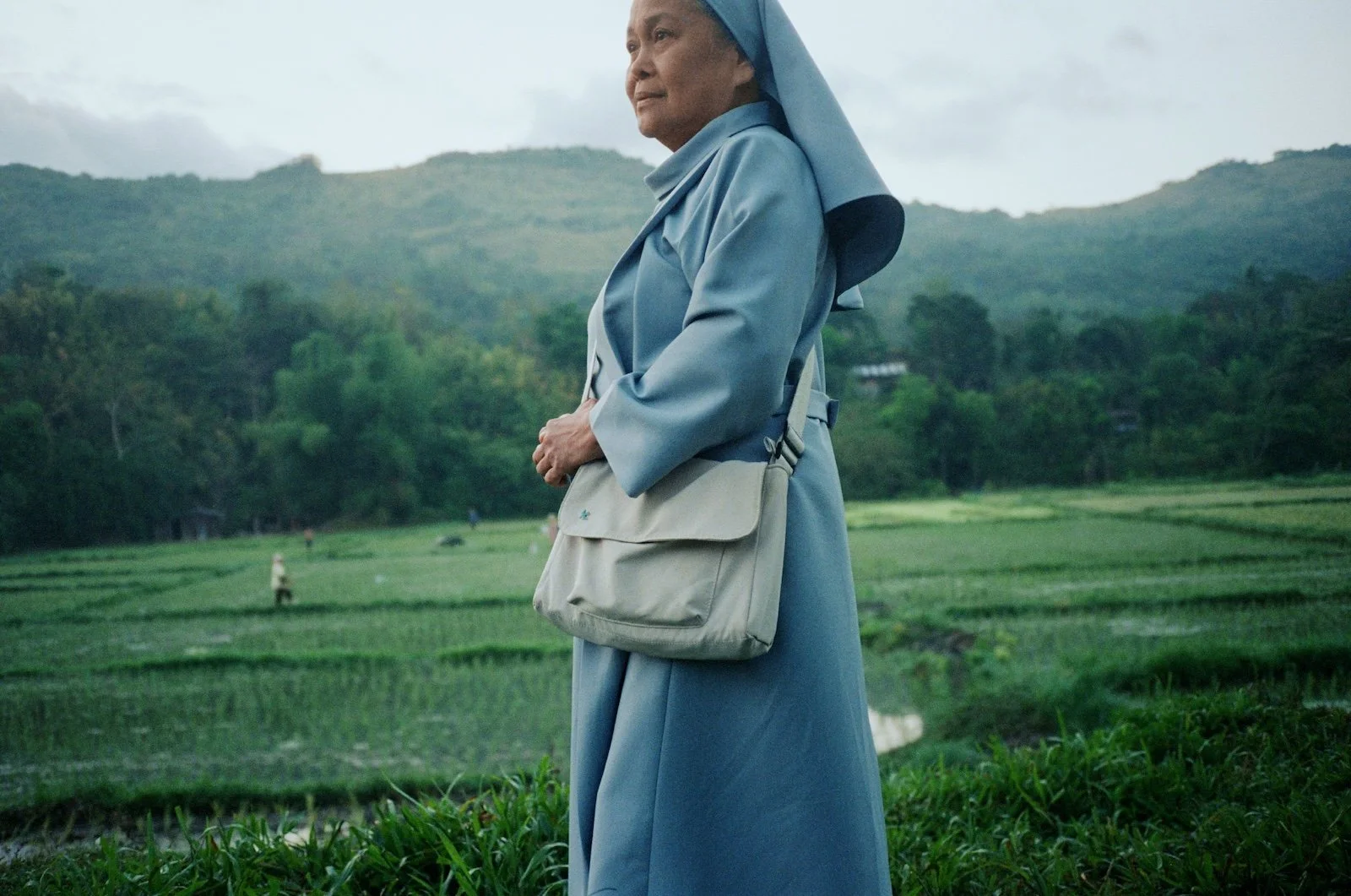
The film recently screened in Rotterdam, after enjoying its international premiere at the Marrakech Film Festival in the fall and I caught up with the filmmaker, his DoP and one of the actors while they were at IFFR.
Back in November, when I interviewed Rémi Bonhomme, the artistic director of the Marrakech International Film Festival (MIFF) for Screen, he pointed to First Light as being one of the highlights of the upcoming festival in Morocco. Aware of Bonhomme’s unquestionable taste, when I was asked to interview filmmaker James J. Robinson while the film was in Rotterdam, I jumped at the chance.
One weekend afternoon, anticipating our chat, I sat down with the film, in the early darkness of a London winter, expecting to view something beautiful. After all, Robinson has been a fashion and celebrity photographer and the Filipino/Australian artist, now based in Los Angeles, has immortalized the likes of Kylie Jenner, and Rihanna, while directing campaigns for brands like Apple and Maison Valentino.
What I wasn’t expecting at all was an epic masterpiece, featuring a pint-sized heroine and her convent Sisters, possessing all the power, subtlety and cinematic prowess of a film made by a man well beyond the filmmaker’s 29 years. I’m not being condescending here, but Robinson holds the reins of his story, about a woman’s faith at a point of crisis, firmly and with a savoir faire one would expect to find in a seasoned filmmaker like Ang Lee, or Bernardo Bertolucci. His silences also hold the same potential as in Michelangelo Antonioni’s best oeuvre. In his own bio, Robinson mentions cinematic masters like Andrei Tarkovsky, Edward Yang and Abbas Kiarostami as his inspiration, and I can see that too!
The story of First Light takes place in the mountains of the Philippines (the film was shot between the Ilocos and Calabarzon Regions on Luzon island in the north of the country) where Sister Yolanda (Ruby Ruiz) a seasoned nun, goes about her work with a sense of diligence, unquestionable duty and unrelenting faith. One day, she is faced with the violent death of a young construction worker in the local hospital and after administering his last rites, discovers the ugly truth about her Church, her country and the legacy of Colonialism which continues to decide those who are more worthy and those who don’t deserve to die with dignity. Hint, money talks and the wealthy are often those reaping the rewards of the class system Colonialism has left behind, as its ugly recompense. Sister Yolanda’s journey is one of doubt and one we find ourselves on with her, questioning our own relationship with faith as a result of watching the film.
Surrounded by a supporting cast of wonderful actors, which includes Ruiz (whom we may know in the west for her role in the Amazon series Expats), newcomer Kare Adea as the younger novice Sister Arlene, as well as Emmanuel Santos who plays Cesar, the construction worker’s wise father, and sat in on our interview.
Also present during our chat was the film’s cinematographer Amy Dellar whose work highlights an already spectacular vision by adding a touch of mystical to the director’s work.
I loved what you said in your director's statement, that your “relationship with Christianity is clouded in dilemma.” And I think that sort of applies to every one of us when it comes to our relationship to religion, whatever that religion is. Can you talk about how you came up with this idea and what made you want to shoot your first film in the Philippines, which has not really been your home, I imagine, for most of your life?
James J. Robinson: I guess what attracts me to my favorite stories, my favorite literature, my favorite movies, is always a character that's being taken on a journey that makes me kind of reckon and question my own relationship with something. When writing this film, I wanted to map out my own experience with Catholicism in that at the beginning of this character of Yolanda she is very much dedicated to the Church, almost to a fault, without question, and then the big question rises, which makes her kind of reckoning with what her relationship is. That's very much my own story and all these different characters that populate the film, are different figures from my own life.
So the film and the story, I guess, if you break it down into metaphors, is literally just my own journey through Catholicism with the people in my life populating different viewpoints that have, throughout my life, made me question different things.
When it came to setting it in the Philippines, I've been thinking a lot about what, obviously, it would mean to make my first feature film and knowing that this film is going to take years of my life. The idea of applying that and being intentional with how I was going to film it meant that I could use the film as an excuse to go back to the Philippines to reconnect with the language, to reconnect with my family over there, to spend time in the mountains. Because for a lot of people, second generation immigrants from all around the world, we have this weird severed relationship with our own countries where we are so informed by the culture and the people and our families, but the actual connection to land has been cut off. The chance to be able to go to the Philippines and spend that many months there is almost impossible to think about without a project like this, so setting it in the Philippines was both my way of classifying this within Filipino Catholicism, but also just as an excuse to be able to go there and reconnect with the land because, at the very least, no matter how the film would turn out, at least I would have restored this connection that I felt was lost with the Philippines.
Emmanuel, your background isn’t really as a professional actor, so how did you connect with the script, and come up with this extraordinary performance as Cesar?
Emmanuel Santos: I think it's more about the sentiments of the script that can resonate in my own emotional learning for expressing and either spreading the beauty of the cultural history and the enigma of the cultural history of the Philippines, which, you know, outside the Philippines, no one knows about. Because everybody just knows about what is on the surface, that the Filipinos are just the best exported skilled laborers, nurses, and, you know, overseas workers in the Middle East. And yet there is a deeper kind of life that goes on underneath that surface that is known, one that is not known and concealed only in the depths of those places, in the Philippines that we went and travelled to. And I think regarding the acting, when I was reading through the script, I could almost hear the multiplicity of the characters, the people themselves, that represent those sentiments, those feelings. And I said, "This a very good voice. And I want to be part of that voice to bring it out.”
Amy, in the film there are all these ominous elements. Yolanda’s illness, the rot from the forest, the bats on the ceiling of the monastery, the water coming into the convent — all creating this chaos. And I wanted to know from you, when we sit and watch the film, we actually smell it, we smell the rot, we see the gloom approaching, we feel like the bats and the kind of ominous thing that they create when you see bats. How did you manage to film what appear to be un-film-able things, and what was your connection to the country that you could do it so well?
Amy Dellar: I feel like even when I first got to the Philippines and went on the location scouts, my mind was just blown straight away because the locations already do so much of the talking. We'd already agreed that we wanted to shoot using wide lenses and really give the sense of the location, whether it be inside the convent walls or outside — this real intertwining between the land and the character and the space. And because we were shooting quite naturalistically, even though we did have some quite big lighting setups to keep that deep focus so we could see everything at all times, I think shooting naturalistically and embracing the light and the dark, so to speak, just really lent itself to those ominous moments. I don't think we were necessarily trying to make them ominous, but we were shooting a little bit wider and giving the audience and the characters space to breathe. So as not too directly inform an emotion.
We did guide through camera movement and lighting and that kind of thing, but ultimately, we wanted the drama and the story to come through with body language, the production design, the costumes, all of those things. We didn't want the cinematography to be too loud and overtake that. So I think paired with those other things and James's direction, of course, those moments were really allowed to speak for themselves and the cinematography just helped articulate it.
And finally James, what was it like to screen the film in Marrakech and in Rotterdam? What were the main differences you noticed in the audiences’ reactions?
Robinson: When Rémi [Bonhomme] proposed to have our film world premiere in Marrakech, he said “I think audiences in Morocco are really going to respond to the message around religion.” And they did. The questions that they had there were so insightful, and I think it speaks to the universality of what we're trying to say about the Philippines, and when it comes to the separation between Church and state, that is something that every country in the world is grappling through in their own way. I didn't realise how that was gonna resonate so much in a place like Morocco, as much as it would in Australia or in the Philippines.
The screenings there were incredible. As you know it's a young, incredible audience there in Marrakech, lots of film students, and it was, yeah, it was the most incredible, beautiful festival experience I could ever imagine. I think, for our film, Marrakech was truly special.
And Rotterdam?
Robinson: While in Morocco it was so much more about discussing the morals and the ethics of religion, in Rotterdam, it has been more discussions on the process of the filmmaking itself. So, you know, a lot of the questions have been about how did I approach lighting and I guess more kind of practical things around what metaphors are being brought up. Whereas in Marrakech, it was so much more about “what is good? What is evil?” And it's interesting because there were so many times there that I was answering the questions and thought, these are things that are brought up in the Quran, that are brought up in the Torah and it’s brought up in the Bible. And here, in Rotterdam, I would say it’s more secular, it's less about the religion, and more about the technique of the filmmaking and maybe more about the politics than I guess the faith.
Images courtesy of Majella, used with permission