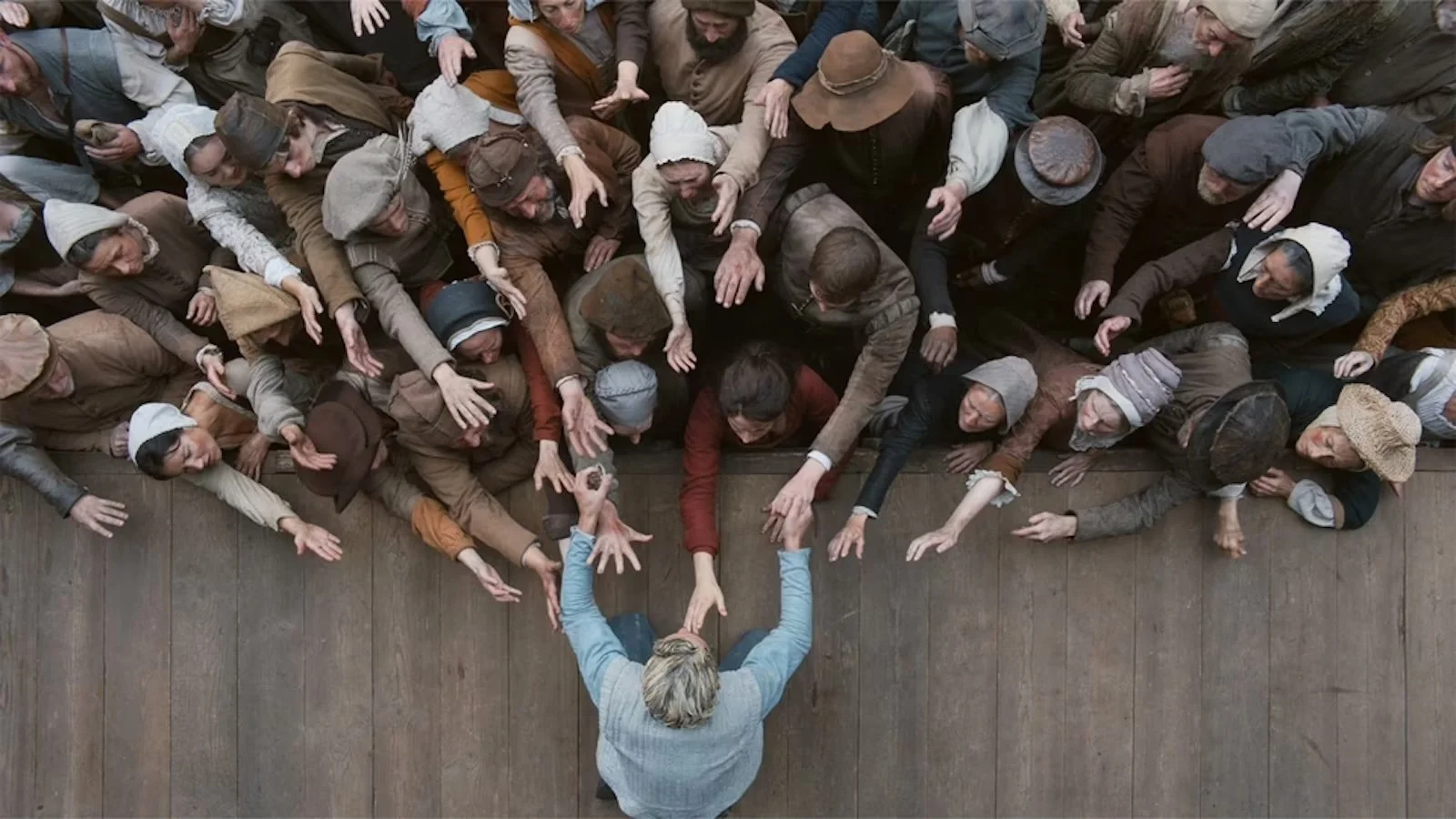
Reinventing Shakespeare, to make his plays and own story more actual and better understood by contemporary audiences, is the key to keeping him alive. And the Chinese-American indie filmmaker turned big budget director finds that balance, perfectly, in her latest film.
“At times we seem more attracted by his person than by his work… He [Shakespeare] has become the biggest, the most mysterious, the most unsettling provocation in the history of the modern spirit; comprehensible then the impulse to attempt to catch him, bottle him and seal him up hermetically.” So German Shakespeare translator and dramaturg Hans Rothe wrote in his 1961 book about the Bard, titled Shakespeare, the Provocateur.
It is probably the essence of that sentence which made watching Chloé Zhao’s latest film Hamnet such a treat for me. You see, Hans Rothe was my beloved grandfather.
Early on, during a written prologue on black screen in Zhao’s film, we are told that the names Hamlet and Hamnet were interchangeable in Shakespearean Stratford English. And then, we forget about what seems a throwaway line, if we haven’t read Maggie O’Farrell’s 2020 novel by the same name, Hamnet. That cue is a gift, given to us by the filmmaker early on, a key almost to unlock the mysteries of her soulful, deeply personal it turns out, film. O’Farrell also co-wrote the script with Zhao.
The story of Hamnet unfolds with a young woman playing with her pet hawk in the woods, an image in a rusty red dress, set against the green background. It turns out to be Jessie Buckley’s naturally beautiful Agnes, the protagonist of the film, and her striking looks don’t go unnoticed by young tutor William Shakespeare (played by way more handsome in person than in the movies Paul Mescal). He finds her, kisses her and soon the two are lovers. And then, baby makes three, which causes them to legalize their union, against the advice of both their families. You see, Agnes (AKA Anne, in history) is thought to be the daughter of a witch, and has inherited from her special mom the ability to cook up herbal concoctions to heal and a vision for predictng people’s futures — among other special powers.
When she holds William’s hand she sees big spaces ahead, success, while her own fate, she divulges, is to die the mother of two children. Another key presented to the audience by the story early on.
Soon enough, the family is joined by twins, as William defies his father’s wishes to take over the glove-making trade senior (John) Shakespeare is in, and goes off to London to write and interact with the theater community there. We know, all the while, who William is, and the move seems inevitable.
But what is not so obvious is why Agnes is so upset by the pouring rain, on the day she goes into labour with her child — which later turns out to be twins. You see, in her tradition, children should be birthed in the wild, in the woods, possibly near the mysterious cave she favors and visits often.
While the first half, up to here, of Hamnet is wonderful to look at — and it helped me that I’d visited a special exhibition in honor of the film earlier on the day I watched the screening of Zhao’s movie to see some of the objects in the film up-close — the second half is mind blowing. It helps that DoP Łukasz Żal has shot, during his career, both fascinating “arthouse” films and cool commercials because his viewpoint makes it almost seem, after watching Hamnet and on subsequent days in one’s thoughts, like you’ve watched this story through some fly-on-the-wall, intimate shots secured with hidden cameras, but also drones which have taken you up to the sky, and then dropped you on the lush, green ground below. As I walked out of the screening room in central London, I felt as though I had lived with Agnes and Will, and their children, daughter Susanna, and twins Hamnet and Judith.
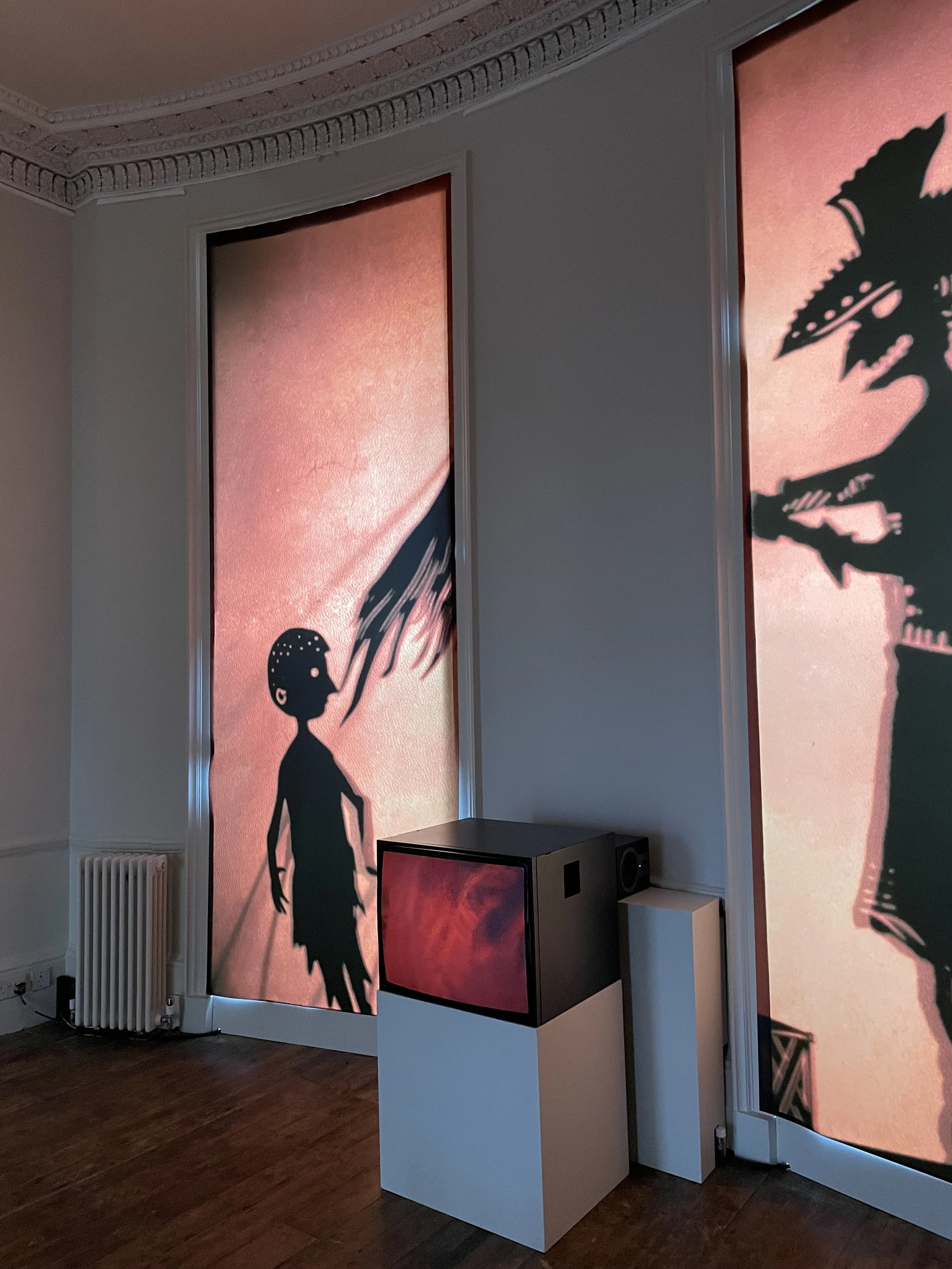
At the exhibition “Even as a shadow, even as a dream” dedicated to ‘Hamnet’ in London
In the second half of Hamnet, tragedy strikes and Zhao has made it very public that her own breakup with long-term partner and frequent collaborator, British cinematographer Joshua James Richards fueled her creative process. While that is the case with all artistic endeavors, we are all fueled to do it by some wrongs we’ve experience and a basketful of pain, what Zhao really manages to convey well is the love. That love, which allows Agnes to go on, and us to connect with her story, but also with Will’s agony at his absence. When the final scenes of Hamnet come on the screen, there were sniffles to my right and to my left, but strangely, I felt a deep sense of hope. The moment when I instead felt my heart almost leap out of my chest was when Agnes enters the Globe Theatre and I imagined my grandfather Hans and how joyous those moments must have felt for him. In his will, he asked to be cremated and the ashes to be sprinkled in or around the church where Shakespeare is buried, which my father did, with the approval of the chaplain of Holy Trinity Church. So when you go to the chapel in Stratford and a mild breeze blows or your steps tread deeply, you are walking amidst the ashes of my beloved granddad.
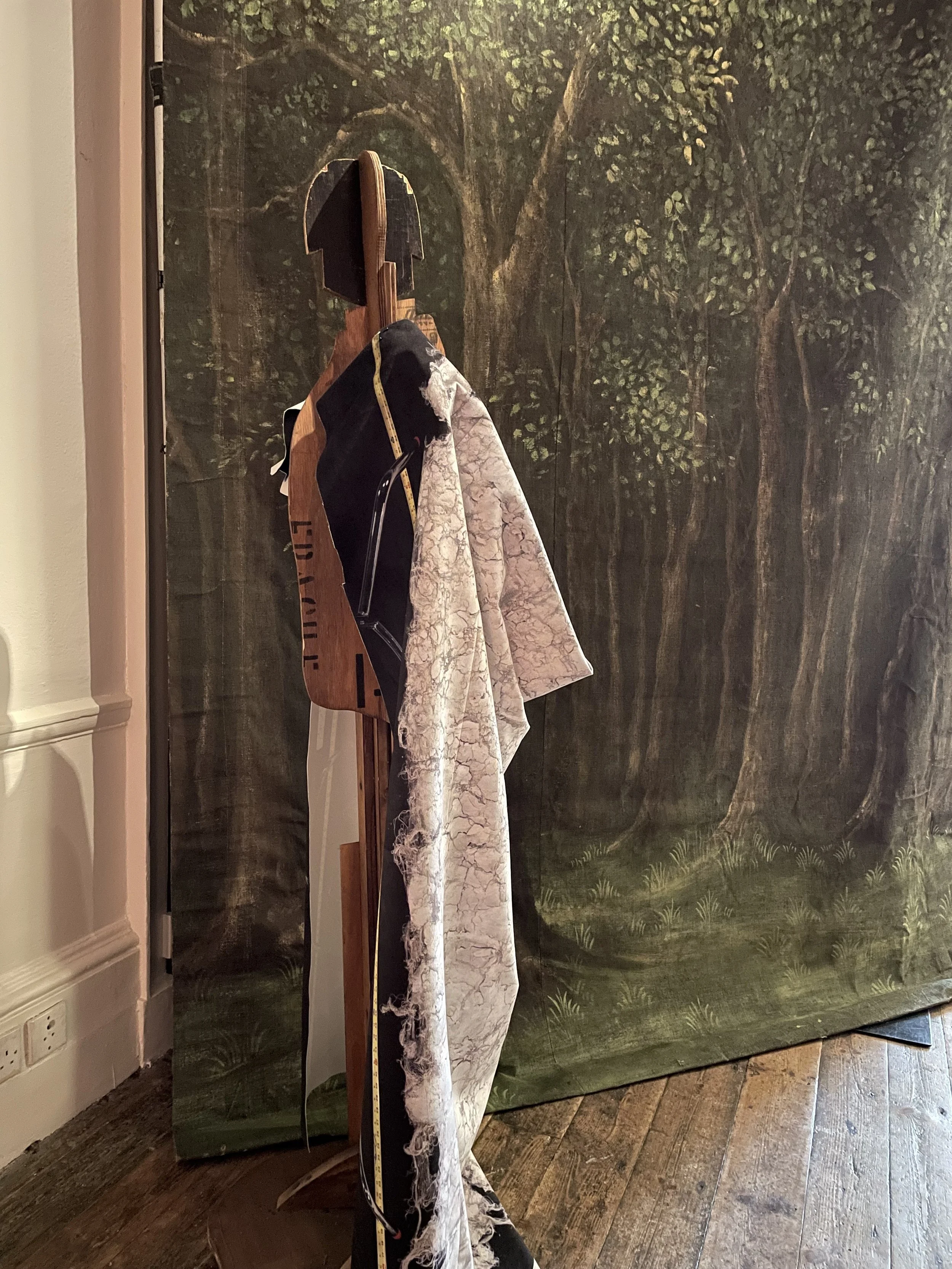
The backdrop which brought me to tears during the film, at the London exhibition for ‘Hamnet’
A bit of a spoiler… So don’t read this bit if you’ve yet to watch the film and don’t want to know! That moment, that stage backdrop (which I’d visited earlier in the day) and when Noah Jupe comes on as Hamlet, with his hair made blonde by mud and makeup and wearing a sky blue shirt, it’s a moment of movie magic, right up there with Orson Welles as Harry Lime coming out of the shadows in The Third Man and Omar Sharif appearing as a mirage, as her rides closer and closer atop a camel in Lawrence of Arabia. I have used the final moment of that scene as the header image above, because it feels like he is the roots of a tree of life, with everyone wanting to touch his hands. A tree of life Agnes, and Will desperately need in that moment. Incidentally, what a stroke of genius to cast Jacobi Jupe’s real-life brother as the man interpreting the part little boy Hamnet (Jacobi Jupe) has inspired. Even writing about it here, I’m still getting shivers.
Finally, another quote from Hans Rothe’s book, as he also taught Shakespeare to university students when the family moved to America. “No one, not even Shakespeare turns 400 with impunity,” granddad pointed out, “though we may regard him with the highest opinion as an inimitable genius… qualifying him as a genius is not enough to bring him [and his works] to life.” He went on to explain that the power and success of contemporary translations and reinterpretations of The Bard’s work lie in reinventing his oeuvre for modern audiences.
And if we follow that meter to measure Chloé Zhao’s Hamnet, then she has succeeded above any and all expectations in creating a masterpiece of Shakespearean magnitude for audiences to cherish and enjoy and share with their loved ones. Without a hint of old fashioned or archaic in sight.
Hamnet is in UK cinemas as of Friday, January 9th 2026 and is a Universal Pictures release.