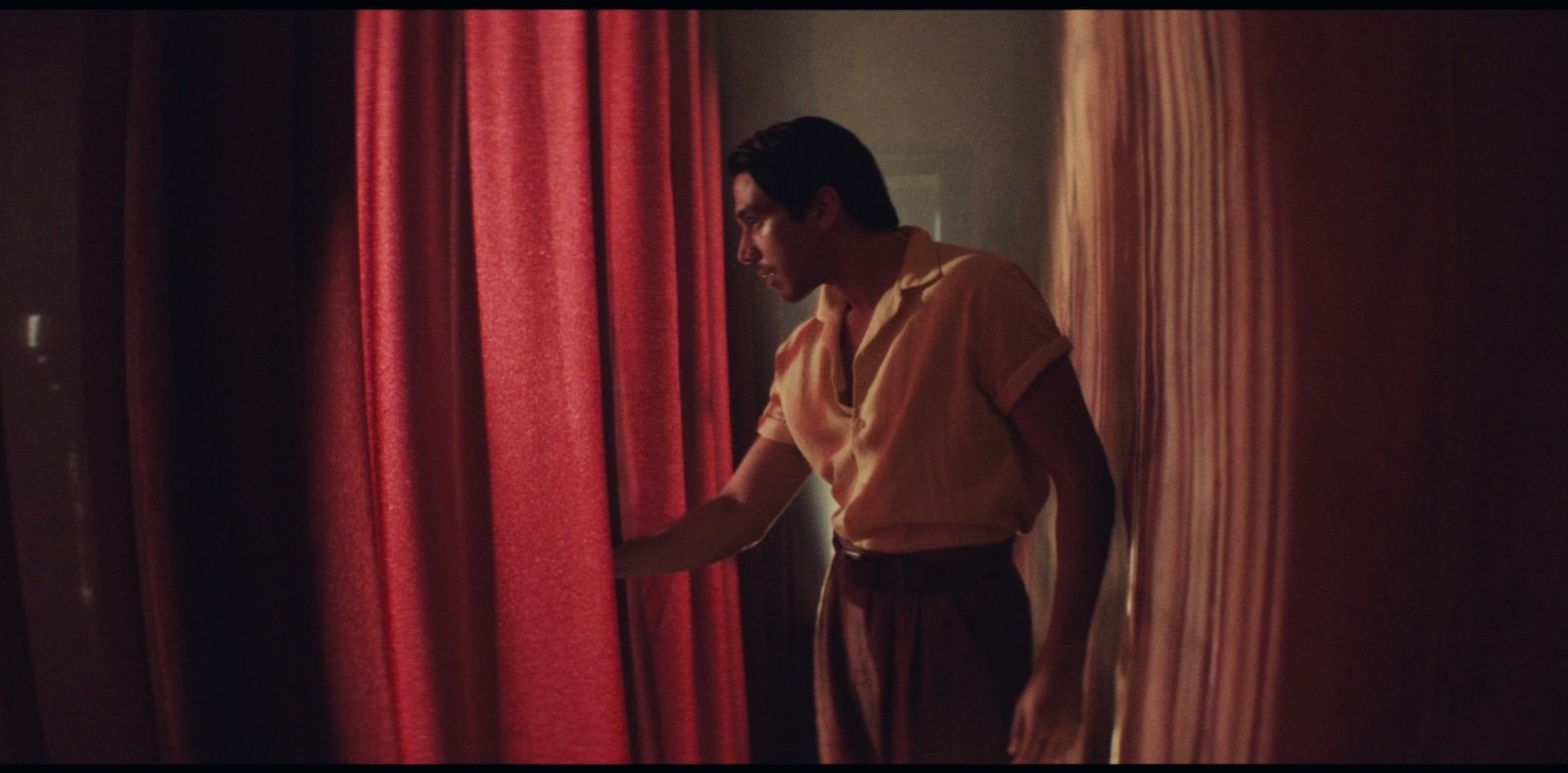
The brilliance of a film is sometimes in the casting and Martinessi’s latest film, screening in this year’s Panorama section, proves that point, with a central cameo by an actor who makes you sit up in your chair as soon as he enters the picture.
It is 1959 Paraguay, at the height of a suffocating military regime under the dictatorship of Alfredo Stroessner. It was a period known as “Stronato” which is particularly poignant for an Italian watching this film, since our word for “off key” is “stonato” — similar in both sound and lettering. Narciso (played by Diro Romero) is a mysteriously handsome young man who has recently come back from Buenos Aires with rock & roll in his blood and a passion for change. He soon breaks into radio, the only mass culture medium widely available at the time in South America, and his softly pronounced promotion of Fats Domino, Bill Haley and His Comets and other US musical legends of the era drives young men and women crazy. While also destroying the false calm infused by the locally sung Guaranias, with their melancholic, romantic root. It is, we learn early on, a fuel which which only needs a spark to turn into a fire.
The radio station where Narciso begins to work broadcasts live from a small theater where Paraguayan artists perform, dance and read out a Dracula weekly series. Everyone isn’t who they seem to be, including the man who heads the station, played by Manuel Cuenca, as is often the case in a dictatorial society where people have to hide their beliefs and sexual orientation. To add fuel to the fire which will eventually burn, hot in front of our eyes, Narciso isn’t shy about showing his fluid sexuality. He flirts with equal gusto with both men and women.
And then, in the midst of this tale of a stranger coming into town, another stranger, an American “gringo” this time comes to town, helping to set up a water purification plant for the country. With drinking water, finally, comes trouble. From the director’s notes in the film’s press kit, this is taken straight out of Paraguayan history: “Running water arrived in Paraguay in 1959 through a project promoted by the United States,” he writes, “the very plant we filmed is still functioning today.”
As soon as that stranger, the ambiguous slim and dandy American Mr. Wesson, played by magnificent actor Nahuel Perez Biscayart, we the audience sit up, gather ourselves from our comfortable slouching position and perform a figurative lip licking, knowing we are in for some interesting cinematic times to come.

While Narciso, as a film which also involves a mystery, could get lost in the sea of films screening at the Berlinale this year, Perez Biscayart’s appearance in it, small as that cameo is, guarantees it will not. The actor we have come to know through the 2017 Cannes Grand Prix winning film 120 Beats per Minute — and personally come to love thanks to the 2024 wacky Argentinian masterpiece Kill the Jockey — slinks, he mispronounces, he asserts himself as only an American in foreign lands can. And he flirts his way around the story, and into our hearts. There is something so perfectly magnetic about Mr. Wesson and we understand why everyone wants to claim they know him, even intimately, and particularly if they do not. He’s that cool and yet, at the same time, almost like the snake that convinced Adam and Eve to sin… There is something very reptilian about him, which makes him the prime suspect to our eyes.
The ending of Narciso — part of which is shown to the audience at the very beginning, before retracing the story before our eyes — is shocking. That final image carries with it so many other moments like it, from the Holocaust to the fate of the ‘Desaparecidos’ in Argentina. The same ending is what allows us to forgive any shortcomings the film may have and perhaps one is the lack of depth in developing some of the characters, so they may become more sympathetic to us. All in all, thanks to Martinessi’s masterful direction, his insightful script and Luis Arteaga’s sultry cinematography, along with the art direction and performances by everyone involved, Narciso succeeds in entering our hearts and grabbing our imagination, for a long time after the story the ended and the lights of the theater have been turned back on.