With its heart clearly in the right place, Dellal’s film mixes what I love most in life — fashion and cinema.
I attended a special screening of Park Avenue last week at the Bvlgari Hotel in Knightsbridge, hosted by Joana Granero of Fashion & Cinema. It featured a post-screening Q&A with the filmmaker, British actress/writer/director Gaby Dellal, whose story touches on personal moments during her life in NYC. As she introduced the film she said “I will do anything for this film” thus setting the tone for the 100-some minutes trip to come.
As the film opens on a sprawling outdoors in Colorado (which stood in for Canada in the film) a woman on horseback is avoiding a man calling out to her. “Charlotte!” He, a rancher, shouts to the wind, and we know she is hearing him but choosing to ignore him. She gallops on her beautiful horse back to a house on the mountain, grabs her belongings and flees.
The next time we meet her, she has arrived at the Park Avenue building where she grew up, to see her mom and escape a toxic marriage — we later learn. Her hubby isn’t bad, he’s just not right and a sense of unhappiness looms large over Charlotte’s soul and being.
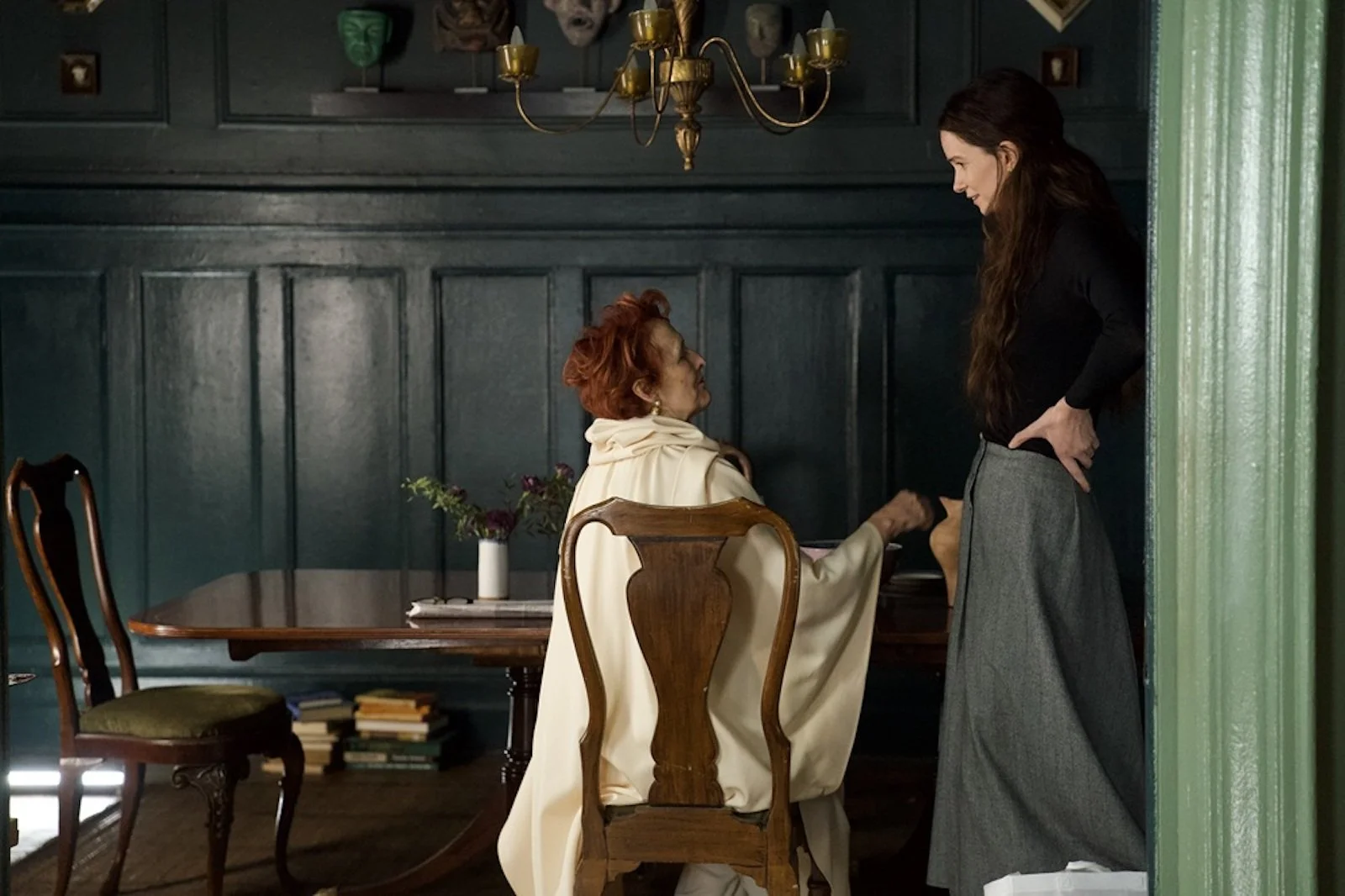
Her mom Kit, played by Fiona Shaw, does little to appease her. She is a larger than life personality with a wardrobe to match. Gold lame YSL skirt suit, butter yellow Anne Klein suede cape, fuchsia dyed Afghan hat, you know, the stuff of dreams if you’re me.
But Charlotte (Katherine Waterston) is her mother’s daughter, and throughout a film that takes us on an incredibly unusual journey, she comes to that realization. Being bigger than life, emotionally loud is better than being small and repressed.
Park Avenue feels like a personal film, from the moment it kicks off in such an idyllic, wide open setting yet a place which feels so claustrophobic for Charlotte, to the setting of a Park Avenue dwelling which was actually filmed in the lobby of a Harlem apartment building. The interior of Kit’s apartment are all created from scratch by the film’s art director Katie Fleming, and to say that they hit the nail on the head is an understament.
To those of us who have lived in NYC, at some point in our lives, Park Avenue the address holds a specific meaning. My BFF as a teenager lived there, while mom and I owned a fifth floor walk up loft in Soho. Whenever I’d go to visit my friend, it felt like I was traveling to a different city, where the walls where wallpapered in brocade yellow fabric and ancient old masters painting hung next to antique Italian pottery. Their kitchen was half the size of our place and our loft on West Broadway was pretty large by New York apartments standards.
All that weirdness, organic mixing of posh and everyday, as well as the specificity held by the prestigious address which names the film is present in Dellal’s latest. She gets it perfectly, partly because she herself has lived in NYC and also because Kit is inspired by a real person, a woman, she explained during the Q&A, “I came across in the park, wearing a long red coat and looking like Kate Hepburn.”
While the film was inspired by Dellal wanting to write something about her mother, “she was always very glamorous and I grew up not liking how she dressed,” the director admitted, the real Kit took over and at one point, Dellal confessed, she even dreamed Kit would leave her the apartment she owned.
Park Avenue also features a collection of cinematic Easter eggs in the form of cameo performances, including one by Phylicia Rashad (The Cosby Show) and another by Didi Conn (Grease, Benson) .
But the inspiration went beyond the dreams, as Kit would utter lines like “the mannequins at Bonwit Teller are modeled on me,” something she has her cinematic Kit say at one point. Bonwit Teller was a luxury department store off Fifth Avenue which still existed when I was a teenager in NY and its iconic shopping bags featuring a bouquet of lilacs still occupy a piece of my memory.
Beyond the feel and flow of the film, Park Avenue is also an ode to a time gone by. A place and time where timeless elegance existed, not just to post on Insta or TikTok as an achievement, but as a complete lifestyle. This wasn’t a choice, or a boasting mechanism for the women who sported it, it was a kind of intrinsic quality, a style which could not be separated from the person. Perhaps watching the new Cecil Beaton exhibition at the National Gallery, in silence and without taking pictures of the photos, explains it best.
Fact is, Dellal and her extraordinary costume designer Thomas Schuster have managed a miracle. A couture wardrobe, which jumps off the screen and becomes the stuff of dreams in just a few instances, on a tight budget. The clothes are all bought and borrowed, mostly vintage finds from NYC street markets and there isn’t a piece out of order in the whole film. Even the choice to dress Charlotte in a mix of cowgirl chic and rich hued suedes is absolutely spot on.
While Dellal admitted that “making an independent film is hell!” she will be working on a comedy next, a “father-daughter story” according to her. If she had at her availability a larger budget, she confessed to me, she would have rehearsed more. The shoot was short, 5 weeks, and there was no time for that.
What she would like us all to take away from the film? “For you to be moved,” she said to all of us lucky enough to witness the film at the couture screening, “I’d like the conversation to continue.”
Mission accomplished I’d say. The film will be screening in the UK and Ireland this month. To find out more, check out their official website.
All images used with permission.