
Why, you ask? Because if we are ever to understand the Palestinian/Israeli issues of the present, we need to go back nearly a century and wrap our heads around the crimes, struggles and mistakes of the past.
Palestinian filmmaker Annemarie Jacir’s films define my life. There, I’ve said it. In fact, I can tell you exactly where I was, geographically and emotionally, when I first watched her debut feature Salt of this Sea, which also placed Palestinian superstar Saleh Bakri on his path of stardom. From that viewing in NYC, I then followed her career to Abu Dhabi, where I watched her sophomore project When I Saw You, another masterpiece of visual beauty, narrative poetry and hidden politics. In Locarno, five years later I watched Wajib (“The Invitation”) a film which required more than one viewing from me, to fully understand its brilliance. Fast forward eight years and now, in London, during the glitzy BFI London Film Festival, I finally watched Palestine 36, on the big screen, in all its splendor, and will henceforth remember time — my life — as pre-Palestine 36 and post-viewing it.
Jacir’s cinema is that powerful. From her 2008 first feature, where some male critics found her heroine (played by Palestinian-American poet Suheir Hammad) too “angry” — read powerful, beautiful and self sufficient — for their liking, I fell in love. I saw a Palestine, and Palestinians, that could have been in all of this helmer’s work and heroines, along with imperfect heroes I could relate to.
In 2012, when I watched When I Saw You, this feeling of possibility was also reborn in me, with a story taking place in 1967, at the height of the Naksa, when Palestinians were displaced once again after Israel’s win in the Six-Day War and more land was seized away from their rightful owners. Shying away from full-on politics, Jacir’s intimate story followed a boy living in a refugee camp in Jordan with his mom and their escape to freedom, by any means necessary. The film’s ending left me breathless and perhaps, spoiled me for any Palestinian cinema I would watch thereafter.
“When the roads are blocked, draw a new map.”
Now, in present-day London, as the embers of the ongoing Gaza tragedy smolder in the background of all our lives, and at the forefront of all Palestinians’ existence, Jacir manages the impossible: to create a cinematic roadmap, a big screen, epic masterpiece that both explains and expresses how we got here. And the film comes at the perfect time, avoiding the all-too-fresh wounds in favor of old ones, the kind of scars that have brought us to this point. And from which, not to be negative, we will probably never recover as a human race. Unless we truly vow to never repeat this history, ever again.
Palestine 36 is the Palestinian submission to the Best International Feature Film Oscar race and, to paraphrase the words of an esteemed Lebanese producer, all the Arab world should rally behind it. In fact, all of us who believe in freedom and justice should too.
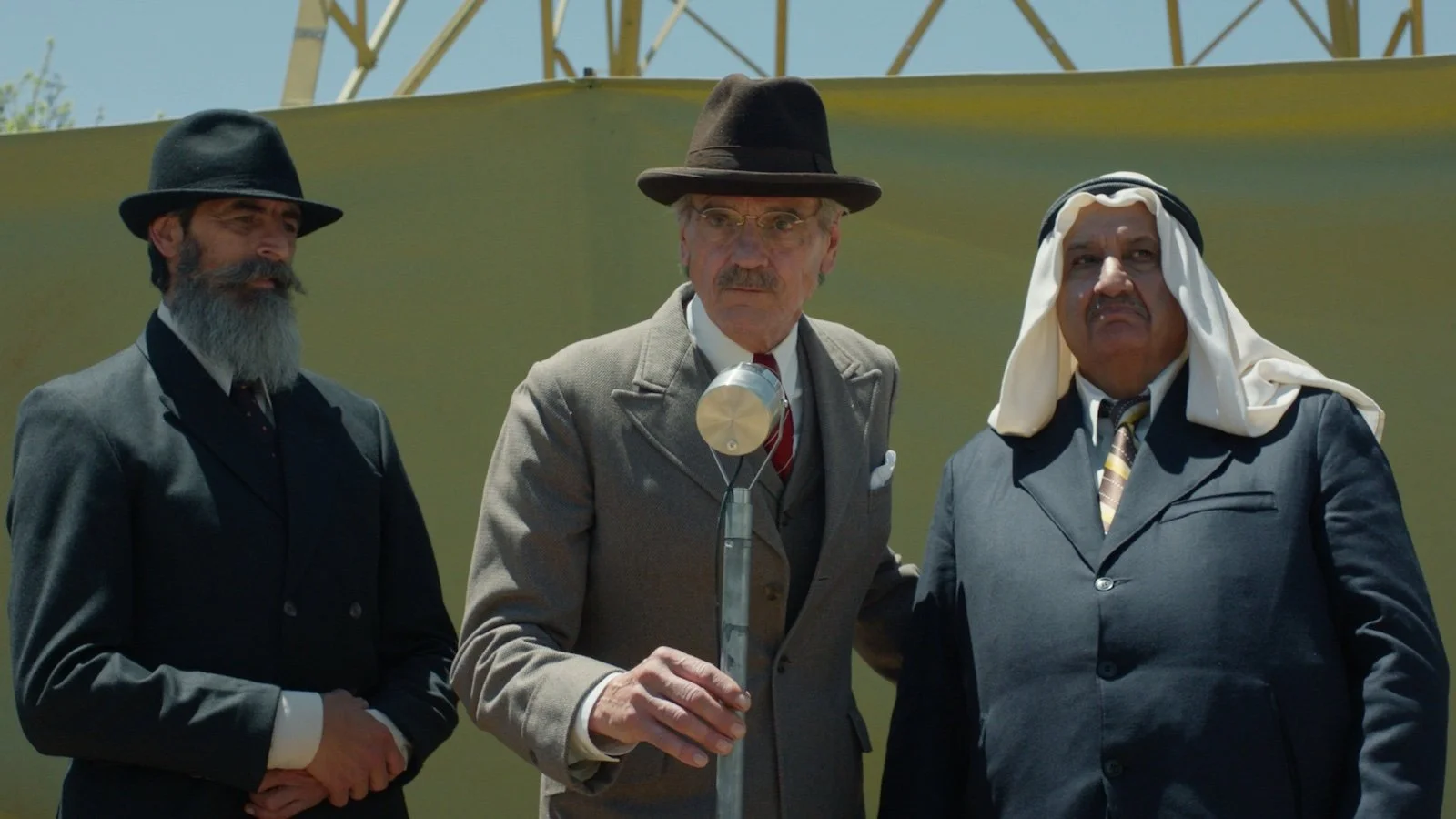
Jeremy Irons in a still from ‘Palestine 36’ by Annemarie Jacir
In the telling of her grand scale story, Jacir is aided by a cast of magnificent actors. From a personal favorite, Lebanese-born actress Yasmine Al Massri (Caramel, Quantico) as Khuloud Atef, the influential Palestinian journalist who has to write under a male nom de plume to be taken seriously; to Saleh Bakri (Salt of this Sea, Blue Caftan) as Khalid, a farmer who is simply pushed too far and joins the “revolutionaries”; to English thespian Jeremy Irons (The Mission, Stealing Beauty) whose cameo as Arthur Wauchope (the real life British High Commissioner in Palestine at the time the film takes place) adds enough western star power to the project to guarantee it will be watched by audiences and awards voters alike, this is an ensemble cast never before seen in an Arab film. But then again, to call Jacir an Arab filmmaker would be to diminish her power and vision as a powerful woman helmer, taking her place comfortably and deservedly in the world cinema landscape.
To top it all off, casting-wise, Jacir has once again managed a miracle, or two. She has discovered new Palestinian talents, which include the nuanced Ward Helou in the role of Kareem, a young boy who undergoes a tremendous change due to the pain inflicted on him and his village. But also the spellbinding Karim Daoud Anaya in the role of Yusuf, who also begins his journey in the film as a kind-hearted and fair young man eager to discover what life has in store for him, only to be turned into a revolutionary by the cruelty he’s subjected to at the hands of the British. With Daoud Anaya, one imagines what David Lean must have felt the first time he laid eyes on Omar Sharif, because the Palestinian parkour artist turned actor is just that charismatic and the camera loves him. But then, so do we, watching the film.
The story of the film takes place during a few months, hardly a year, beginning in the spring of 1936. Known as the Arab Revolt, this was a time when anti-semitic feelings in Europe bubbled over, inspiring a Jewish mass exodus towards the Holy Land and, helped by the British who had been ruling Palestine since the start of the 20th century, the new arrivals began pushing the local inhabitants out, “by hook or by crook,” as the old saying goes — very appropriately in this case. Farmers who had toiled the lands of their ancestors, built terraced fields and planted crops like cotton and olives, were simply walled out, their lands confiscated and given to the Jewish settlers.
Now, imagine living in your simple home, built by the fruits of your labor and having someone come to your door telling you get out. They need the place for the new neighbors who were unhappy in their previous home and are counting on your “inshallah” attitude to oblige them. I challenge anyone to walk out and go, “please, do take everything I own away from me,” without holding a grudge and vowing for revenge. Yet this is exactly what the British military and the authorities giving their orders expected the Palestinians to do.
That, in fact, is the root of the issue, of everything that is happening today, and to those who are still saying, or thinking “well, Hamas started it, the Israelis are just defending themselves,” this film says “this is called injustice.” And just like the African Americans said in their slogan, “No justice. No peace.” Now that is a simple enough idea to wrap our heads around! I’m surprised politicians, from the UK to the US and beyond haven’t understood it yet.
That is why Jacir’s film is so important, because maybe, perhaps, we, the audience could begin to understand it all and help bring a solution to the table. One that involves justice and peace.
Jacir’s film, in case you were wondering, doesn’t only point the finger at the British — I love my adoptive land and found it painful to believe the unbelievable, true and relentless targeting of the Palestinian farmers at their hands. It also pokes at the idea of Palestinian collaborators, in its most visible form here found within the character of Amir Atef, played by Tunisian star Dhafer L’Abidine, who helps Zionists write propaganda and sells it as coming from a Palestinian journalist. And, just in case the Americans were feeling all cushy and protected by their “awesome” — read: dubious — domestic and Middle East policies, there is a Trumpian figure in the midst of the film, complete with his declaration that wall building and getting rid of freedom of speech, and the independent press, is all that is needed to keep the Palestinians in check.
In case everything seems way too serious to be entertaining in Jacir’s film, her masterpiece comes complete with a donkey named Lord Barfour — yes, she went there — and a footnote in the credits about olive oil, which as the good daughter of a Neapolitan mother, made me chuckle out loud. You’ll have to sit through them to find out for yourself.
As a bit of an ending to this personal piece about one of the most important Arab films ever made, I would like to remind you of the one figure that could make a difference, the one man able to bring together the Palestinians and spark a glimmer of hope in their existence — Marwan Barghouti. The Palestinian politician in favor of a two-state solution has been in prison since 2002, convicted by Israel on charges of his involvement in deadly attacks that resulted in the deaths of five people. Up until that time, Barghouti had led street protests and diplomatic initiatives, and he is the only man Palestinians agree could lead them out of the darkness, even topping polls asking them who they would want for president. Time and time again, his release has been denied by Israel, even in the most recent prisoners’ exchanges taking place at the time of the current ceasefire. He was offered a deal to go into exile in Turkey, which he refused.
So famous last words are, those who cannot remember the past are condemned to repeat it. But with the help of Annemarie Jacir and her stunning film Palestine 36, maybe we can climb out of our historical amnesia and into the fight to make things right once again. Because restitution is a worldwide thing, not limited by race and place.
Palestine 36 will open in cinemas in the UK and Ireland on October 31st, distributed by Curzon, and is slated for a US release thanks to Watermelon Pictures.
All images courtesy of Philistine Films, used with permission.