
In her latest film, which kicked off this year’s Un Certain Regard section in Cannes, Tunisian-French helmer Erige Sehiri highlighted women’s friendships at the heart of a community under attack in Tunis. In the process, she created something so moving, touching and so perfectly beautiful, I urge you to watch it on the big screen, as soon as possible.
At the heart of Promised Sky is an idea that resonates with me, deeply. The concept of women’s friendship, the true solidarity of sisterhood, sorority as Sehiri calls it, but also how the world is always conspiring to tear us apart. We struggle, in an ever increasingly more male-centric arena, only to find an ever shrinking piece of the pie that we can divide amongst ourselves, thus making us enemies. What you have must have come at the cost of what I’m missing in my own life, and so I must fight you for it, without realizing that at its core, there is more than enough to go around — if we include the whole cake, including the boys’ share.
To tackle that idea and also work into it the struggles faced by modern West African immigrants living in Tunisian society, trying to make a better life, is sheer genius and Sehiri is a brilliant storyteller — aided by her co-writers and frequent collaborators Anna Ciennik and Malika Cécile Louati.
Promised Sky is the kind of essential viewing that you didn’t know you needed, absolutely were craving to watch, until you come across it, and it never ever leaves your heart.
When the film opens, Marie (French actress Aïssa Maïga), Jolie (Ivorian artist Laetitia Ky) and Naney (newcomer Debora Lobe Naney) are gathered around a bathtub taking care of little foundling Kenza (Estelle Kenza Dogbo), a child who lost her parents through the family’s dangerous migration. Marie is a Pastor, we soon learn, running a clandestine church for fellow Ivorians out of her home, while Jolie is a student from a well-to-do family, living with a valid student visa in Tunisia. Naney, the last of the trio of women, is living in Tunis illegally, hustling to provide for her young daughter at home, back in Ivory Coast. The women share a home, Marie’s house, leased to her by a Tunisian landlord (Tunisian thespian Mohamed Grayaâ) who doesn’t fix anything and keeps promising Marie a new lease.
But this is today’s Tunisia, a country that, like the rest of the world, is getting more and more intolerant of the migrants coming to their cities from all over Africa. And the women will all experience something that will change each of their existence, and their collective friendship forever, before the film’s end credits roll on.
The rhythm of Promised Sky, which takes its name from the song played over those end credits, the haunting ‘Promis le ciel’ by Creole band Delgres, is something which will require the viewer to abandon themselves to the story. It also benefits from a terrific soundtrack, by France-based composer Valentin Hadjadj and Tunisian editor Nadia Ben Rachid whose work with filmmaker Abderrahmane Sissako is legendary.
Promised Sky is a film that needs a space of its own, as it is like nothing you’ve ever watched.
And if I sound partial to this film, and to its wondrous filmmaker, I am. I’ve followed Sehiri’s work since her previous project, Under the Fig Trees premiered in Cannes in 2021, and this year, I got to be one of her current project’s mentor in Qumra, the annual industry event organized by the Doha Film Institute. It was great to powwow with Sehiri and her producing partner on the film, Didar Domehri of Maneki Films. She is one of those rare voices who hits the ground running, already a formed artist with a clear vision.
And poised to take on the world of cinema by storm. Here is my Cannes interview with Erige Sehiri.
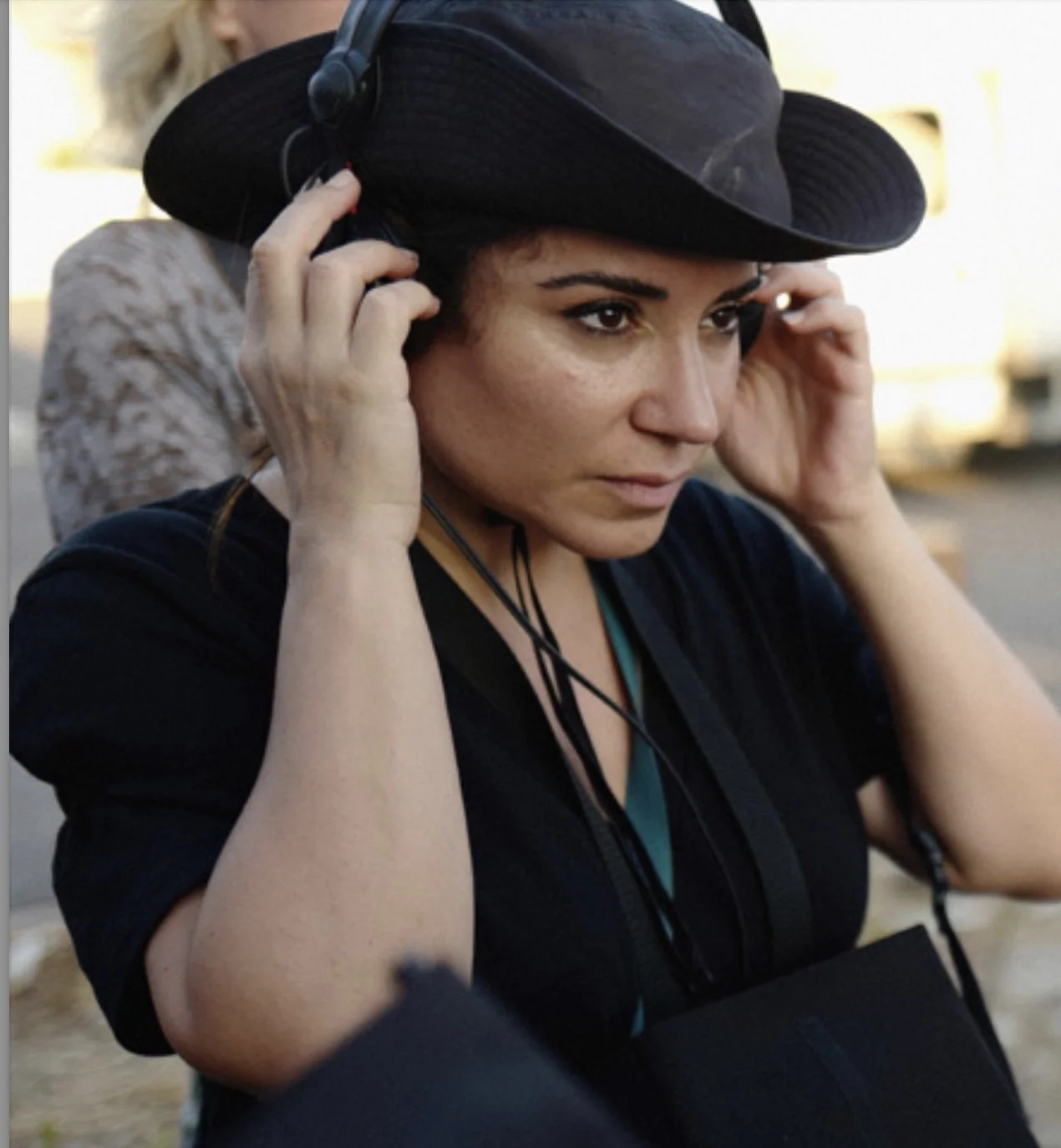
Erige Sehiri on set
When I first talked to you, for a piece in Screen when the film was participating in the Atlas Workshops, there were only two characters, Marie & Jolie — also the title of the film then. So when did the character of Naney enter the picture?
It’s funny because I was doing auditions for extras and for secondary characters and she [Debora Lobe Naney] came with someone looking at me from the side — like “who is this Tunisian woman who wants to make a film about Africans”… And she’s right! But she was so beautiful and she has character and I asked her if she would audition too. I gave her parts, some very small parts at first, in the kitchen of my friend — we were doing auditions in my friend’s apartment in Tunis.
You’re also the film’s the casting director, I read in the credits!
Yes, I am. It’s so important for me. Really, I don’t think of the characters in terms of script, I really, slowly slowly find my characters in life, especially women characters, what they have in them that really moves me. That’s why I cannot choose to have just one character, it’s really hard for me to have a single female hero.
I tried this time, I thought Marie was my hero in the beginning. But that would have been too easy, I felt I needed another character that would be saying something else. And then I auditioned her and fell in love. And during the shooting Naney took on an even bigger part than was expected.
I love the way your characters speak. They talk, they’re not reciting lines, it’s a real conversation between women. How do you achieve that — because there is you and two other writers on this film, so I imagine it’s not a film that is improvised?
Yes, it’s written but it’s open. We write to imagine all the conversations they can have and that helps me a lot during the shoot because even when they improvise, there is already something written. But I mostly don’t give them text to read, I just tell them what I want from the scene, words, or a specific sentence, but never everything.
Just Marie, when she’s in the church, she has a text, or when she’s rehearsing, the text she says to Kenza is her rehearsing is the text I gave her. It’s something I learned a lot also in documentary filmmaking which is try to make in the scene something stronger than the camera itself. Which means that you have to create something in front of the camera, between your characters — it can be a challenge, or something funny or it can be something emotional — that makes the camera very secondary. That’s what I tried to do with them.
How do you feel about the term “cinéma-vérité”, I mean, do you think it applies to you?
Maybe more “cinema du réel”, although I don’t know… What I love in fiction is that reality can become poetry, reality can become something else other than just reality. That’s why I love fiction, otherwise I’d must make documentaries.
The story of this film could have easily been a documentary, just as your previous film Under the Fig Trees could have been a doc. But you always put an ending, something which happens that is beyond the final scene in your films, that helps you to make the film and end it as in real life. Can you talk about that?
Here I think it’s the car scene with Kenza at the end. If there is a separation between all those women who are not family but have become family, what will they keep within themselves from all the others. Even though it was a short time, what do they keep from the others? And I need those little things which help me navigate a film which is not strictly constructed, not strictly written. It helps me to retain the essence.
I heard so many stories while making this film, I could have chosen so many characters, so many combinations of characters — everything was possible. But then you do “goutte-à goutte,” you condense it and that’s what I tried to do.
For Under the Fig Trees, I kept this question in the back of my mind — if an accident were to happen on the road at the end of the day, what will this day look like for this group? This helped me to avoid getting stuck in the narration of a dramaturgy because it’s very easy to say, we’re missing this ingredient it’s not dramatic enough… Although I’m sure I will read that in articles written about the film!
And like your previous film, Promised Sky doesn’t end in a neat package. It ends and we have to interpret it because that’s how life is. It’s never “they lived happily ever after.”
Exactly, there is no ending. But I also knew I didn’t want to end with the car scene, I wanted to show the women’s energies going forward.
What also appeals about your film to me, is that as women we are always fighting for an ever shrinking proverbial “slice of the pie” and we end up fighting each other for it. There is that feeling, in this film, that each of the characters’ survival is almost based on the failure of the others. You navigate that idea so beautifully, without being heavy-handed.
For me the story was a way to question sorority in a different way. Not just in the sense of we’re women, we are having fun and we’re going to make it. It’s how are we going to navigate life.
The soundtrack is absolutely stunning and I’d love to know how you found your composer?
The music is by Valentin Hadjadj who scored both of Lukas Dhont’s films, Close and Girl. When we met I told him, “I’ve listened to all your music, it’s very dramatic, you know — that’s not what I want!” But you know, it is so lyrical, it’s really music. So I asked him to modernize it, in a way, so there are the beats of the clubs where they go in the evenings, and there’s the lyrical aspect also and it’s something we searched for. We didn’t want it to be pushy, but we also assumed we wanted music.
There were also scenes that had nothing to do with each other and he helped me to connect them, through music. It’s really beautiful.
And costumes, a lot of filmmakers in the MENA don’t pay enough attention to costumes but you do. They are very specific, their colors, so I’d love to know who helped you with costumes.
I also do costumes actually. Of course we had someone [Imen Khalledi] to find the clothing, go around markets, etc, but I love doing costumes. There is something in the film about the blue and the pink, several scenes point to the two colors.
The pink for me is Naney, because when I went to her house I asked, “please Naney, can I open your dresser?” And she said of course, and I opened it and I saw this pink dress, which she wears in the film, it’s her dress! And it becomes for me her outfit. And she also wears it towards the end when she goes to the church to testify. And blue of course is for Tunis, the capital of Tunisia which is very close to the sea, and that means the sea is never far away and the idea of blue is never far away.
And the color of the sky of course, for the religion aspect of the film…
Blue and pink were the two colors we chose, without making it too obvious of course.
And the last question is about your cinematography, which is credited to DoP Frida Marzouk, but I also imagine you had a lot of influence over how the film was shot. I say it because your use of light, it’s almost like another character in the film — how it flickers into the room at the beginning, and the dawns, the dusks, you use them as a way to show Tunis.
Like a limbo a bit. Frida was a gaffer before, she was doing the lights, she was not a DoP, she had worked with Abdellatif Kechiche, and I called her for Under the Fig Trees. I told her, I need someone who knows lights because I won’t have any lights, so you need to know the light, you won’t have any artificial lighting.
Someone asked me what references I sent to my DoP and I told them, I didn’t send her any references — I told her “come with me to Sunday church” and have a beer with Naney and those were my references, to spend time with the characters before we started shooting.
Images courtesy of the Festival de Cannes, used with permission.