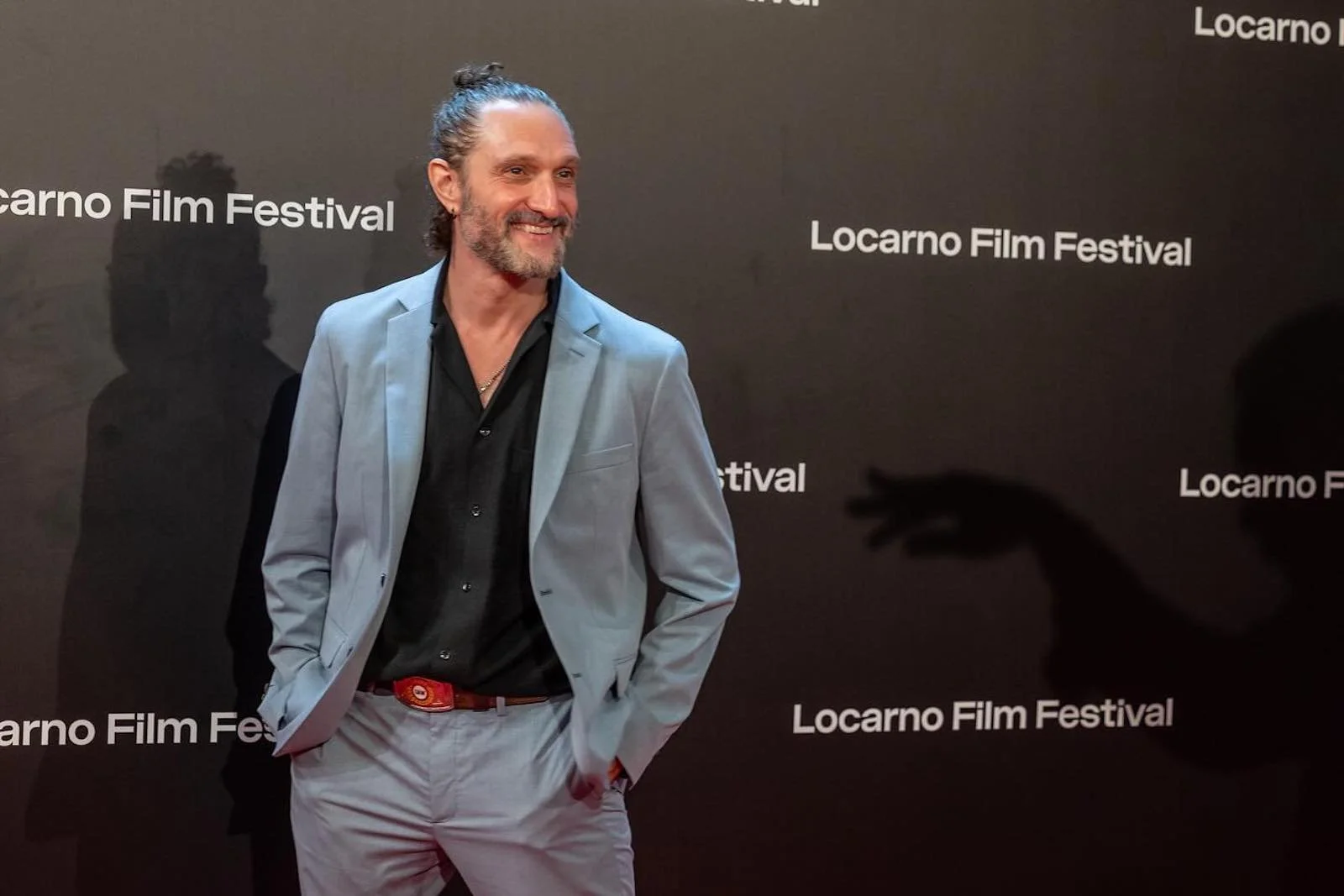
It is a luxury to be able to follow someone’s career for years and I’ve had that privilege with Xido, whom I first met in 2013 in Dubai, where he was presenting his cult rockumentary ‘Death Metal Angola’.
A word of warning — you may not recognize yourself in Jeremy Xido, as he is someone cut from a different cloth from many of us. What you will find instead is a human being in all its complexities and rare beauty, someone whose authentic eccentricity you can attempt to emulate in your everyday life.
Xido describes his parents as “revolutionaries, committed to social justice,” but continues “they were also a hot mess.” As the only white kid in his neighborhood in Detroit growing up, when his parents were struggling, Xido was taken in by “Myrtis and Jimmy Brown, as one of the cousins in a black family.” He admits “it wasn’t until I was 12 years old that I was around larger groups of white people for the first time,” then chases that idea with a “but that’s a whole other story…”
Xido’s life is full of stories, and he’s always found a way to tell them. Whether as a filmmaker, with the 2012 Death Metal Angola, a music documentary I watched at DIFF about youths in the southern African country of Angola and their embrace of heavy metal music to help expunge the horrors of the wars they’ve experienced, or the more recent The Bones, a 2023 doc about the strange trade of dinosaur fossils told as a global thriller. I reviewed The Bones when it premiered at CPH:DOX in March of this year.
Or even as the co-creator and actor/dancer in a one-man performance art show The Angola Project, which Xido described as “a confrontation” to the Travelogues of the 19th Century, and the “poor cousin” of Death Metal Angola, in an interview I published with the artist on the HuffPost in 2014.

A still from 'Transamazonia' featuring Helena Zengel and Jeremy Xido
Or, more recently, while acting the part of the missionary father to Helena Zengel’s healer character in South African-born filmmaker Pia Marais’ Transamazonia, which Variety’s Guy Lodge named “a handsome Amazon mood piece,” when it premiered in Locarno earlier this year. The film, which credits the Assurini people of Brazil’s Trocará Indigenous Territory as associate producers, is next screening at the NY Film Festival on October 7th, 8th and 10th.
In one of his next projects, the doc Sons of Detroit, Xido will also address his unique upbringing and why, when he left his hometown 20 years ago, he never went back — until he started making the film.
So, you see what I mean about not being able to place Xido in any box? He lives so far out of conventions and so removed from the commonplace that it is impossible to identify with him and his life — and that’s a good thing. Actually, in today’s conformist world, where we are told what to wear, eat, do, how to act and where to go by scores of “experts” on social media, Xido is a breath of fresh air that once you’ve inhaled a whiff of, will change your life.
“I want to tell messy complex stories that are morally ambiguous about fallible people who wrestle with big things like hubris, love and remorse.”
Following is an exclusive interview with Jeremy Xido.
What usually attracts you to a project?
They are all accidents.
The way things seem to begin for me is that I randomly meet someone, or hear about a place or a thing that happened somewhere and there’s some sort of contradiction in the story that I can’t quite process or that challenges my assumptions about the world or how people behave. I become curious, maybe even a bit irritated. A little fissure in the facade of the world opens and I can’t resist digging my finger into it. I need to know more, get close to it. So I set out to learn. And inevitably, along the way, something unexpected will happen that lures me to a deeper place that I wasn’t even aware existed. Kind of like hearing a noise in a dark old house that leads you, against your better judgement, down to a creepy basement or up into the sealed-off attic. As you tiptoe towards it, heart pounding, something lurking in a dark corner jumps you and possesses you.
I have this line in The Angola Project: “Maybe there’s a dormant narrative lodged deep in the recesses of my own life waiting to find a form in this unsuspecting world.” And I think that’s really it — the collision between the outside world and whatever is inside of me, whether from my childhood, my experiences, or my well of fears, traumas and longings. That’s how all of the projects start. The rest is coming to terms with that initial smash-up of me and the world.
But the point of entry is always like getting jumped in a dark alley.
Where did you learn filmmaking, writing but also performance art, acting, etc.?
Well…I grew up in Detroit in a very physical world, where you had to know how to dance and play football and basketball in the street. Physical prowess was central to everything we did.
Later on I went to Columbia University in New York and studied Comparative Literature and Painting. But I spent the bulk of my time taking graduate film classes with folks like Richard Peña and performing in strange experimental plays and a cabaret that we modeled off 19th century French and Russian cabarets like The Black Cat and The Bat. Peña introduced me to international cinema and the Cabaret was a wild and strange performance playground where I got to perform things — like Hugo Ball’s dadaist poems and a shadow puppet play about Johannes Kepler, his mom and the devil on the moon. It was all a bit pretentious, but wildly inventive and fun and gave me a taste for mixing forms and genres.
When I left school, I trained as a classical actor at the California Shakespeare festival and went on to perform roles like Malvolio, Berowne and Hotspur in theaters and festivals around the US. Eventually I trained in New York at the Actor’s Studio and Alvin Ailey, got a Fulbright grant to study in Barcelona and dive into the physical theater world of companies like DV8, Sasha Waltz, Wim Vandykebus and Theatre du Complicité.
But really my life sort of opened up when the Austrian choreographer Claudia Heu invited me to tour Europe as an actor and dancer. This started a 12-year collaboration of making theater, dance and performance pieces. And we toured the globe.
Not unlike my early forays into cabaret, our work was agnostic about form. We were constantly mixing theater with dance, visual arts, and film. And through all this I was continually writing scripts and shooting and editing. Eventually we got a commission by the European Union to make a series of 6 short films in 6 towns around Europe, about local criminal cases. This experience became my film school. Everything I had learned back in the day at Columbia, on stage in Europe and on my neighborhood streets in Detroit came to inform how I approached these stories and cinema. I basically lived by the dictate “fake it ’til you make it.” And that’s how I started making movies.
The difference between acting and filmmaking?
For me, acting and filmmaking are two different expressions of the same urge. To tell a story. And for me, I understand all stories first and foremost through my body. They have to pass through me physically from a pre-verbal state to some form of inadequate articulation to eventually finding a form that can be shared with others in community.
Directing for me is physical. I feel my way through where a camera should go, what feels important to capture, how the story is being built. I’m there in space with the film’s subjects collaborating, living through what they are living.
As an actor, before shooting, I spend a lot of time with the script, thinking about the story and researching, but once the camera is rolling, I live moment to moment. I put myself in the middle of the given circumstances of the story, the relationships and the world around me and I react. I try to take what the other actors are giving me and respond as honestly as I can. And I go where the river takes me, knowing the director will pull me back if I go too far, or push me in another direction if necessary.
But really the biggest difference for me is about who puts out the fires. When directing, it’s clearly me who is responsible for everything that goes wrong. And while acting, I can put all that stuff down and let others handle it. My job is to be alive and dance through the scene.
Can you talk a bit about your performance art work?
As I mentioned before, for years I worked very closely with the Austrian choreographer Claudia Heu. We created the company CABULA6 together and made these mad, beautiful, strange pieces that played constantly on the borderline of what was real and what was fabricated. Fact and fiction interlaced.
We were lucky to be in Vienna during a renaissance of contemporary dance and performance based around the Tanzquartier. We had the incredible opportunity to devise theater, dance and site-specific works that constantly pushed the envelope of performance. They were collaborative works, often derived via improvisations and game structure, working with artists and non-artists (truck drivers, night watchmen, hair stylists) who become part of the pieces. The formal experimentation always emerged from the stories we were trying to tell. For example, we did a series of audio tours in which the audience walked in the footsteps of characters from 1919, listening to instructions over headphones. They became the actor, audience and camera in their own movie as the voices in their ears choreographed them through a city and dropped thoughts into their heads. Other pieces, like The Angola Project, were straight-up theater performances mixing movement, story and film in front of a captive audience. It was an incredible and creatively fertile time for me.
I went back and forth between creating and touring this work around the globe and working as an actor and dancer for hire in other people’s work, including film and TV.
How do you believe your unique upbringing helps you as an artist?
I feel like I grew up with a very keen sense that people are never who they seem on the surface. There is often a vast distance between a person’s intimate sense of self and the way the world reads them. And these two forces are constantly in battle. Our identities are forged in the clashes and entanglements of conflicting attempts to define who we are.
I feel like knowing this deep in my bones is a gift and a curse. But for me, in this in-betweenness, there’s an opportunity to find deeper meaning, truth and possibility. That’s the gift. It leads to needing to constantly improvise, move, shape-shift, reconfigure the meaning of stories, emotions and relationships. I think this has served me well as both a filmmaker and an actor.
I’m always looking for the subtext in moments and scenes, whether in front of or behind the camera. I get jolts of energy and joy when what is said and what is meant are out of sync. That fissure is the beginning of every creative impulse. A need to address the inquietude.
What are you working on next?
I’m in the final stages of post production on my film, Sons of Detroit and I’m working on a Ladino language cowboy movie called Sangre Sucio set in the borderlands between Coahuila Mexico and south Texas during the closing days of the American Civil War. It’s about a father and son, Crypto Jews, who have to make a perilous journey north to heal an old family wound before the father dies.
I recently received a development grant from Reboot Studios and head off soon for a residency the Headlands Center for the Arts [California] to work on the script.
And finally, what is your “mission” as an artist?
I want audiences to feel themselves actively in dialogue with what they are watching. I want them to be moved, dazzled, delighted, challenged and by the end of the experience, to turn their focus inward and consider how they live their own lives, question the choices they make and to re-envision the communities within which they live.
I come from theater. That’s my first love. That and neighborhood parties back in the day in which everyone was a participant. No one passively consumed. Everyone in that room or backyard was part of something that couldn’t exist without everyone else there. So sitting together always alchemically turns individual experience back to collective activity and belonging. I want to tell messy complex stories that are morally ambiguous about fallible people who wrestle with big things like hubris, love and remorse. I want to explode the assumptions I have about the world, share that with an audience and allow them a space—through joy and delight—to be present with themselves and everyone else in that room.
Images courtesy of the filmmaker, used with permission.