
Hint: it was terrifying and I finally understood how my grandfather Hans must have felt, on the eve of his departure from Berlin, never to return to his homeland again.
If you watch one theater production this year, make it the Royal Shakespeare Company’s The Resistible Rise of Arturo Ui, starring Mark Gatiss. If you’re in the UK, you’ll need to take a train (or two) and if you’re anywhere else in the world, a plane and two trains will get you there. But run, don’t walk; fly, don’t think. Not only is Stratford-upon-Avon a stunning place to visit this time of year, all aflower, pretty and green, but this very necessary — and actual — play will terrorize the will to vote a bloody dictator into power out of you, for as long as you shall live. And goodness knows people around the world need to have that need scared out of them, as even the UK begins to teeter on the edge of voting right (gasp!) again.
Well, actually, I checked and you may have to hold that thought, running to the Swan theater in Stratford that is, as the play’s run is completely sold out, apart from a single lone ticket for sale on the 16th of May. I’m hoping the production gets transferred to the West End, or better Broadway as it’s a necessary watch.
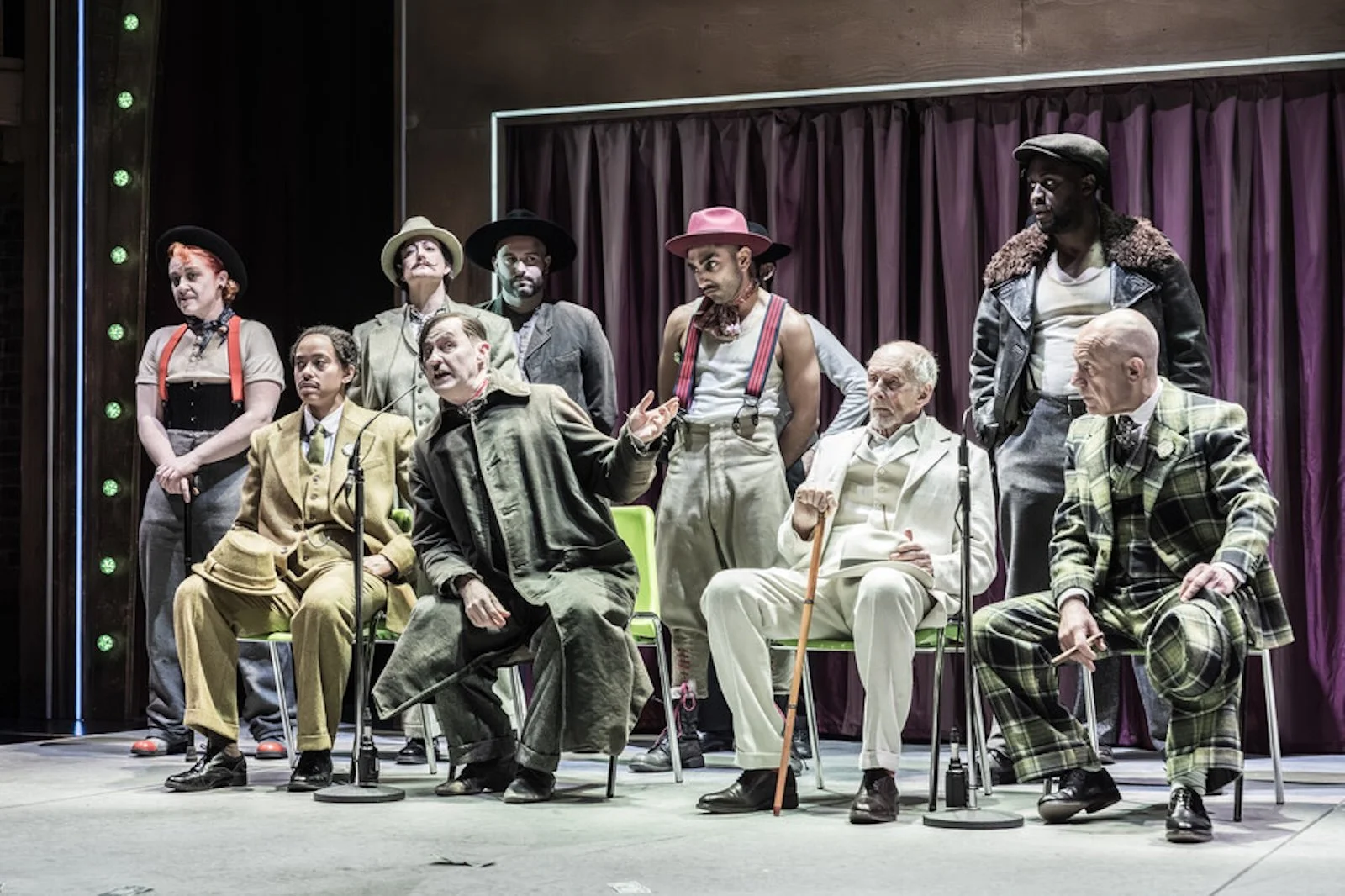
The cast of ‘The Resistible Rise of Arturo Ui’ photo by © Marc Brenner
At the start of this stunning production directed by Seán Linnen, which grabbed me from the first line — uttered by Mahesh Parmar who, on the night we watched the play was the stand-in for Giri, due to Mawaan Rizwan’s absence — a group of men are introduced to the audience on a bare stage dotted only with lime green plastic chairs matching the Royal Shakespeare Company’s logo on a screen above. “Justice is in a coma” Parmar announces, still in a hoodie and being himself. “Let’s begin our fascist parade,” he then says, as he introduces the cast of characters, while placards are held up telling the audience when to applaud. I didn’t realize it consciously, but by then my body was already beginning to feel the trapped terror of someone witnessing the wrong kind of history playing out right in front of them. Monsters were being normalized, before my very eyes, albeit donning their garish, almost clown-like costumes. But then, everyone loves a clown, right?
Among the cast of characters in this Chicago mobsters tale offering a German Nazi cautioning, actor Christopher Godwin as Dogsborough, a play on words to represent General von Hindenburg, the President of the Weimar Republic in the early 1930's; Giuseppe Givola, played by the phenomenal and gender fluid LJ Parkinson, an obvious stand-in for Joseph Goebbels, the master propagandist of the Nazi party who famously wore a metal leg brace and walked with a limp; the bigger than life Kadiff Kirwan as Roma, representing Hitler’s henchman Ernst Röhm; and Parmar as Giri, the Hermann Göring character in the story, an art, and hat, collector with a taste for blood and injustice.

Mark Gatiss as Arturo Ui, photo by © Marc Brenner
Last to enter is the spellbinding Mark Gatiss as Arturo Ui himself, a dead ringer for Adolf Hitler, the Führer, the future Nazi leader of Germany himself. But in Bertold Brecht’s masterfully written play, a satire and allegory aiming to ridicule the leader and his posse, Ui is at first a wannabe mobster who plans to ingratiate himself with the Cauliflower Trust (representing the German landowners). Once the stage is set, literally, and the games — power games that is — begin, it is time for the audience to shiver in their seats. And while the play is touted as a satire of course, there is little to laugh about and loads to grieve as the story unfolds.
The Resistible Rise of Arturo Ui takes Hitler’s rise in Germany and moves it to Chicago, while transforming the Führer into a has-been who wants to rise to be the head gangster in the war of the vegetables. Earlier in the day, in Stratford, I’d walked by the local Tesco and saw a group of down on their luck derelicts interacting on the sidewalk outside the supermarket. So great is the production that at first Ui and his men seemed like those guys, picked up and transported to the theater just in time for the lights to be turned on. The metamorphosis they all go through, throughout the 2 hours and 18 minutes of on stage performance is astonishing, aided only by their talent and costumes (by Georgia Lowe), with a bit of lights (the work of Robbie Butler) and seamless set changes (again Lowe) thrown in. By the time we realize that Ui is now a full fleshed version of the most evil man the world has ever seen, it’s too late. He’s parading in front of us in full military garb, raising and lowering his legs like Basil in Fawlty Towers and he’s no longer a derelict, rather a criminal and the most dangerous criminal there is. One who pretends to help while he kills, usurps and steals. Ui even enlists the help of a black velvet garbed Shakespearean actor to aid him in creating the role of the perfect dictator. Just as Hitler did actually hire an actor to help him find the commanding qualities he lacked at first…

Kadiff Kirwan in a still from the production, photo by © Marc Brenner
Brecht was not light-handed in his depiction of the ignoble. He dotted all his i’s and crossed the t’s. He held back no punches and depicted the Nazi leader and his cronies as power-hungry, pompous, grotesque beings, hardly human at all. Yet the new translation this version of the play is based on by Stephen Sharkey is even less subtle than the original work, perhaps as a way to make sure the audience doesn’t just sit and watch the evil get away with it. The brilliant staging is presided over by a band playing the score by Placebo which does to the play what a soundtrack does to film, and with the help of lights and several breaks of the fourth wall by the cast, the audience is unwillingly enlisted to become the voting German public which allowed Hitler’s rise to power. Enabled, simply standing by, probably horrified by what they were witnessing and unable to find the courage to act. In Dante’s Inferno, the cowards are placed outside of hell, too awful for the devil even, and forever destined to be stung by wasps and flies, having chosen to stand for meaninglessness, as their torture.
It is this horrifying stillness, this powerlessness that I felt during the play at the Swan Theatre which has hit me like a ton of bricks. As an example, there was an empty seat next to mine, separating me from my neighbor just to the left. It was there on purpose, I now believe, as the young man to my left was at one point asked to hold a placard which said something like “Chicago for Chicagoans” or “Save the veg”. And multi-role performer Rebekah Hinds, playing Dockdaisy, along with Parkinson’s Givola debated from the stage nearby, whether to sit in that empty seat, upping my terror level tenfold. In that moment, I realized the fear that my grandfather Hans must have felt when he read that the SS wanted to “give him a one-way ticket to Auschwitz,” for his portrayals of Shakespearean villains as Hitler caricatures in his translations from English to German.

LJ Parkinson and cast, photo by © Marc Brenner
Also a new addition, flashing above the stage and read by various members of the cast at each chapter change during the play, are the parallels between the rapidly evolving Chicago story and the ascent of the Führer in Germany, from early 1932. That was the year Hans Rothe, my granddad, left his homeland, never to return again. Even when it was safe for him to return to Europe, after the family had finally received a passport in the USA — then a bastion of hope and freedom — he refused to ever set foot in Germany again. I was too young when he died, but I imagine that if I’d asked him what he went through, I would have been scarred for life by his reply.
As per Hans’ last wishes, his ashes lay less than seven hundred meters from the Swan Theatre, in the cemetery in front of Holy Trinity Church, where William Shakespeare lays in rest too. So, that fear, that vested interest I felt in the production and its message really made me understand granddad’s flight, his plight and the desperation he must have felt as he stepped across the German border into Italy, at first. Then France, Spain and finally the USA, as fascism kept at his heels, catching up with him and his new family. I believe he would be horrified by what Trump’s America has turned into, of course, the place that seemed to welcome him with open arms in the early 1950’s.
The final brilliance of this production, apart from the extraordinary casting of Gatiss as Arturo Ui, a man who feels part destitute loser, part cunning political engineer and part rockstar all rolled into one, lies in the easygoing dialogue of the translation and returning to the play’s basic premise, pre-Trump-inspired previous theatrical versions.
Even the final speech is more direct and more straightforward than in previous versions, the magic moment when Gatiss wipes off his Hitler trademark mustache and breaks the fourth wall to tell the audience:
“This is no time for celebrating, for bunting and champagne,
Although this time the world stood up and stopped the bastard,
The bitch that bore him is in heat again.”
When the play ended, I drew a breath, what seemed like my very first bit of air in two and a half hours. There is a twenty minute intermission, so I must have been breathing then, as I visited the ladies’ toilet, but I can’t be sure. My body relaxed, I got up from my seat and with my lovely travel companion and colleague Rich Cline, we made a beeline for the local pub, a few hundred meters from the theater. Only to discover that behind us, a queue had formed of equally distraught theater goers who were just coming up for air too. If only we could have all voted then, I bet we would have chosen right…
For more information and to discover the full RSC program, check out their website.
All images courtesy of the Royal Shakespeare Company, used with permission.