
The Amman International Film Festival – Awal Film (AIFF) is in its sixth edition and scheduled to take place in the Jordanian capital from July 2-10, 2025.
Geopolitically, Jordan is a country at a crossroads, often the middle ground — quite literally — between the Arab world and Israel. Surrounded by, clockwise starting from the North by Lebanon, Iraq, Saudi Arabia and Palestine/Israel, it’s no wonder that Jordanian leaders often moderate, even unwittingly, the struggles created by the world(s) around them.
When it comes to cinema, the Amman International Film Festival — Awal Film, or AIFF as it is known for short, has always come to be known as an event that unifies and provides a bridge across many different cultures, viewpoints and lenses. This year, with the tagline “A World Unscripted” it seems to capture the mood of these chaotic times as we move through challenges that definitely don’t come with a manual, or a script.
According to the press release announcing their film lineup,“this year’s carefully curated selection includes over 60 films representing 23 countries, which will be screened in three venues in Amman: Taj Cinemas, The Royal Film Commission — Jordan and Rainbow Theatre as well as in Jordan’s Governorates. The AIFF is proud to offer 23 regional premieres, out of which 16 are world premieres. We are also honored to showcase several powerful exclusive stories from the heart of bleeding Gaza.”
Festival President, Princess Rym Ali said about this year’s theme: “This edition embraces the unpredictable and the deeply human in the midst of a volatile and rapidly changing world,” she elaborated, “life doesn’t follow a script; recent years have certainly been unscripted. Thus, we honor storytellers who bravely explore and narrate moments that feel more lived than written.”
The festival this year also took the initiative to integrate sign language in some films, making them accessible to the deaf and hard-of-hearing community. To reach out to a larger audience, most of the films will be subtitled in both English and Arabic, something of a practice at the festival in past editions as well.
The sections included in this year’s festival are four competitive lineups which include Arab Feature-Length Narrative Films, Arab Feature Documentary Films, Arab Short Films and Non-Arab Films. The latter is a new addition, to the awards lineup as well, as this will be the first year that the Black Iris Award for Best Non-Arab Film will be given to the winner. The prestigious section is curated and programmed by friend and colleague Chafic Tabbara, a respected film critic from Lebanon.
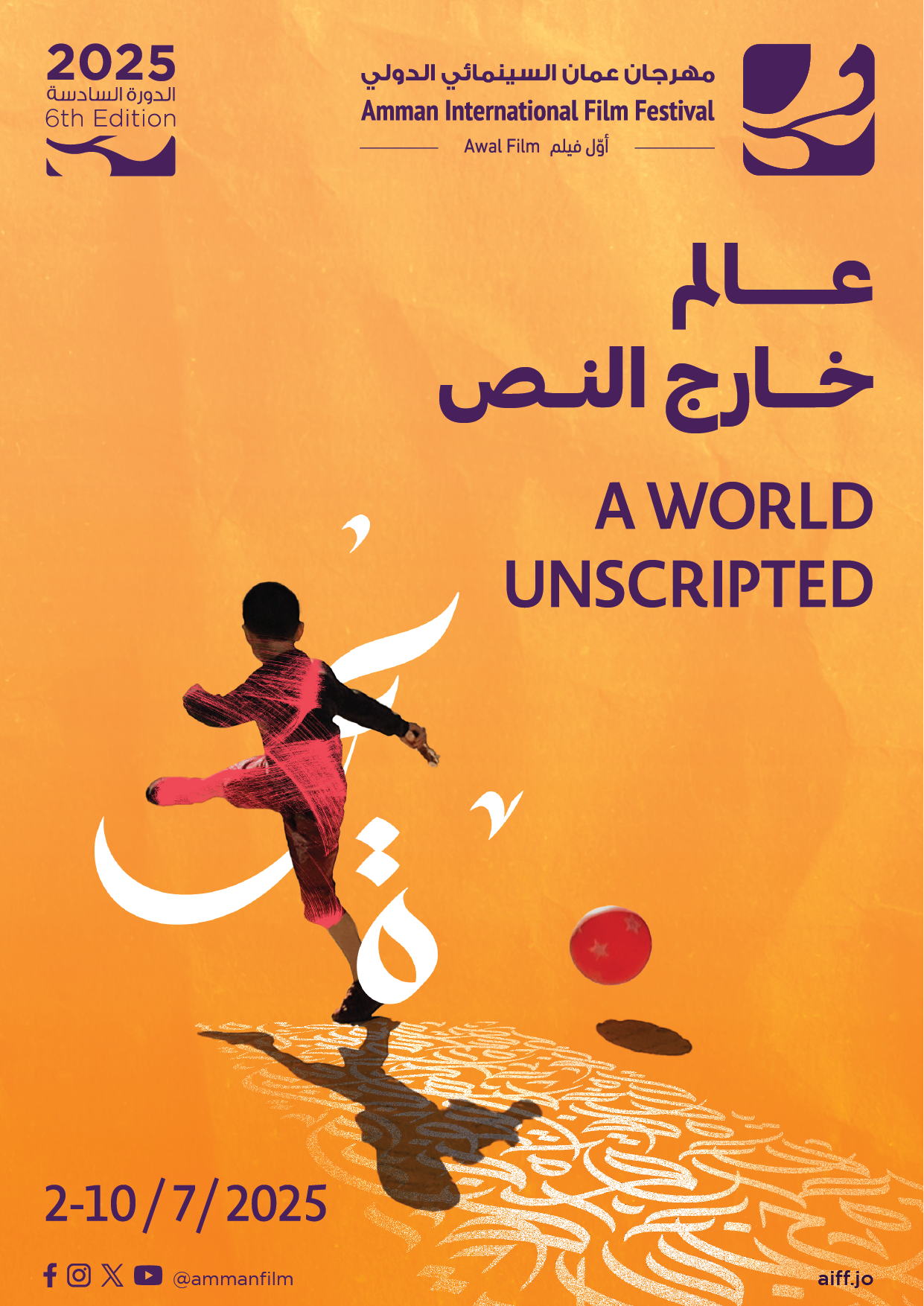
This year’s festival is by HUE Innovation & Design, image used with permission
Two sections will not compete for the Black Iris Award and they are the Out-of-Competition lineup, as well as a special Spotlight on Irish Cinema with special guest Jim Sheridan participating, along with some masterpieces of Irish cinema, including My Left Foot and In the Name of the Father, both directed by Sheridan and starring Daniel Day-Lewis, Michael Collins by Neil Jordan, The Wind That Shakes the Barley by Ken Loach and The Banshees of Inisherin by Martin McDonagh.
Sheridan, a fascinating storyteller on and off the screen, will also reflect on his cinematic journey — from his earliest work My Left Foot (1989) to his newly released Re-creation (2025) — exploring the evolution of his storytelling and the deeply humanistic spirit that runs through his work. He will be hosted in a public conversation with acclaimed Egyptian director Yousry Nasrallah, on 6th July 2025 at the Royal Film Commission — Jordan. Personally, as an aside, I always thought that some of his films, like his 1997 title The Boxer, would make great Palestinian stories, reworked and reinvented in that setting of struggle and injustice, just as Sheridan’s Ireland.
Juries this year include Algerian actress, writer and director Adila Bendimerad; acclaimed Yemeni director Amr Gamal; Lebanese film editor and consultant Gladys Joujou; Jordanian director Amjad Al-Rasheed; Palestinian director Rashid Masharawi; Jordanian star Saba Mubarak; and celebrated Egyptian filmmaker Yousry Nasrallah. The Amman Film Industry Days (AFID), a section which runs concurrently with the festival and features projects in various stages of development seeking mentorship and prizes, the Jury this year includes renowned Tunisian producer Dora Bouchoucha; Linda Mutawi, a Jordanian producer and founder of Fikra, a production company specializing in cross-cultural cinema projects between Scandinavia and the Middle East; and Burundian filmmaker Joseph Bitamba.
At the AIFF, there are also four Audience Award which reflect the direct voice of festival-goers and is granted in each of the four competitive sections: Arab Feature-Length Narrative, Arab Feature-Length Documentary, Arab Short, and Non-Arab Film. This award celebrates the emotional impact and resonance of a film with the public, offering a unique counterpoint to the jury selections.
Now onto the films. Among the Arab Narrative titles in Competition are Egypt’s Seeking Haven for Mr. Rambo, directed by Khaled Mansour; Palestine’s To A Land Unknown, directed by Mahdi Fleifel; Somalia’s The Village Next to Paradise, directed by Mo Harawe; and my beloved Thank You for Banking With Us, directed by Palestinian helmer Laila Abbas. Stay tuned for a review of this film by yours truly, finally!
Jordan’s Tell Them About Us, directed by Rand Beiruty; Lebanon’s We Are Inside, directed by Farah Kassem; and Syria’s Time Out 22, directed by Ali Kazwini are titles vying for the Best Arab Feature Documentary award. Among the notable Arab Short Films in Competitions are Does It Hurt Too Bad to Look at Me? directed by Rana Matar, from Saudi Arabia; Behind the Curtain's Edge, directed by Kacem Skalli from Morocco; Casting, directed by Youssef Sanheji from Tunisia; and one more from Saudi, this one titled Rouge and directed by Samaher Mously.
And last, but not least, in the Competition for Non-Arab films programmed by Tabbara are some festival favorites, the Norwegian Armand, directed by Halfdan Ullmann Tøndel; All We Imagine as Light, directed by Indian helmer Payal Kapadia — both titles were their country’s entry to the 97th Academy Awards. As well as Venice’s Luigi de Laurentis Lion of the Future winner Familiar Touch, a first narrative feature directed by American director and choreographer Sarah Friedland. Friedland also walked away with a Best Director award in Venice.
Out of Competition features a favorite title from this year’s Berlinale, Yalla Parkour directed by Areeb Zuaiter, which is a Jordan/Palestine co-production; the short Upshot by Palestinian wonder Maha Haj; and a series of Palestinian stories, told from ground zero but also from the outside looking in.
For more information, to view all the titles and to attend the screenings, check out the AIFF website.