
English-born filmmaker Claire Belhassine didn't know, for most of her young life, that her grandfather was Hédi Jouini, who is recognized as the Godfather of Tunisian music and the “Tunisian Frank Sinatra.” She spent summers in the company of her Tunisian extended family, yet they never talked of his historic past — and this is a man who was even featured on a Tunisian postage stamp! Until, one day in the back of a Paris taxi, she learned that her grandfather Hédi was a superstar.
So how is that possible, you may be thinking right about now? Well, I won't give the details of Belhassine's spellbinding and utterly pleasant to watch documentary away, but I will tell you that the filmmaker takes us on a personal journey with her, accompanied by Jouini's music and her own soothing narrative.
This coming week, 'The Man Behind the Microphone' premieres in Tunis at the Manarat Film Festival of the Mediterranean in Tunisia, a passion project by another wondrous woman, producer Dora Bouchoucha. The film originally world premiered at the Dubai International Film Festival where I watched it and it was probably the most interactive film there, complete with an impromptu concert on the beach by some of Belhassine's talented family.
After its Tunisian festival premiere, 'The Man Behind the Microphone' is scheduled to be released in Tunisian cinemas in late September, where Jouini's cult status will guarantee a successful run.
I wanted to catch up with the lovely Belhassine and since we've enjoyed a social media friendship for the past few years, I reached out by email to ask her a few questions.
Can you take us chronologically through the story, when you found out about your grandfather’s “secret” life and when you decided to make this a cinematic journey where we, the audience, could come along on the discovery with you?
Claire Belhassine: It began when I found out that my Grandfather whom I’d know as a child was a national treasure, a superstar in Tunisia. And I found this out accidentally in Paris. I heard his music in a taxi then I met a Franco/Tunisian producer who had interviewed him in the 60’s. I went to his office and he pulled out a load of VHS tapes of his performances and a wonderful programme called "Tunis Chante Et Danse" about the history of Tunisian arts and culture, beautifully narrated by Frederic Mitterrand -- that was the first time I’d ever seen footage of the public persona of my Grandfather. I went back to the UK and began to ask my Father questions which he couldn’t or wasn’t really ready to answer…
So I planned an initial research trip to Tunis.
On this research trip I discovered that bizarrely it was my Grandfathers centenary year and there was to be an hommage event at the Theatre National. I was working as a producer in London and thought it would be a good idea to make a short biography on his life, given the relationship between France and Tunisia for French Television while learning about his career. I thought I could turn this around in about 6 months -- 10 years later the film was ready! So the first shoot was filming his centenary event which was pretty spectacular to see this packed theatre, all clapping and singing songs I had never heard before. The family, his 6 children had not been officially invited so this was the first clue in Hedi’s/the families relationship to the state.
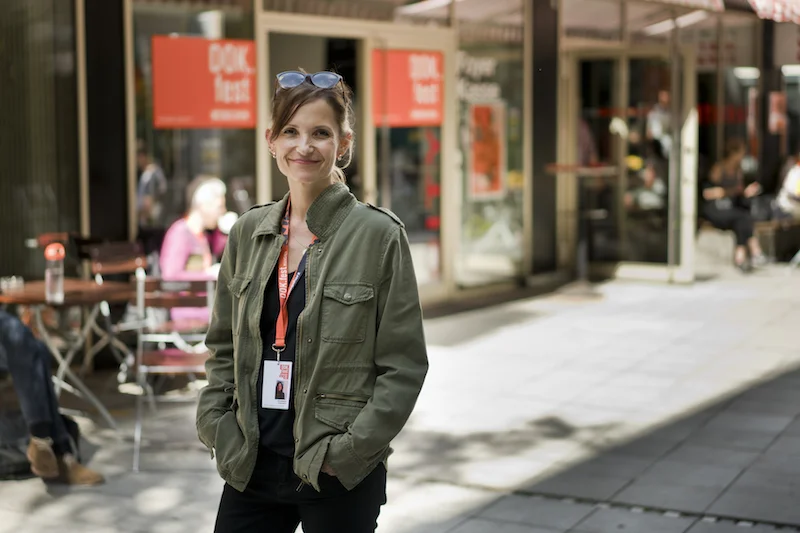
Filmmaker Claire Belhassine
What happened next?
Belhassine: Then I realised that many of his contemporaries were getting older so if I was going to shoot interviews with them I had better do it soon. We shot the second shoot, the bulk of the interview footage at the end of 2009. At this stage it was still along the lines of a traditional bio-doc. My co-producer encouraged me to shoot footage with me in them, and conversations around the project were becoming more related to me and how interesting my discovery was. In parallel, I began to interview members of the family and this began to open up his personal life to me and help me unravel the complexities within the story. At this point in my head Hedi’s career and the family story were two separate things. It was really the important next few years of development which began to find the storytelling structure which would allow me to do both at the same time. That’s when I and the key people involved in the project knew it knew it could be developed into a feature doc.
Why do you think your parents never went into the singing fame of your grandfather with you?
Belhassine: I don’t think it was a conscious choice, there were a myriad of reasons, life in the UK was far removed geographically when I grew up -- there was no internet, remember. One phone call to the family on a Sunday night every now and then. Had I grown up in the 90’s with the internet it would have been a different story! I think my Father anglocised himself to integrate into life in the UK and wanted a distance from his past due to a difficult relationship with his father and being himself a surrogate father to his 5 siblings.
Who is Hédi Jouini to you?
Belhassine: Mmm… The process of a 2-year edit and watching hours of footage of him over and over was quite strange -- he and the members of my family became characters. It was necessary to distance myself from them in that way, they all had a role in terms of the narrative. Becoming familiar with the music and its context within Tunisian culture cemented his public figure image and the family interviews constructed a full image of him as a human being. Of course it’s subjective and so is my interpretation of who he was as there is much of his story we don’t cover. So I have a good grasp of his legacy and how and why he was who he was, from his difficult and unusual (for the time) upbringing to his musical gifts and pioneering spirit.
He was very open and modern in his way of thinking, he looked to the Occident and dressed like a matinee idol, his lyrics were very daring for the time. He was a rebel yet at the same time he was deeply traditional and nationalistic. He loved his country. He was humble, I loved his humility which must have been frustrating for my Grandmother. But he had almost a childlike quality to him that was very endearing. The family talk very fondly of him and have hilarious stories of his eccentricites and humor which are not actually in the film. Then there are my childhood memories of him as “just” a Grandfather which remain unchanged by everything I’ve learnt making the film. I can still hear his voice, remember his smell and his soft energy, how gentle he was with me and loving despite not being around much… And it may sound hippie-ish but on my travels I do feel him with me. I've felt him supporting me through the whole journey. And my Grandmother.
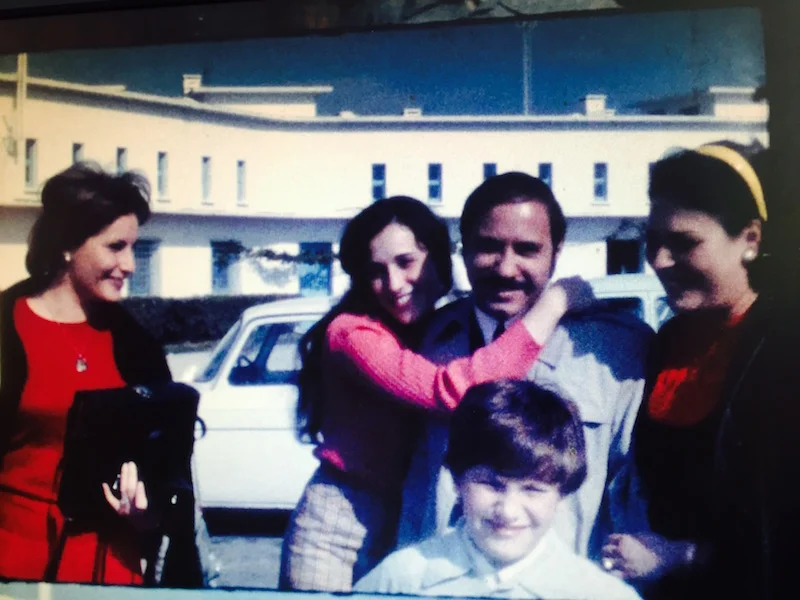
'The Man Behind the Microphone'
What do you think he represents to Tunisians?
Belhassine: Even though the film has yet to play in Tunisia, Tunisian ex-pats who’ve been to screenings in other countries all react with an enormous amount of nostalgia and emotion. The songs mean something to them that they simply cannot mean to me or to someone who has not grown up with them. The songs are so deeply woven into society, culture, the Tunisian DNA in a way that is very moving to me. And this is something I could not relate to in the UK where there is not that unequivocal reverence for a singer or musician. He sort of transcends that to become a “Godfather” if you like, because of the importance of culture and music in Tunisia being so profoundly related to a sense of national identity. It’s a film about identity -- what ties us to a culture, what role does culture have in defining our sense of self and personal identity? And sense of home. People always tell me his music sounds like home.
You know my own pride when it comes to my grandfather, we’ve talked about it I think. So what are your feelings about yours and how have those changed since discovering his singing fame?
Belhassine: When I started the project I felt a certain sense of pride being connected to this national figure. But it was like a superficial pride. This was dissected I suppose throughout all the workshops we did with the film which were immensely helpful in transforming my approach and delving a bit deeper beyond the “famous grandfather and a taxi story”. This was not enough to make a good film. It was the hook and where we went after that was how to bring his story and the family story via my discoveries over an 8-year period. So now I understand the music and its relevance the authentic pride is something I regret hadn’t come sooner. It was clouded by the murky waters around my Father’s experience and that of the family. And the pride is related also to the country that he loved and worked all his life for. I feel like the film sort of reclaims that and him.
I’m proud to be related to someone who a did incredible work and for all the deeply human qualities I respect about him.
What is the significance of a festival like Manarat to showcase your film?
Belhassine: Screening the film at the first edition of Manarat felt right to me, I have a great respect for Dora Bouchoucha and everything that she has achieved in a man’s world. It is a tremendous privilege to have a voice, this irony was not lost on me given that the women in my family didn’t get to have a voice. A festival curated by Dora and her amazing team felt like it would be the right platform to launch in Tunisia, with the French support, the public screenings and summer timing. So when they approached me I jumped at the opportunity.
Finally, if you could sit down with your grandfather today, what would you talk about?
Belhassine: What a beautiful question. I would thank him for this wonderful journey we’ve been on. I’d share my experiences about making the film, about his children. I’d ask him how he would have told his story, how he looked back on his life. And I’d ask him how he felt when his eldest son brought back an English baby [Belhassine herself] to the family home in Tunis. I’d tell him how beautiful I think his music is and how glad I am that he immortalised the love for my Grandmother in his lyrics… I’d have a hundred more questions!
For all info and future screenings of the film, check out 'The Man Behind the Microphone' website.