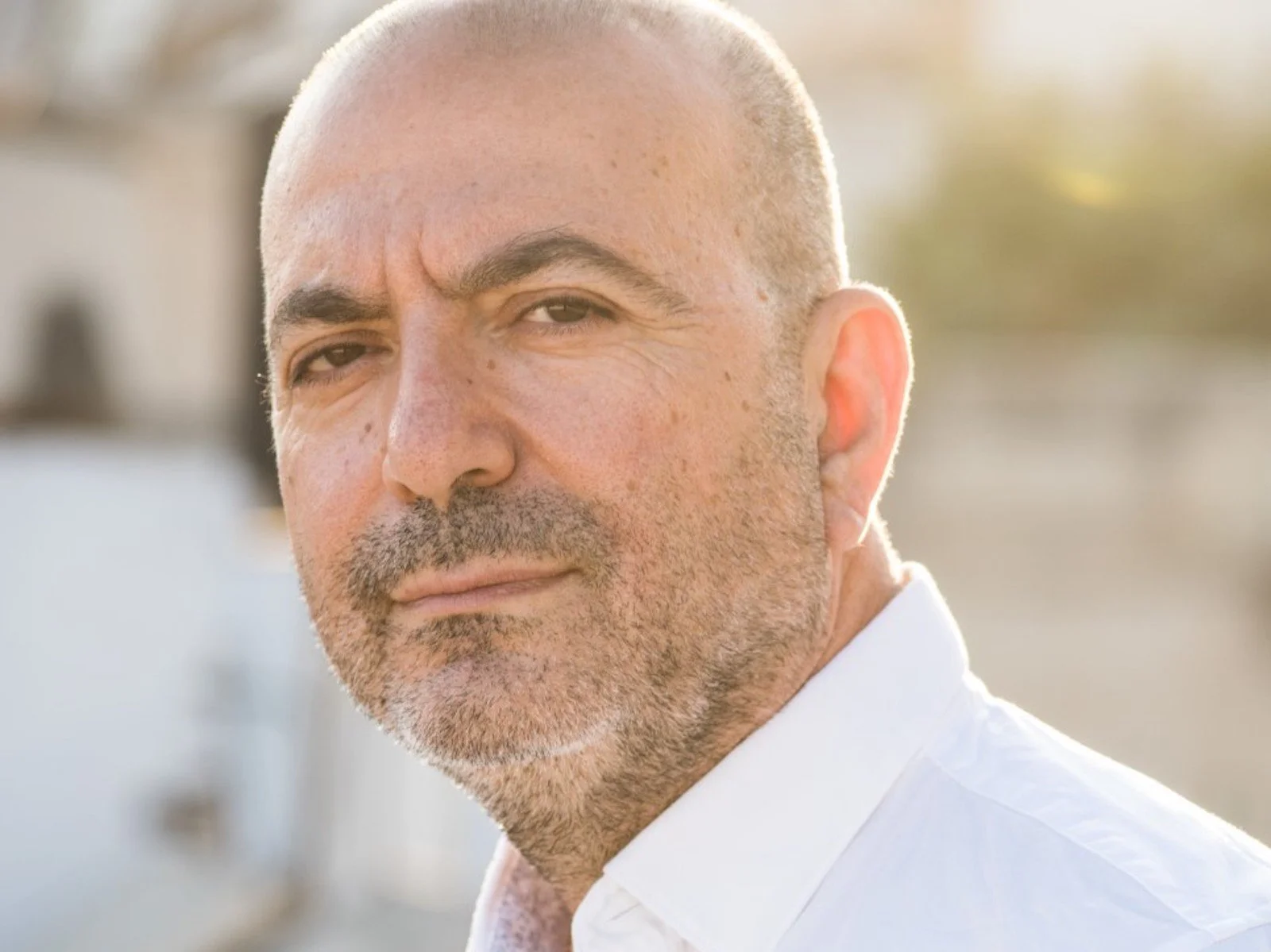
In his latest film, Palestinian auteur Hany Abu-Assad does what he does best -- tackles betrayal and draws us a story made in human shades of grey.
No filmmaker alive manages to paint betrayal quite like Hany Abu-Assad. He's completely unafraid of laying it all out in front of our eyes and allowing us, the audience, to make up our minds. In the process, we come up with our issues, our past acts of duplicity, our own experiences of having been stabbed in the back, figuratively of course, by friends, family or lovers. And once we come out on the other side of one of Abu-Assad's masterpieces, I've yet to watch an average film by the Palestinian auteur, we feel both shocked and awed but also refreshed -- as if we've faced all our demons and finally expunged them.
The theme of betrayal is one Abu-Assad tackles consciously, at least in Huda's Salon. He admits that "the film is about the contradiction between betrayal and loyalty," and when we talk via Zoom, as he sits in his home study in Nazareth, I ask him why he thinks that is. "When I wrote it, my wife said to me, do you realize that all your movies are about betrayal? Omar is about betrayal, Paradise Now is about betrayal... what do you have, you and this theme?" Abu-Assad confesses, continuing, "so I was thinking that's true! Why is that? Why am I going back to the theme of betrayal and blackmail?" He concedes, "I then recalled two events in my life that were probably so traumatic, they are still not healed, they are still hurting."
What were those two events, I ask? "I was 17 and a friend of mine betrayed me, and I almost lost my life, I felt I was in danger, he left me in danger. I loved that friend, I felt he was my hero and suddenly to betray me, I went for almost a year into a depression... sure you overcome it, but it was one of the biggest traumas of my life." And the second incident, I prod, "the second trauma happened when I was 11, I was friends with my classmate and I betrayed him. I falsely accused him of doing something he did not do and the school and teacher punished him. And from that, I still carry around the guilt -- I saw him in a supermarket about a month ago, he didn't recognize me but I knew it was him and I almost went over to apologise... But I couldn't. Because maybe, I thought, he forgot about it and why should I remind him, it was probably nothing for him but it's still with me."
Two events that happened more than 40 years ago, as Abu-Assad himself admits, and yet shaped his consciousness. "If I want to make a film about anything, I go back to those feelings, but I'm hoping this is the last one," he jokes.
In his latest oeuvre, Huda's Salon, Hany Abu-Assad does what he does best, delves into the idea of "how contradiction can meet, because everything good cannot exist -- without evil, good has no meaning," as he points out. People who live in shades of grey, instead of just being all good or all evil, are the filmmaker's speciality. But instead of male characters at the centre of his story -- as we have seen in his Oscar-nominated films Omar and Paradise Now -- he features a female narrative, one woman betraying another and the disastrous results that brings about for both. And remember, this is life lived in shades of grey, not black and white, which makes the film even more fascinating.
Huda's Salon begins on an ordinary day, as Reem (Maisa Abd Elhadi), a young mother married to a jealous man, goes to get her hair done by Huda (Manal Awad) at her salon in Bethlehem. As they talk, Huda drugs her coffee and after managing to put Reem in a compromising position, threatens to blackmail Reem into becoming an informer for the occupiers. For Reem, the idea of being a collaborator with the secret service is devastating on several fronts. She fears the danger for both herself and her child, the secret will tap directly into her husband's jealousy and most importantly, her Palestinian pride doesn't allow for such a clear betrayal of her people, and herself. Enter Hassan (Ali Suliman) and other members of the resistance, who have been surveilling the salon and when they kidnap Huda, Reem's safety, as well as her honour are all threatened, along with Huda's life.
Abu-Assad discovered the idea at the centre of Huda's Salon in "a small article in a newspaper." Yet it wasn't until the filmmaker told his wife, also a writer, about it that she encouraged him to make a film based on the story. "But when you start writing, you need texture from real life," he continues, "and I researched the story more." Even though the real-life woman Huda's character is based on still lives in a protected area in the West Bank, Abu Assad never met her, or the real victims. "The best research I did was with a friend of mine, she's working in a shelter protecting women who have been abused by their husbands, by the government, by the secret service. And she told me a lot about these cases, which she has witnessed very closely," says Abu-Assad.
The next obvious question is about his brilliant casting, as the trio of leading characters that make up this Kafkaesque triangle sizzle. They are Maisa Abd Elhadi, Manal Awad and Ali Suliman, the latter worked with Abu-Assad before, on his 2005 Oscar nominated film Paradise Now.
"Before I started writing the story, I wanted to have the actresses in my mind," the filmmaker admits, "and the first one I called was Maisa. I said to her, what I want to do needs a lot of guts, and you are the only one who is brave enough to be emotionally naked and the only Palestinian probably who is ready to be also physically naked." Abd Elhadi thought about it and decided to do it, as Abu-Assad continues to tell the story, "it was then that I started to write because, I thought, if I start to write and don't have an actress, it's wasted time." It is challenging in the Arab world to find an thespian willing to be as vulnerable as she becomes in the part of Reem and Abd Elhadi is also attractively spellbinding, which doesn't hurt in a visual medium like cinema. "Then when Maisa said yes, I immediately called Manal and told her, this is what I want to do, and I won't do it if you're not in -- and she said, I'm in." Abu-Assad then called Ali Suliman and did the same.
And the rest is cinematic history.

Hany Abu-Assad, photo courtesy of © Yani
"The film is actually about three characters, and when I started writing it, the three actors were in my mind. Later, they actually helped me shape the characters in the way they became, who they are now, in the film. They were in my mind when I wrote it and during the shoot they were active in shaping the characters." This generosity towards his actors is a trait that Abu-Assad is almost singular in possessing, as one doesn't often hear of a filmmaker beginning his writing process through his casting. And that magnanimity is repaid by the actors' performances in Huda's Salon, as the film turns into a kind of theatre play, a preciously intimate performance the audience is privy to and feels privileged to have been a part of.
The film has been described as a political thriller and Abu-Assad himself has called it a "feminist spy thriller." When asked about his influences, the filmmaker has said "I love movies like The Fugitive (1993) with Harrison Ford and The Firm (1993) with Tom Cruise. Those are incredible films. And also movies like Le Cercle Rouge (1970) by the great Jean-Pierre Melville, who made so many French thrillers. Also, I’m a big fan of Egyptian thrillers, which have a different approach, Three Days of the Condor (1975) and I really love Donnie Brasco (1997)."
Like in many of the classic thrillers, organizations and places aren't talked about in depth in Huda's Salon and I have a feeling that the film will resonate even more with U.S. audiences than it has so far. It enjoyed positive reviews when in premiered in Toronto in September of 2021, so I ask Abu-Assad about the recent MENA premiere at the Red Sea International Film Festival in Jeddah, this past December. Huda's Salon is a film that, after all, points the finger at the Arab world, making it confront its own responsibility in the geopolitical spectrum and in personal conflicts.
"The critics in the Arab world mostly appreciated the film. The public as well, but the public at a film festival is different from an average audience, as someone who goes to festivals tends to be more open-minded," Abu-Assad answers. "So I have no idea how normal people will react," to the film, he admits candidly, "but I know women, how they reacted and they were the most affected -- I feel the movie affects deepest Arab women and women coming from a conservative society, because they understand the horrifying experience of someone who can't go back to their family and tell them what happened. This extortion, this rape that is perpetuated again and again." In Jeddah, "the Arab women who watched the film were the most affected by it, unbelievably affected -- when the lights came on, I looked at their faces and could see the horrifying image of the nightmare they lived."
Huda's Salon opens in the U.S. on March 4th.