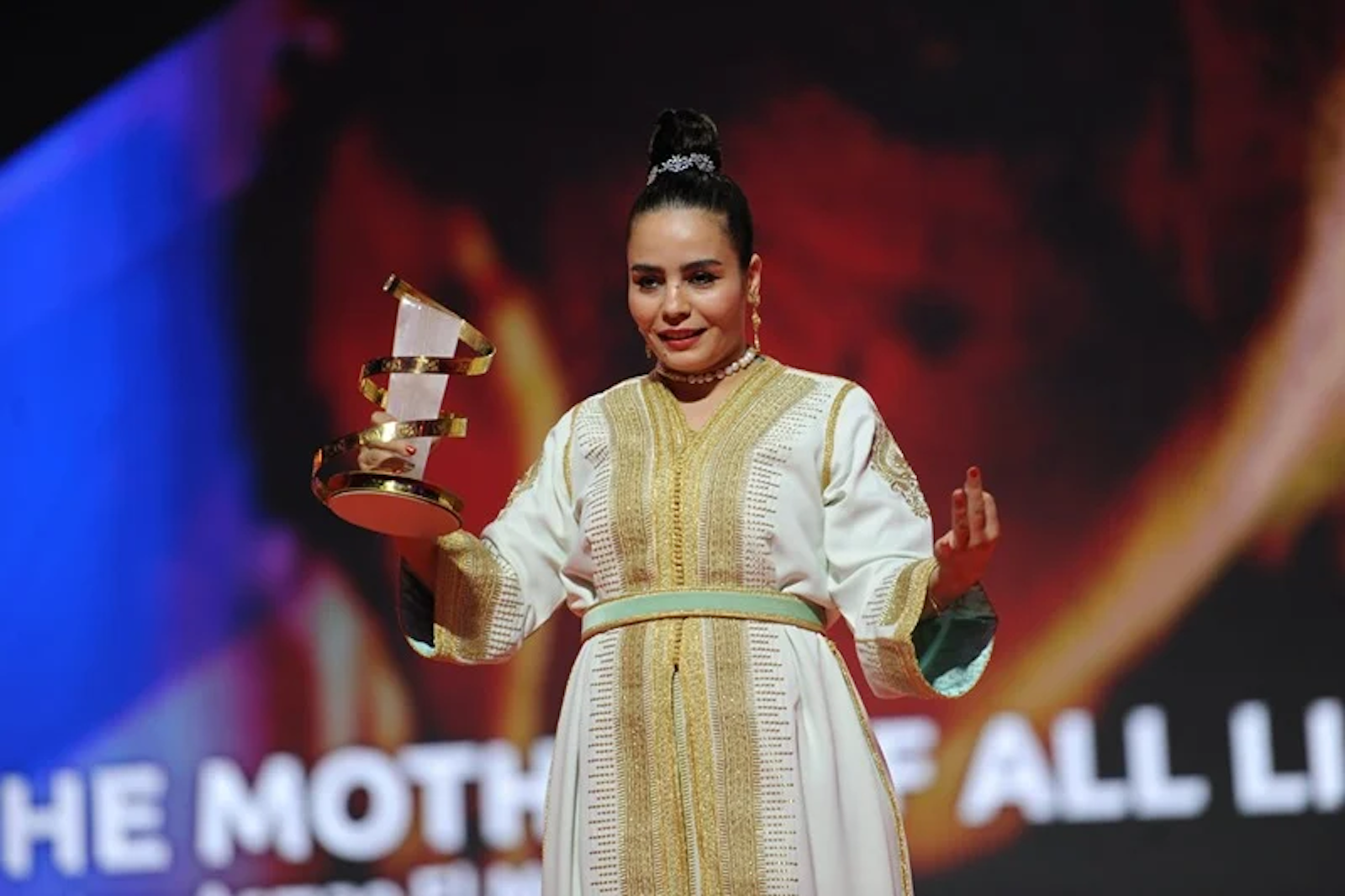
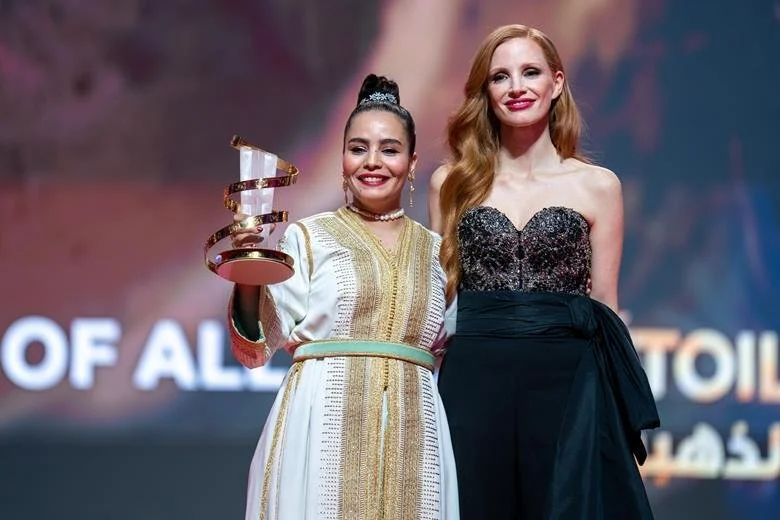
When the film world premiered in Cannes’ Un Certain Regard, it won filmmaker a Best Directing award, as well as the Cannes Best Documentary prize. That was only the beginning, as the film ended up going to on win best film at Sydney FF and best documentary at the Durban film festival. In Marrakech, it won top prize, with Jury President Jessica Chastain handing the diminutive, yet powerful El Moudir the award.
While we all can easily recall the Arab Spring revolutions in Tunisia and Egypt, which then spread to most of the Arab world and added fuel to the fire that Western allies had already lit, most of us don’t know much about the 1981 Bread Riots in Morocco. Little visual testimony is left as the legacy of this bloody revolt, an event often referred to as the “Black Saturday ” of King Hassan II’s reign. The revolt was driven by increases in food prices, paralleling the demands of the Arab Spring. After all was said and done, between 65 and 600 youth (depending on who counted and gave the numbers) were left dead in Casablanca and 2,000 were arrested by police cracking down on the insurgents. It is important to remember that in the early 80’s more than half the city’s population was under the age of 15.
This is the Casablanca that filmmaker Asmae El Moudir once called home. She was born in a neighborhood deeply affected by the riots, yet never knew about their existence until one day when she questioned her family about the presence of only one photograph bearing her likeness. A photograph which the young El Moudir didn’t even think was of her.
In her sophomore feature, which had its world premiere in Un Certain Regard at Cannes, El Moudir rebuilds her neighborhood and reinvents a way to tell her story, along with that of her family and the tragedy of her city. As she explains in her director’s statement, “during one of my visits, I saw on TV, news of the inauguration of a cemetery not far from our place, dedicated to the 1981 Bread Riots victims. I was already 25 years old when I discovered this completely forgotten event of my country’s history. The violent Bread Riots had taken place 38 years before, not only in my city, but in the middle of my family’s neighborhood.”
The result is an unconventional, complex but simply told film, a hybrid documentary titled The Mother of All Lies which won -- along with Kaouther Ben Hania’s Four Daughters -- the Golden Eye for Best Documentary in Cannes. Incidentally, both films are now shortlisted for Best International Feature, representing Morocco and Tunisia respectively.
The Mother of All Lies is a very personal film, approached in a very particular way, a new way of making cinema which uses a documentary technique but done through the use of a reconstructed neighborhood and personal retelling by El Moudir and her family. This fresh genre, the hybrid documentary, seems to appeal best to audiences and critics alike, when addressing a difficult moment in history.
“I have been developing the film for the past 15 years but I didn’t work every day on this project,” El Moudir admits, when I sit down to interview her in Cannes. “For me, my characters are my father, my mother, my grandmother, my neighbors, and these people were in these dark ages, if we can call it like that.” She explains further why she chose to use a miniature homemade model of her neighborhood to set her film in, because “asking them the questions about this period was not easy -- to get something cinematic out of it. I tried a lot of ways, to put microphones in the house, to ask questions and to forget them and then ask them again, but I didn’t get anything — about my personal story also. Because there is a personal story and a national story which are mixed.”
The national story, one would think, could be a problematic one to tell, yet here we are with El Moudir sitting inside the Moroccan Pavilion in Cannes. “I think it’s okay today to talk about the past, because it’s a good thing. I’m coming from the 90’s generation so we are reconciled with this past,” she admits. She also explains that she “wasn’t looking for guilty people, I just wanted to understand. How did the story go, if we don’t have any visual or concrete proof of what happened…” Which is where the reconstructed neighborhood comes in, courtesy of the filmmaker’s dad, who is also in the film. Much of the spirit of The Mother of All Lies feels to me like the Pirandello play Six Characters in Search of an Author. Instead of the actors crashing the performance to search for their lives’ meaning, here it is El Moudir’s mother, father, friends, neighbors and fiery grandmother Zahra, wielding her tiny, long stick, who do the crashing. And clashing of course, as a way to explain the future, through understanding our past. As the Father in Pirandello’s play says, “We all have a world of things inside ourselves and each one of us has his own private world. How can we understand each other if the words I use have the sense and the value that I expect them to have, but whoever is listening to me inevitably thinks that those same words have a different sense and value, because of the private world he has inside himself, too.” El Moudir has found a way to help us understand, and for her and her family to reconcile as well.
One of El Moudir’s lead characters is definitely the reconstructed neighborhood, built by her father, Mohammed El Moudir who, as the press kit points out was “the most popular tiler/mason in the Medina of Casablanca in the ‘60s.” She took the family away with her to Marrakech, and through this miniature set of houses, lit and inhabited by mini versions of themselves, the family opened up -- to us, on the big screen, for all to see. “That ‘dispositive’ was my invention,” El Moudir tells me, explaining further “also because I couldn’t film in some locations. Or it was not easy to get permission.” It also gave them all, “just a moment of talk, after years of silence -- we just wanted to talk.” Within those moments of talking, as the petite, soft spoken yet fast-talking filmmaker admits, “we have some miracles -- like Abdullah, who started talking about what happened to him, and I lost control of my character then. This is all real life. As a filmmaker I take the real facts, but I change the way I will tell that reality.”
At one point, El Moudir’s feisty grandmother Zahra says “the walls have ears,” but when I tell that back to the filmmaker during our interview, she corrects me. “So everyone thinks about that, that walls have ears, because they are still thinking about the past. But today Morocco is different. I can make this film today because we can speak freely today.” And in fact, during the awards ceremony in Marrakech, El Moudir dedicated her historic win, marking the first time a Moroccan film has ever received the coveted Etoile d’Or, to King Mohammed VI, the present ruler of Morocco.
Part of this interview was originally published in MIME.news.