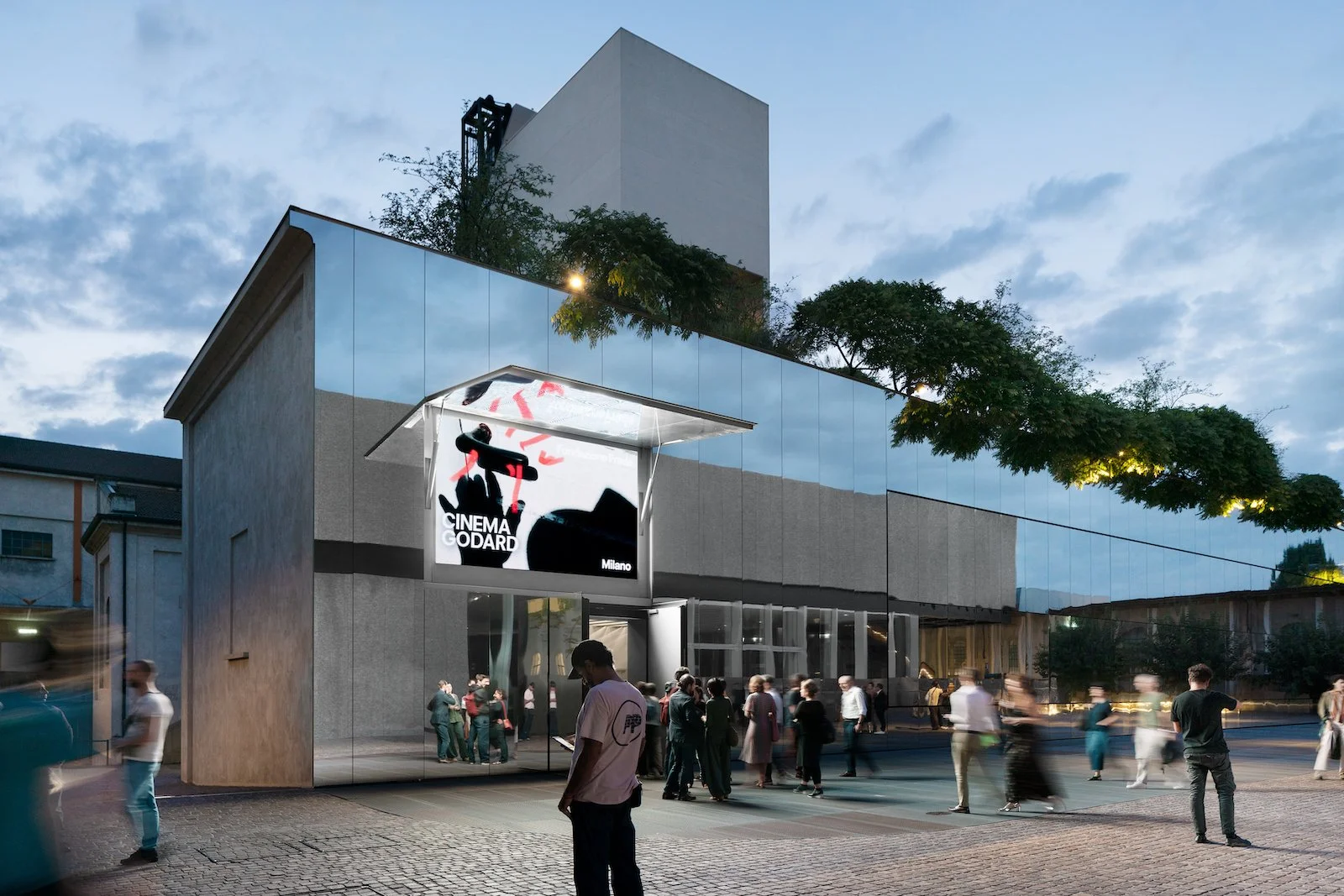
Long live Prada, a fashion brand with a clear understanding that cinema is as important as what we wear, and vice versa. Now, with the blessings of the Fondazione Prada President, Miuccia Prada, a new Film Fund worth 1.5 million euros, to help sustain independent cinema, will be launched in the fall of 2025.
The Fondazione Prada announced today the creation of Fondazione Prada Film Fund, a yearly initiative to sustain independent cinema. Worth 1.5 million euros, the Fund will be launched in Fall 2025 through a call for entries. The goal of this project is to support works of high artistic value by enhancing Fondazione Prada’s twenty-year commitment in the field of cinema. Each year, the Fund jury will select ten–twelve feature films with no geographical or genre restriction. The choice will be based exclusively on criteria such as quality, originality, and vision, with the aim to concretely contribute to the film’s crucial development, production, and post-production phases.
As stated by Miuccia Prada, President and Director of the Fondazione, “Cinema is for us a laboratory for new ideas and a space of cultural education. For this reason, we have decided to actively contribute to the realization of new works and to the support of auteur cinema. For over twenty years, the Fondazione has been investigating these languages in different ways, thus advocating a free, demanding, and visionary idea of cinema. Through this Fund we intend to deepen and broaden a dialogue with creation and contemporary experimentation.”
The Fondazione Prada Film Fund is based on an editorial autonomy, which is built in dialogue with a team of cinema professionals—producers, curators, internationally acknowledged experts—, and on a rigorous selection process, fully consistent with Fondazione Prada’s cultural mission, which aims to generate unexpected resonances and intersections between different disciplines and visual languages.
Long known for her support to world cinema, Prada has been behind the long running ‘Miu Miu Women’s Tales’, an ever growing anthology of short films made and filmed by some of the most exiting women filmmakers in the world.
This new initiative intends to operate efficiently and effectively, adopting a wide and inclusive perspective capable of embracing well-known authors, emerging talents, and research projects. This openness will allow the Fund to support heterogeneous works in terms of language, productive scale, and artistic vision, thus concretely contributing to the plurality and vitality of contemporary cinema.
Fondazione Prada Film Fund is a project developed by Paolo Moretti—curator of Fondazione Prada’s Cinema Godard program, director of the Directors’ Fortnight at Cannes Film Festival from 2018 to 2022, head of the Cinema department at ECAL (École cantonale d’art de Lausanne), and Director of Cinémas du Grütli in Geneva—in collaboration with Rebecca De Pas, a member of the selection committee at the International Film Festival Rotterdam, art consultant for the Viennale, and co-director of FiDLab—an international coproduction platform—from 2009 to 2019.
Fondazione Prada Film Fund is part of a complex investigation on cinema languages that the Fondazione started in the early 2000s.
From 2003 to 2005, Fondazione Prada partnered with the Tribeca Film Festival in New York, founded by Robert De Niro, Jane Rosenthal, and Craig Hatkoff, presenting the preview of a film selection in New York and Milan, such as Chinese director Wong Kar-wai’s feature film 2046.
From 2004 to 2006, in collaboration with the Venice Biennale, Fondazione Prada launched a film recovery and restoration program, which represented an unprecedented turning point for a cultural institution. It has involved a selection of forgotten or misunderstood Italian genre films shot between the 1950s and the 1970s, Chinese works distributed before the 1949 Revolution, rare films belonging to Japanese popular production, and Soviet musical comedy films from the 1930s to the 1970s.
Between 2005 and 2007, two exhibitions—such as Steve McQueen’s first Italian solo show and Tobias Rehberger’s “On Otto”—deconstructed the mechanisms of vision and the process of film production involving international figures such as Charlotte Rampling, Kim Basinger, and Willem Dafoe.
In 2009, at the Prada Transformer designed by OMA in Seoul, Alejandro G. Iñárritu, in collaboration with critic Elvis Mitchell, presented “Flesh, Mind and Spirit,” featuring a selection of films that profoundly marked the director’s education and artistic vision. The series of movie selections called “Soggettiva” came from this first experimentation and has been proposed from 2018 to 2022 at the Fondazione Prada’s Cinema in Milan. This project has involved filmmakers such as Pedro Almodóvar, Danny Boyle, Alexander Kluge, Nicolas
Winding Refn, Hans-Jürgen Syberberg, and Ava DuVernay and artists such as John Baldessari, Peter Fischli, Simon Fujiwara, Theaster Gates, Damien Hirst, Goshka Macuga, Betye Saar, Luc Tuymans, and Elmgreen & Dragset.
In 2015, the Fondazione opened its permanent premises in Milan, which includes, amongst other features, a projection room and a café inspired by the film world. Designed by the American film director Wes Anderson, Bar Luce recreates the atmosphere of a typical Milanese café by freely referring to two masterpieces of Italian Neorealism: Miracolo a Milano (Miracle in Milan,1951) by Vittorio De Sica and Rocco e i suoi fratelli (Rocco and His Brothers,1960) by Luchino Visconti. The architectural and decorative elements of Bar Luce are reminiscent of Italian popular culture and aesthetics from the 1950s and 1960s.
In 2017, Fondazione Prada presented three hybrid projects that tested new ways of fruition and challenged traditional exhibition forms by contaminating cinema with visual arts, television, and immersive and digital technologies.
In 2018 Fondazione Prada launched a regular screening program in the Cinema in its Milan venue. Classics, experimental works, previews, avant-garde works, television films, rare and restored movies are all presented in a complex, ambitious selection without predefined hierarchies. Fondazione Prada’s Cinema also holds public meetings with established and emerging figures on the international film scene, such as Ali Abbasi, Wes Anderson, Marco Bellocchio, Bernardo Bertolucci, Bertrand Bonello, James Crump, Spike Lee, Steve McQueen, Gaspar Noè, Dee Rees, Caroline Poggi, Jonathan Vinel, Hans-Jürgen Syberberg, and Agnès Varda.
In December 2019, Jean-Luc Godard realized for Fondazione Prada’s Milan venue his only two permanent installations open to the public. With “Le Studio d’Orphée,” the French-
Swiss director moved his atelier, recording and editing studio, living and working place from his studio-house in Rolle, Switzerland, to Milan. Thanks to the sound installation “Accent- sœur”, visitors can listen to the soundtrack of his video work Histoire(s) du cinema, created by the filmmaker from 1988 to 1998.
Since February 2023, the Fondazione’s cinema program undertakes a new phase under Paolo Moretti’s curatorship, marking a renewal in the curatorial approach and an openness to new forms and geographies of cinema. In September, the Fondazione’s projection theater was officially renamed Cinema Godard in tribute to the French-Swiss director’s work and thought.
In recent years, Cinema Godard has welcomed some of the most significant names of contemporary cinema, such as Amjad Al Rasheed, Yuri Ancarani, Wes Anderson, Dario Argento, Jaume Balagueró, Baloji, Lamberto Bava, Kaouther Ben Hania, Meriem Bennani, Saulė Bliuvaitė, Bertrand Bonello, Jonas Carpignano, Monia Chokri, Anton Corbijn, Alfonso Cuarón, Massimo D’Anolfi and Martina Parenti, Álex de la Iglesia, Lav Diaz, Xavier Dolan, Coralie Fargeat, Michelangelo Frammartino, Agniia Galdanova, Yervant Gianikian, Beatrice Gibson, Luca Guadagnino, Jessica Hausner, Werner Herzog, Joanna Hogg, Babak Jalali, Victor Kossakovsky, Elena López Riera, Pia Marais, Pietro Marcello, Diego Marcon, Lucrecia Martel, Sergio Martino, Alberto Mielgo, Roberto Minervini, Giorgio Moroder, Paul B. Preciado, Klaudia Reynicke, Gianfranco Rosi, Eli Roth, Alonso Ruizpalacios, Paul Schrader, Céline Sciamma, Erige Sehiri, Albert Serra, Léonor Serraille, Lina Soualem, Małgorzata Szumowska, Fiona Tan, Jia Zhangke, and Rebecca Zlotowski.
Presented between 2024 and 2025 are a retrospective dedicated to American director, writer, and visual artist Miranda July and the research project “A Kind of Language,” held until 8 September 2025, investigates the creative process that precedes a film realization, exploring storyboards and other preparatory materials.
From 18 September 2025 to 26 February 2026, an immersive exhibition conceived by director Alejandro G. Iñárritu will delve into the cultural and cinematographic dimension of his first feature film Amores Perros (2000).
Image courtesy of Fondazione Prada, used with permission.