
One of the freshest and most romantic films I watched in Cannes was Gianni Zanasi’s ‘Lucia’s Grace’ which screened in the Directors’ Fortnight section. On Thursday night it was awarded the Label Europa Cinema prize and personally, I was elated. Zanasi’s film is another one of those modern Italian cinematic gems that have brought me home. Quite literally.
I moved back to my birth country five years ago because its newest wave of movies and filmmakers made me once again proud of being Italian. And Zanasi’s film also features as Lucia one of the most exciting young actresses in indie cinema today, Alba Rohrwacher, whom we can definitely claim as Italian but who is so much bigger and better than that label alone. Her wit, the way she can take the most basic of characters and build around them grand nuances and subtle mannerisms make her so cool that she may as well read the phone book on the big screen. And I’ll pay to watch that.
The story of ‘Lucia’s Grace’ makes it appear about religion, but it’s really a love story and a story of personal courage, of listening to one’s conscience instead of following blindly what we’re told to do. In fact, at the beginning of the film, the Madonna appears to Lucia while she’s surveying a piece of land for work. At first the young single mother, who has recently ended her live-in romance with Arturo (played perfectly by Elio Germano) tries to get away from the Virgin, while the unrelenting Madonna (also played wonderfully by Hadas Yaron) pursues her, orders her around and when that doesn’t work, even beats Lucia up — in one of the funniest, most spellbinding scenes in the film. Is she real, or is Lucia losing her mind? Well, the thing is, the decision may turn out to be something personal for each of us watching the film. And that’s the brilliance of Zanasi’s story.
I caught up with both the filmmaker and his leading lady in Cannes, on a rainy afternoon. It was one of the coziest moments of the festival for me, a moment that renewed and reinforced the decision I made to return to my land. And both Zanasi and Rohrwacher were everything I’d hoped they would be, and more, in person. Prepare yourself, you are about to sit down at a table for an interview right alongside me. One that felt more like a chat between friends than a formal junket and editing it would have been a shame.
I told Alba before you joined us that I think she’s the most exciting actress in Italian cinema at the moment…
Gianni Zanasi: I agree.
How did your collaboration begin?
Alba Rohrwacher: We met in Japan.
Zanasi: That’s true! She’s right.
Lost in translation then!
Rohrwacher: Many many years ago. But by chance, there was an Italian festival in Japan and we were on the same delegation so we crossed each other… In Japan! We recognized maybe one another.
Zanasi: We really knew each other very little.
So how was Lucia born, with Alba in mind?
Zanasi: No.
So a true apparition!
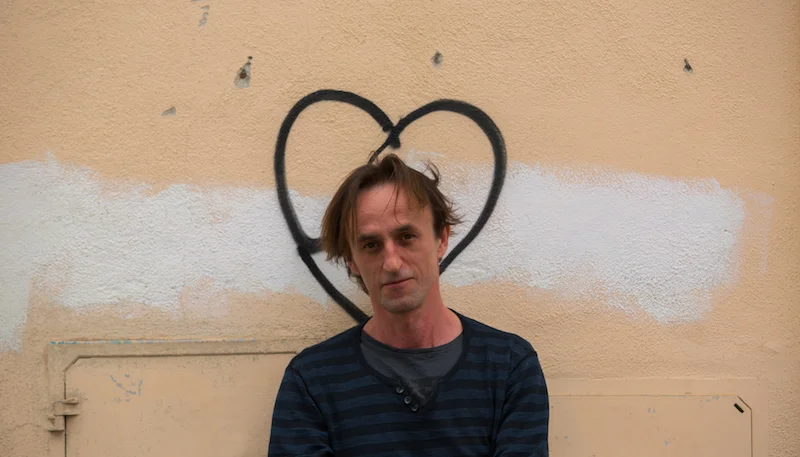
Gianni Zanasi
Zanasi: Yes. I think stories are born often like this. There are many ways… I mean if I now think I want to write a film that deals with religion, and women’s condition, after a week I can’t write anymore. Because those are concepts. At times very important, even noble but they remain concepts, words. There is a conceptual control and rational of motivations. To me a story appears and begins when there is a something emotional that eludes concepts and even turns them upside down. It shuffles the cards mysteriously and so you say “that’s interesting”, and a mystery is born. That’s how the narrative process begins.
When you approached Alba with her character in this film how did you describe it?
Zanasi: If I remember correctly, I think I went straight to the point. I told her, the way I usually told it, it’s the story of a surveyor who has to work on a mapping project, a typical kind of job and one day she sees someone who seems to be a refugee.
Fantastic moment that one. “there is a refugee here, a homeless woman…”
Zanasi: And she even adds, “a destitute”… And I knew when I said those words the attention would fall on certain cues, “so this will be a film about refugees, then, a righteous film…”
Rohrwacher: Yeah, but I knew him [Gianni] so I thought “yeah, and then? Where is this going?!”
Zanasi: Then I continued, you know then she finds her in her kitchen suddenly and she tells her “Go to the men, and tell them to build a church.” But it was a story that came to me like this.
Your collaboration has created this film that hits these wonderful themes, of love and faith, and of people who collaborate with her and help her fulfill her mission. They begin to believe in Lucia…
Zanasi: That’s her ex, he does it for love.
Yeah, in fact your film is a love story to me.
Rohrwacher: Yes, also for me.
Zanasi: I agree.
Then there are these moments that are so funny, and they interrupt the romantic aspect only to create an atmosphere where laughter helps the tears to come. Tears come more easily when we laugh first, in my experience. And that’s what involved me wholeheartedly in the film.
Zanasi: But Alba is fantastic. She has a reaction that I could have had, me or a friend of mine, you can’t help but have that kind of reaction.
You use music in a very specific way. A song like 'Good God Damn' when Lucia sees the Virgin on the road, in front of her car.
Zanasi: It’s a bit mystical. I believe that in the films I love usually sound, music and images mix and they speak the same language. There are films that don’t have a soundtrack and seem full of music. Music isn’t used to help the scene or to underline it. Like "look out, this is a romantic scene." No. It captures the soul of certain moments as only music can do with such precision and accuracy. Because on some things words aren’t enough.
There is another moment and this was suggested by Alba. Because I believe a lot in collaboration and I don’t feel afraid if an actor or someone says “I have an idea.” When I have gone deep into something I know what it is and what it’s not. So if contributions come in, the film ends up happy. In the scene where Lucia, Elio and her daughter at the restaurant it’s clear that there is a moment filled with strong and intense feelings, their love story has ended but it’s not over and it’s ardous and heart-melting. And maybe love is this. And when Alba read the script she said “It would be wonderful if here there were a song that comes out of the radio…” And I remembered about a piece from Last Shadow Puppets and I heard it, I tell you the truth, I don’t even know what the lyrics say.
But it hits you in that moment.
Alba, if you hadn’t been an actress what would you have done in life?
Rohrwacher: I started on a different road, at university I studied medicine but I felt like it was the wrong path. Something I would have had to do, perhaps I would have become a doctor but I don’t know… But it’s really important to find something towards which to strive. The vocation, which doesn’t mean I have a holy fire within me, but it’s something towards which you aim and even if your path isn’t straightforward, there are obstacles, there are doors closed in your face, and you get rejected, you still have the faith to go on. It’s like a mission but you don’t even know why, it comes from your subconscious. So I can't tell you what I would have done because I think I have been lucky to have understood the thing to reach for. I don’t even know what it is, truly, but it’s like I can see the road and I’m going in that direction. Without any cold reasoning behind it. I went to university for three years and I was torn, because I felt that my life was taking me in a direction that wasn’t consistent with my being. I suffered as a result and I think most people live their entire life that way.
I would say the majority of people do. That’s why the world is such a mess.
Rohrwacher: Because I think luck has a lot to do with it. And you must have the ability to say “this is it” and believe in the magic. My father is a beekeeper and he would have perhaps liked for me to be a beekeeper too.
Zanasi: What brings you to do this from a rational point of view is completely topsy turvy unless you happen to come from a family of artists. But that’s rare. There are all the classic motivations like “what will you make money with?” and “you can’t do it.” And it’s something strange, it doesn’t seem real, there are many arguments against it. And that can stop you, more than those doors that close in front of you. And the leap is like faith, you feel like you need to do this thing and you trust it.
A leap in the void.
Zanasi: Which is faith.
Rohrwacher: Which is what Lucia does when she no longer rejects what she hears and feels, this interior or exterior voice, this Madonna, this miracle, this conscience, whatever it is, the moment that she stops rejecting it, she resolves her life, she resolves her relationships.
Alba you hinted that the Madonna for you is Lucia’s conscience but for us she’s very real.
Rohrwacher: Yes of course, and that’s the strength of the film, he gave it a three-dimensional aspect to something that is very inner.
Zanasi: The film also says that what we don’t see, does exist. Especially during historic times like the era we are in… I mean we come from a devastating economic crisis, the biggest in almost a hundred years and that has changed people. I’ve felt it inside myself and I’ve seen it around me. There is a shortening of curiosity and a contraction of feeling, experiencing, to accept diversity. What is not immediately apparent in daily life becomes automatically relegated as something that is childish. It's not given the sense of reality that it should have because deep inside, what moves our lives aren't concrete. Touchable. Lucia's Madonna in this sense would have seemed wrong if she'd come with a halo and giving the idea of the fantastical. She had to be physically real and concrete and almost touchable -- and in fact they do touch. It's a way to say that the complexity of what inside each of us exists.
To me you each and together represent the best that Italian cinema has to offer at the moment. A modern, beautiful movement that makes me proud again of calling myself Italian. So what do you want to see going forward?
Zanasi: For me, simply and briefly, more freedom.
Rohrwacher: Yeah, more freedom and maybe a belief in this freedom.
Zanasi: Yeah, less fear. There isn't much of a film industry and work is left to the individuals.
Rohrwacher: But I have to add that Italy should be really happy. If we think that Cannes is the most important film festival in the world, Italy is here with films that are different, innovative and surprising. In numbers there are many, Bellocchio with a documentary, Garrone, Valeria, Alice and Gianni, there is a nice team. It's something that is blooming.