
Before she won L'Œil d'or, the top Cannes prize for documentary, I talked with the actress turned filmmaker, as we sat perched high up on a terrace overlooking the Croisette on a balmy, sunny day — which made the chat almost feel surreal.
At the start of Rehearsals for a Revolution, Pegah Ahangarani utters a word which will come to represent her award winning film: “Yad". The Farsi word has no English equivalent yet is often loosely translated as “memory,” or “remembrance.” But in Ahangarani’s native Farsi, a complex and beautiful language, it has an active construction and implies a process. And that’s the beauty of Ahandarani’s film, which is as much about how the filmmaker constructed the story as it is about the reality of the history she is describing.
Revolutions, like wars, are a tricky thing. They can be viewed in much the same way as any conflict — human, personal, family, religious — from the POV of the two sides. Meaning, those driving the uprising and those trying to keep control. But revolutions should also, ultimately, be seen from a middle ground, a place where we assume that everyone is right and all are also wrong. Nothing in life is never just black and white and that’s the beauty of Rehearsals for a Revolution as a film.
Many films these days are called “hybrid documentaries” meaning the filmmakers utilizes some kind of inventive technique to tell her or his story, filling with it the space where perhaps archival footage or memory is lacking. In her film, Ahangarani finds another medium, which goes back to that opening word in her film “Yad”. The act of remembering in Rehearsals for a Revolution becomes a full action and if in some places that action is tinted with the colors of the filmmaker’s imagination, or perhaps a gap in the actual way things went, more power to her. What ends up making Rehearsals for a Revolution a winning film, the winning doc in Cannes, is just this artistic license, and Ahangarani’s ability to put the audience within the events and thus managing to change our lives forever.
In this way, Ahangarani also manages to prove herself absolutely genius, because we follow the story from her own, ever-changing POV. While she starts by telling the story of her father, the military hero — “Saddam wanted to trade tanks for him,” she gushes in her singsong voiceover — she ends by showing the results of many years of military training, thwarted revolutions and outwards aggressions in her country and what that has done to its people, and to her family. As Ahangarani herself grows, so do we, the audience, along with her. What little Pegah admires, so do we and when she knows better, as a grownup, so do we. Told as a letter to her newborn daughter, the film takes on added gravitas because of the recent aggression on Iran, by the US-led coalition.
I sat down with the brilliant actress turned filmmaker, now based in London, to talk about her award-winning documentary though she would not find out until later in the festival that she’s secured the top prize, L'Œil d'or.
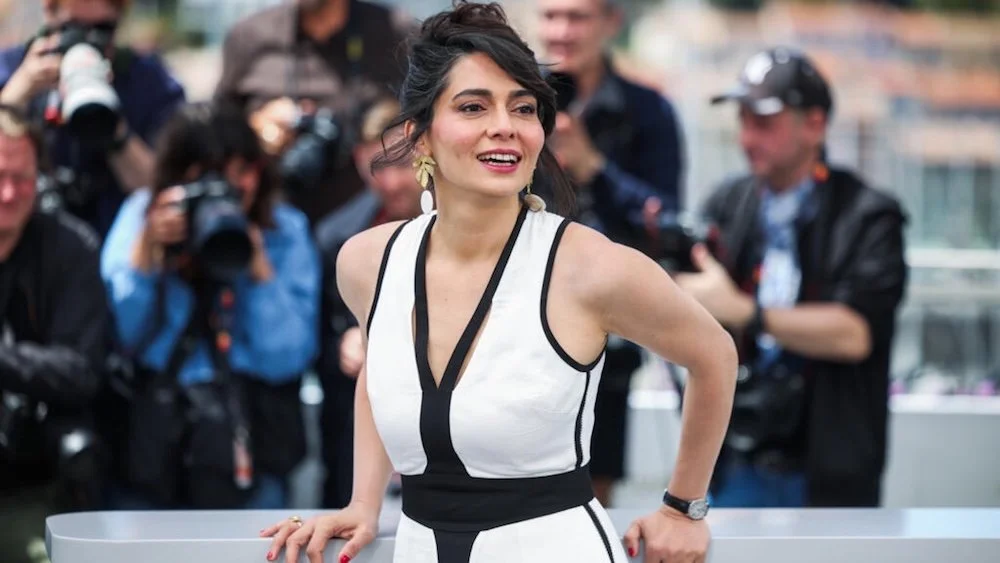
What was the spark of the idea for this film?
Pegah Ahangarani: Well, it all started six years ago. I first started practising in a way with a short film, that was called I'm Trying to Remember and the common idea between this film and the short was to work with archives, having the subjectivity of the archives with a voiceover narration. The short ended up being the first chapter of Rehearsals for a Revolution and this gave me enough practice, and enough boldness to make a feature film.
Most filmmakers, also in documentaries, put a bit of fiction? Are there parts of this documentary or moments where you've introduced something for the sake of narrative?
Ahangarani: Of course, that's a necessity as long as you're creating your story. I mean, the audience, the person you're addressing needs stories. Even if you give them the most spectacular, the most unheard of event or fact, it needs a story, it needs all the intensity of a dramatic construction. So although everything, all the facts about Iranian history are true, all the characters are true, what happens to them is true, but then I really treated each of these chapters as a story that I had to tell. The way you built the dramatic arc of a story, the way you connect them to each other, all this was designed as short stories that I was developing.
What I find fascinating, and this is the case in Jafar Panahi’s films for me as well, is that although you tell a tale filled with accusations, we as the audience grow really enamoured of Iran, because we see the people, and we learn about the people. So did you always set out to make a film that would make us learn more about the people?
Ahangarani: Well, of course this is something that I have felt that we Iranians, like all people in the world, are known through media, through information, through figures. I mean, it's the same, we don't know about other people, and we just hear them as some headline, 10,000 people killed in Iran. We don't know who these people are. They are nothing but an abstract element. But then when you tell the story of people, when you know how a person was born, what their childhood was like, what they did in their life and how they finally died, then you care more about it — even this one person dead — than all this amounts of people who you cannot really connect to, you cannot understand, you cannot imagine. So that's the question, in order to be interested in the fate of one individual or a whole people, a whole nation, you need to know their stories.
In the last couple of months, your documentary has gained poignancy because of the events that are happening. And like you said before, the 10,000 people who are killed, suddenly have a face through your documentary. But is there something that you wish you had kept in the film now, after hearing about, you know, the latest invasions, in the current war on Iran?
Ahangarani: Maybe I could have wished for another ending. Or another form for this fifth chapter under different circumstances, but as a matter of fact, as I was making it, as I was rapping the film, these events happened. One massacre, one war, and I was in a state of shock. So I think there was nothing more honest, nothing more relevant than showing this. Because when you receive such news, when you are confronted by such tragedies, you're completely helpless. You are completely in a state of confusion, not knowing what you should do. So it didn't make sense to try and avoid it or try to make sense or make it look as if I had more distance. I had no distance. I was in the middle of this state of shock. So for me, it was obvious that I had to put in this level as uncertainty, of not knowing what I should do, that was the only thing that could actually fit in this fifth chapter. And in retrospect, I think that it makes sense, as the tone of each chapter belong to its time, to its contents, it was very relevant and very fair to have this tone for the fifth chapter. And I don't think that if I could have waited one year more, to take more distance with it, it would have been more relevant.
Talking about the tone of the chapters, how did you structure it?
Ahangarani: The contents and the tone of each chapter was dictated by the restrictions — by what we had and what we didn't have. And this was obvious from the beginning, that for some characters or some events that I wanted to deal with, I knew that I had no material and what I wanted to show in this chapter was the absence of material. So the way we worked for each chapter is that I had a general idea, I had written text, I had a general idea, but then it wasn't that I gave the script and I gave the material, the archives, the footage, and my editor had to edit it. It wasn't this at all. I came up with the idea and then we started seeking, trying to find the corresponding material. For the episode, for instance, at school, with the the teachers, the head mistress, it was a gloomy afternoon in my school. Of course, there was no image about it. So we thought, okay, what shall we do? Let's go and dig into the animation films of our childhood. And we went and freely looked at all the Disney animation films and afterwards we realized that there was a copyright to pay to Disney. And that was very expensive! We couldn’t use them, so we have to change them all and we had to learn how to make animation ourselves just because we couldn't afford the rights to what we had chosen. For others, every time, we would go and find photos, archives, and then the archive dictated to us the story. We adapted the story to the images that we had. We really had to weave it. It was back and forth between the narrative from one side, the images from the other to create, based on the images, the structure, and the content of each chapter. That's what we did all the way through.
What do you think is the role of cinema in times like these, and how does a festival like Cannes help in that mission?
Ahangarani: I think cinema, like any other art form or any other media, has this power of telling stories and touching people's hearts. As I said, unlike the news, if you want not just to view people as some figures or some general notion, but rather tell stories that leave room for some empathy, room for some understanding and touching people’s hearts, of course, cinema and art is the best form for that. And the Cannes Film Festival, of course there is the excitement of being here and feeling is important because your film is selected in Cannes, but this is really marginal. Because for me, the main purpose of Cannes, and the interest for a filmmaker like me, is that it gives more exposure to my film, my film gets seen more, and that's the reason why it exists, of course, so that's very important.
All images courtesy of the Festival de Cannes, used with permission.