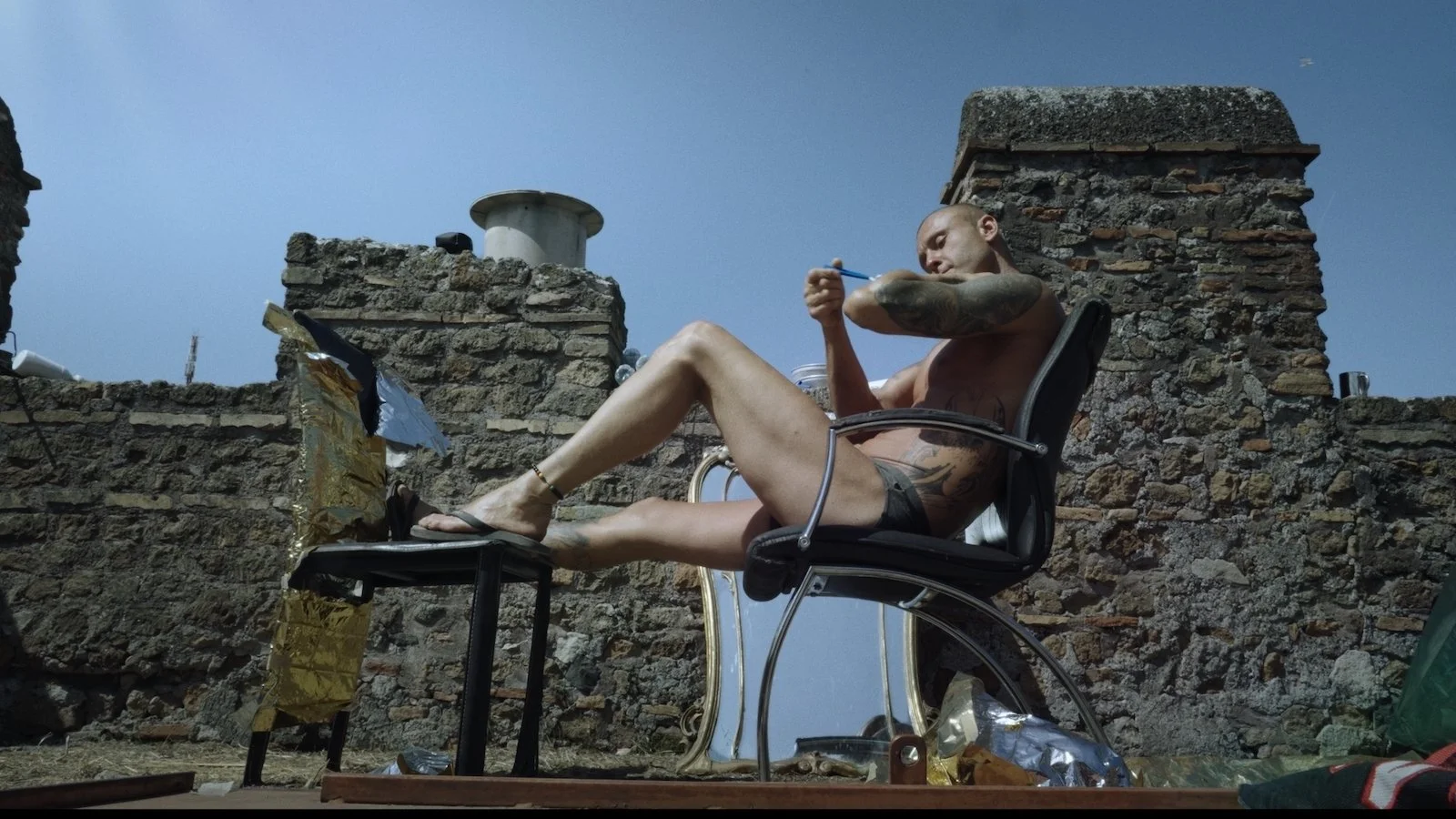
It is rare to encounter a film that is so utterly honest and true to its subject, no matter how difficult a tale that is to tell. Gregorio Sassoli and Alejandro Cifuentes, the duo behind the documentary ‘Saint Damian’ have managed such a feat, and in the process, have created a masterpiece that will crack open some much needed truths, all the while conquering every heart in the audience.
Very quietly, Saint Damian came into my life. It sounds like the beginning line from a nun’s personal story, but it is instead the start of the tale of how a film can enter one’s consciousness for very “mundane” reasons, and end up burrowing into one’s heart and thoughts forever after viewing it. I was asked to moderate a Q&A with the filmmaker(s) of the documentary Saint Damian (‘San Damiano’ in Italian), which world premiered at the 2024 Rome Film Festival, to critical acclaim, and has just screened as part of the Raindance Film Festival in London. That’s how simply the magic started.
To prepare for the task, I was given a link to the film and watched it one afternoon, lost in its portrayal of the nameless faces that populate Rome’s Termini Station, the main train terminal for anyone traveling by land. Italians use trains more than airplanes to get around our boot-shaped peninsula and Termini sees more than its share of tourists and business travelers. Yet what happens just outside the tracks, and the rubber-paved corridors of the main terminal — the concourse is sprinkled with restaurants and shops that range from the local newspaper outlet to world brands like Nike and Eataly — remains something of a mystery for most who use the station. Not so for Romans though, and especially those who live in the bohemian neighborhoods around the station. They have seen the community made up of beggars, homeless people and junkies who populate the area around Termini Station, yet they probably wouldn’t know their names.
Until now.
With Saint Damian, Gregorio Sassoli and Alejandro Cifuentes give names to the nameless, stories to the homeless, visibility to the invisibles and hope to the hopeless, communally brought down by a vicious cycle of addiction, societal refusal and street violence, only too common among what the British call “rough sleepers”. While the duo’s stunning, hard-to-look-away documentary focuses on a Polish man named Damiano, and his close circle of fellow misfits, this story could have been cut and pasted from all over the globe, from NYC’s Port Authority, to Paris’ Gare du Nord. We’ve all seen them, as they stop us to ask us for change, or trail in front of us scoping out the streets for a cigarette, a meal and, maybe, a score.
Sassoli and Cifuentes originally went to Termini to research another story, already intrigued by the encounters they had made while volunteering around the station for a charity. One day, they ran into a man, dressed in a suit and holding a tablet, who impressed them with his banter. That man was Damiano, a Polish refugee who had come to Rome looking for something, something even he could not exactly pinpoint. Maybe it was the Italian movies he’d watched as a child or perhaps Rome’s mysticism as the center of the Roman Catholic kingdom that had drawn this man, who had escaped from a mental institution in his native country. A self described “devil or god,” depending on the day.
Homeless himself, Damiano further intrigued the duo of young filmmakers by telling them he didn’t sleep on the ground, rather he occupied an ancient Roman tower, part of the Mura Aureliane, the original walls of the city of Rome. Without thinking twice, Cifuentes was quickly climbing up the scaffolding that the city had put up around the walls and which Damiano himself used as his own personal staircase to heaven. That was the beginning of a documentary which wiped out any other project and took over Sassoli’s and Cifuentes’ lives for the foreseeable future.
Although the filmmakers credit US-based Italian director “Roberto Minervini and documentaries such as On the Bowery,” a 1956 Oscar-nominated docufiction film by Lionel Rogosin as their inspiration, I can also personally see some of Gianfranco Rosi’s Below Sea Level in Saint Damian, along with Federico Fellini’s La Dolce Vita. Anytime a film about Rome has a fountain scene, Fellini’s oeuvre comes to mind, and this film has a fountain scene, albeit it one that sees the drug addicted, brown-haired and much less sultry Alessio in the role of bombshell Anita Ekberg. The sweet life is switched for the rough life, black and white film for color shots, yet as soon as those feet hit the water, it was a go for me!
There is also a hint of Agnès Varda‘s Sans toit ni loi (‘Vagabond’ in English) which blended fiction and reality to create a haunting story of personal isolation, despite living in an increasingly chaotic, and overpopulated world.
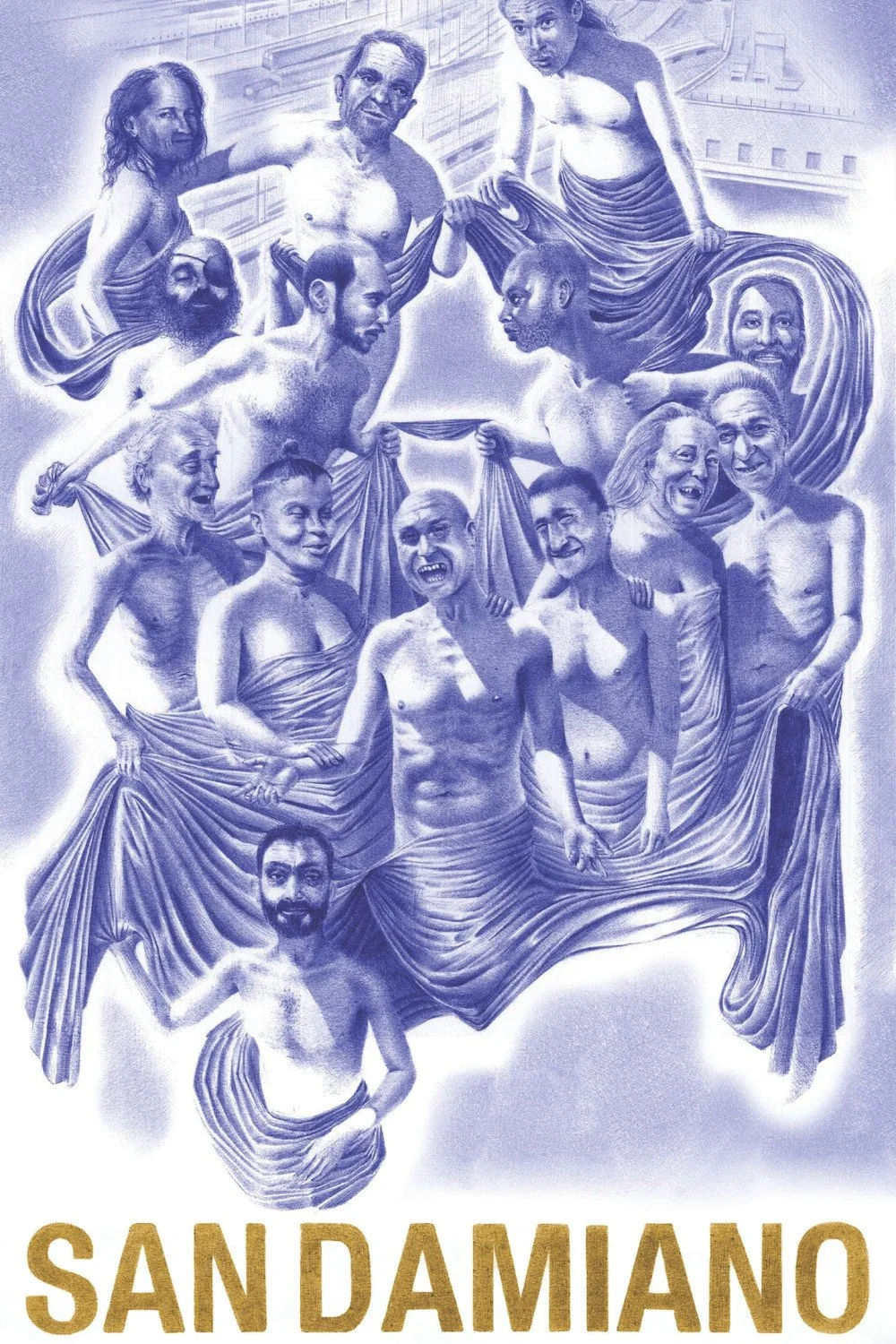
The Italian poster for ‘Saint Damian’
Beyond evoking so much, Saint Damian is first and foremost a brilliantly made film about a man who navigates a community, culture and world that do not belong to him. And he doesn’t belong to them. That’s the core of this story and once again, who among those reading this doesn’t recognize hers or his own self in that statement! I certainly do, born in one place, grown up in another where I didn’t even speak the language at first, and now living somewhere else, entirely new. All the while, possessing a serious case of imposter syndrome augmented by the advent of AI and a shrinking profession flooded with boney-elbowed influencers taking over the game. That Damiano wants to make it as a rap artist, and is “not an accountant” as he declares exasperated at one point, is only the icing on this cinematic cake. This is a story about desires gone awry, about being born in wrong body, in the wrong country, at the wrong time. And there is nothing anyone can do about it to right that wrong.
Just as any fairy tale, because for a film to hit my heart there has to be a kind of fable at its core, Saint Damian is complete with a princess, to Damiano’s prince. She is Sofia, an American-sounding drug addicted homeless woman who at times betrays an intelligence and savoir faire that reach beyond our understanding of her predicament. “He asked me to live in his tower,” she tells the camera, which made her feel like a princess, although the mentally unstable Damiano soon hits a wall, and in the process Sofia too. This is a violent community, where people smash car windows to let out steam and hit one another to settle scores, hardly the postcard-like image of Italy that is sold to tourists worldwide to entice them to bring their money to Rome. At times, I sat on the edge of my seat watching the film, imagining how the filmmakers must have felt, observing something that could easily have escalate out of control in front of their very lens.
When I asked Sassoli in person, during our Q&A session, if he and his co-director ever felt like interfering or stepping away, he confessed that during a climactic moment in the film, they had to “reenact” the scene, as they thankfully were not there filming the day it happened.
I won’t give away the ending of the film, or where Damiano is today. You can probably Google that and find out, but if you have a desire to watch the film, I would suggest you don’t search for answers. This is a film that needs you, requires of you to give all of yourself while watching it, leaving judgment and what you believe you know about this only too common story packed away. And when you do watch it, you’ll thank me for recommending it.
What I can give away from the ending is that a favorite song by Edoardo Bennato (see video above) plays as the credits roll and we see the names spelled out of each protagonist of this story, including the two intrepid filmmakers.
But I can’t leave you just yet, not before I call it a masterpiece once again.
There I said it — now this review is complete.
Saint Damian was produced and distributed in Italy by Red Sparrow SRL.
Images courtesy of the filmmakers, used with permission.