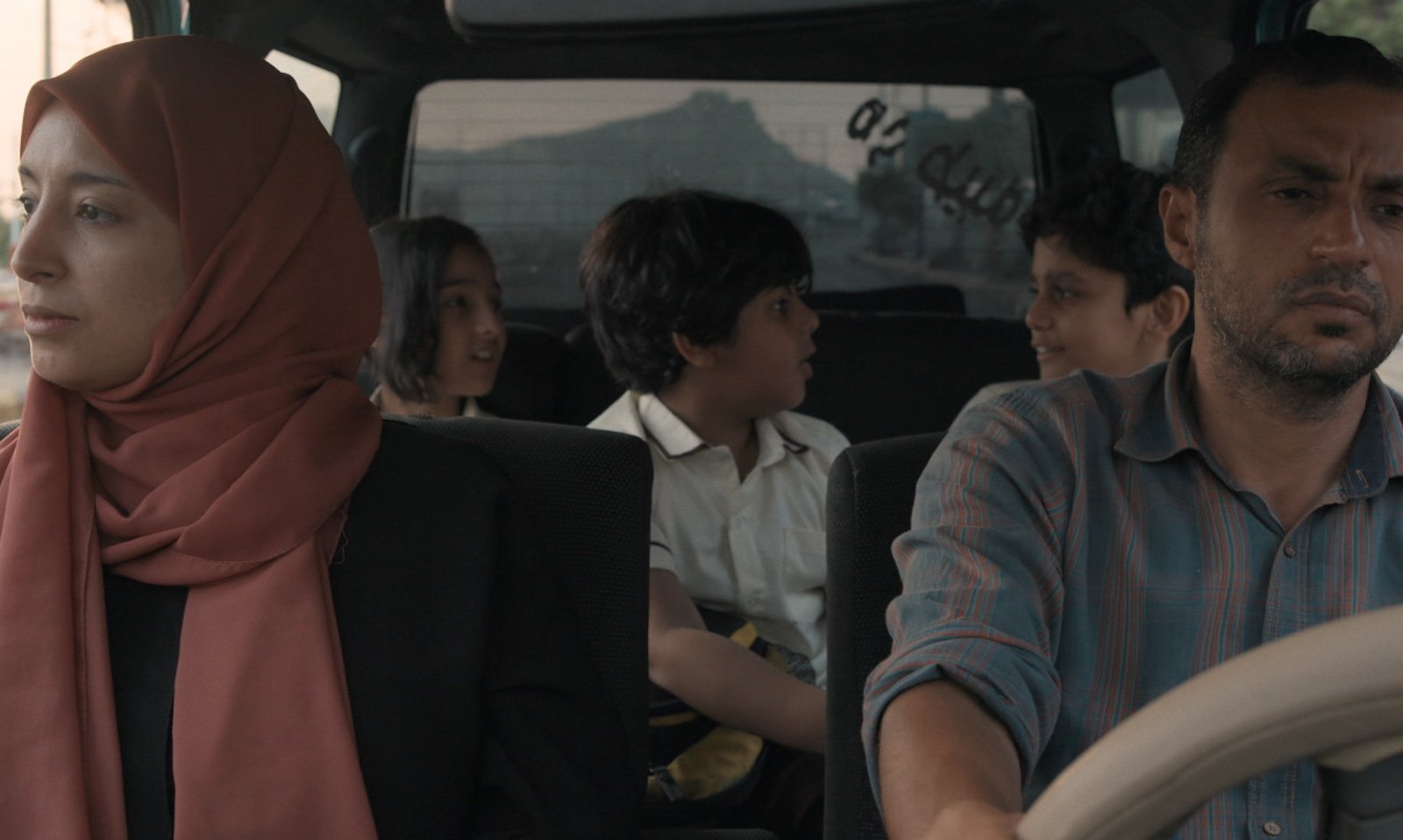
The Yemeni film, which screened in the Panorama section and won the Amnesty International Film Award at this year's Berlin Film Festival, is a groundbreaking oeuvre which transcends the already strong power of cinema.
Amr Gamal's stunningly shot feature The Burdened ('Al Murhaqoon' in Arabic) belonged in the Berlinale Competition. There I've said it.
The Yemeni / Sudanese / Saudi funded film instead screened in the Panorama section, which by its own standards, screens "extraordinary cinema" and "is explicitly queer, explicitly feminist, explicitly political – and at the same time seeks to think beyond these categories - always looking for what is new, daring, unconventional and wild in today’s cinema."
Starting from its funding structure and moving across content and themes, The Burdened is a groundbreaking oeuvre which transcends the already strong power of cinema. To all who follow MENA news, the idea of a film from Yemen, the southern city of Aden specifically, funded in post-production by the Red Sea Fund from Saudi Arabia seems like a miracle. And Gamal confirms to me, during our interview inside the Berlinale Palast, that his principles and the script were not questioned by the Fund. "My thing is, if you don’t interfere in my script and don’t tell me what to write and not to write, then we are fine. It was just a post-production fund and they [Red Sea Fund] liked it."
The Burdened is also co-produced by Sudanese filmmaker Amjad Abu Alala, whose own 2019 feature You Will Die at 20 was the official submission to the 93rd Academy Awards from the Sudan. Abu Alala's co-producer Mohammed Alomd'a also shares co-producer credit on Gamal's film, along with Gamal himself and Yemeni-American producer and TV presenter Mohsen Alkhalifi -- both credited as producers on the project.
The story of The Burdened centers around a couple in Aden, who are faced with the idea of bringing a fourth child into their world -- an already difficult existence. Ahmed and Isra'a can barely support their three kids, and they must make a decision that will impact both their lives but also their beliefs. In Islam, as in most religions, abortions are "haram" -- forbidden -- looked upon as a sin. Yet when they dig deeper into the Holy Book, the Quran, they discover fatwas that allow the procedure, in theory, until the 120th day. It is upon this fatwa that the couple base their actions and once they have personally accepted the idea, they must then begin the arduous task of convincing those around them to accept it too. As well as one doctor who is needed to perform the operation.
The film brings into play the power of our community's hold on our decisions and how important not only our beliefs are in carrying forth our actions but also what the opinions of our neighbors, friends, family will be once we have made our peace with our decisions.
Gamal explains the inspiration for the film "I have a friend, I’ve known for a long time and I knew when he and his wife tried to abort their third child and they were afraid of religion and felt guilty. They tried and felt like everyone was refusing to do the abortion for them. They themselves were also afraid they were doing something wrong. And once that child came, I was around them and saw how the husband, my friend, treated his third child. Even if he’s an Arab father, his two daughters, the first two, he loved them. And he hated the boy. He was calling him 'burden'." That was in the middle of the Arab Spring revolution, Gamal explains, and from that time everything started to collapse, "there was no state and so they couldn’t ’t afford this third child but brought him into the world because they were afraid -- of the religion and the community. We have a saying “the child comes, and God gives…” which is not true," Gamal concedes. Children are expensive, financially and emotionally.
"I was traveling to the U.S. to screen my first film, and I was in Abu Dhabi airport and received a WhatsApp note from my friend, where he said 'I didn’t tell you 'cause you were traveling but my wife was pregnant and we did it, she had the abortion'." This was a fourth child on the way and that simply seemed too much to bear for the couple, already strained by the financial "burden" of having three kids. "On the airplane for the whole fifteen hours, I was thinking about this story," Gamal admits, "and asking myself how they did it and when I arrived in Washington D.C. I called him. And he started to tell me how brutal it was and how hard it was and what struck me was how they started to find the space in the religion." He explains, "they went through the fatwas, one says on day one it’s forbidden, another says that before 40 days it’s not forbidden. And another, that before 120 days it’s not forbidden, so they went with the 120 days one. So they would have time… This is how people manage when they need to survive."
I ask the soft-spoken, kind Gamal if his magnificent film is also a commentary on how religion, particularly Islam, can be interpreted in different ways, according to how the words are read and understood. "Yes, because that’s how my friends changed their minds," he continues, "those who know Islam well will also recognize some lines in the script, we have this phrase in the Quran which says that Al-Khidr received a prophecy to 'kill that boy, because he will burden his parents in the future'. So Ahmed says to his friend, in the scene after signing the lease to the new apartment, 'Al-Khidr did it'." In the film, Ahmed's friend replies that Al-Khidr was a prophet and Ahmed is not, which of course is how religion typically explains things that are out of the ordinary, to ordinary followers.
While we talk, I address the fascinating assortment of financial support that the film benefits from, which includes the above-mentioned funding from Saudi Arabia. "We applied," Gamal admits simply, then explains his POV, "I always feel like, artistic wise, we should not mix things," meaning politics and the arts. "As a country, we have a big problem with Qatar as well but I don’t have a problem with the Doha Film Institute. If we start to think of those we have problems with, I will never come to Berlin or Europe because they are selling weapons to fight in my country. I think we should separate art and politics," a wise thought by the wise-beyond-his-years filmmaker. I've always thought artists would make much better politicians in this world.
Casting in the film, done by Gamal himself, is absolutely brilliant, as is the cinematography by Indian DOP Mrinal Desai, whose previous credits include the award winning Court (2014) and Pryas Gupta’s Siddharth. As well as the editing by the fantastic Heba Othman, the Egyptian editor responsible for the seamless transitions of You Will Die at 20 and other award-winning films. The soundtrack is by Ming-chang Chen (Maborosi by Kore-eda Hirokazu) and location management on the project is by Hussain Anwar, who also plays Wajdan in the film. Sound design is by the brilliant Rana Eid.
I ask Gamal about his actors, and how he could find them in the landscape of a country that doesn't currently have a cinema culture. Turns out what Gamal calls "very cheesy television" in Yemen was where he sourced most of his actors. "For my casting I chose some who were already actors and some newcomers and some of them, like the leading actress [the perfect Abeer Mohammed], had two or three lines in different TV serials. I really wanted her because she has this kind of innocence and doesn’t possess the burden of overacting. Also the doctor [another perfect casting coup, Samah Alamrani] was in a TV series and this was her second role and the actor who plays Ahmed [Khaled Hamdan] is a professional." Gamal remembers to add, "the nurse [Manal Alshebany] was the make up artist and I liked her."
Will The Burdened screen in Yemen, where the story could turn out to be a controversial subject? "Yes," Gamal assures me, "if I don’t do it, I will not be a true artist. If I did a film in my city, I must show it in my city and in my country. And I should accept if they like it or not like it. But not screening it means I didn’t make a real film -- I respect the filmmakers who have tried and are refused, in many different countries, but at least they tried."
Controversial because there are many layers to this stunning film, which to an Italian with roots in the southern city of Naples, possesses the kind of beauty we often associate with our traditional Nativity scenes -- "Il presepe napoletano" -- taken out and put on display every Christmas and which adds gravitas to an already powerful film about the meaning of an abortion within a family. "The story was one I wanted to tell and wanted people to know about," says Gamal, about "how we sacrifice every day. I always say that abortion in Arabic literature comes with dreams and a future. When we want to say 'I couldn’t achieve by force my dreams', we use the word “abortion” in Arabic literature — 'they aborted my dreams, they aborted my future'.”
And finally, what would Gamal like audiences in Berlin to take away from his film? Aden, as a character in the story, it turns out. And Gamal explains further, "even if it’s the “burdened” side of Aden, because in Aden I could show you things that would make you want to travel there tomorrow. But the burdened side of the city, and those old buildings, every single building, every single outdoors scene is completely organized, it’s not by coincidence. It features a building that I’m afraid tomorrow I may not find there anymore. A building that either I have a personal relationship with or is part of the history of the city — with hundreds of years of civilization before we went through all these problems in the 90s, and the collapse of modernity and light into darkness that happened after the unification with the North -- those places are important."
Wisely, he concludes, "I always say countries that don’t have cinema have Alzheimer's. Because there is no memory— cinema is the memory. I want to participate in keeping something for the future."
The Burdened is sold worldwide by Films Boutique.
Photos © Adenium Productions, courtesy of the Berlinale and used with permission.
** This article was originally published on MIME.news, on Feb. 27th, 2023. The site was bought in May of 2023 and subsequently shut down by its new owner.