
Let me preface by writing that I tend to be sold right away on a film that features an exceptional woman as its central heroine. When that woman is a real life figure, still going strong and advocating both women’s rights as well as nature’s preservation, well the film immediately drives up to the top position of my favorite films. More on such a film, ‘The Woman Who Loves Giraffes’ in a minute. First bear with me and my mini trip down memory lane.
My personal anecdote on giraffes is a tiny snapshot of a morning city safari through Nairobi’s National Park, in 1998, when I was promised lions by my mom and our guide and instead I got the curious stare of a pair of giraffes while I peered out the back window of our car. Here they were, majestic and tall, beautifully hued and perfectly behaved and their sight left me breathless. I still yearned to view my beloved lions afterward — though they remained elusive.
I captured the eye-level kind stare of the giraffes — we were on a slightly higher plain in our taxi and thus their faces were almost on par with ours — with my camera, before iPhones and digital photography. Various moves across several continents later, I can’t find the iconic shot. But the memory is embedded in my heart. Those animals, in retrospect, were exactly what I needed to see in that park, on that day. Because nothing is quite as stunningly beautiful and impressively elegant as a giraffe, it turns out.
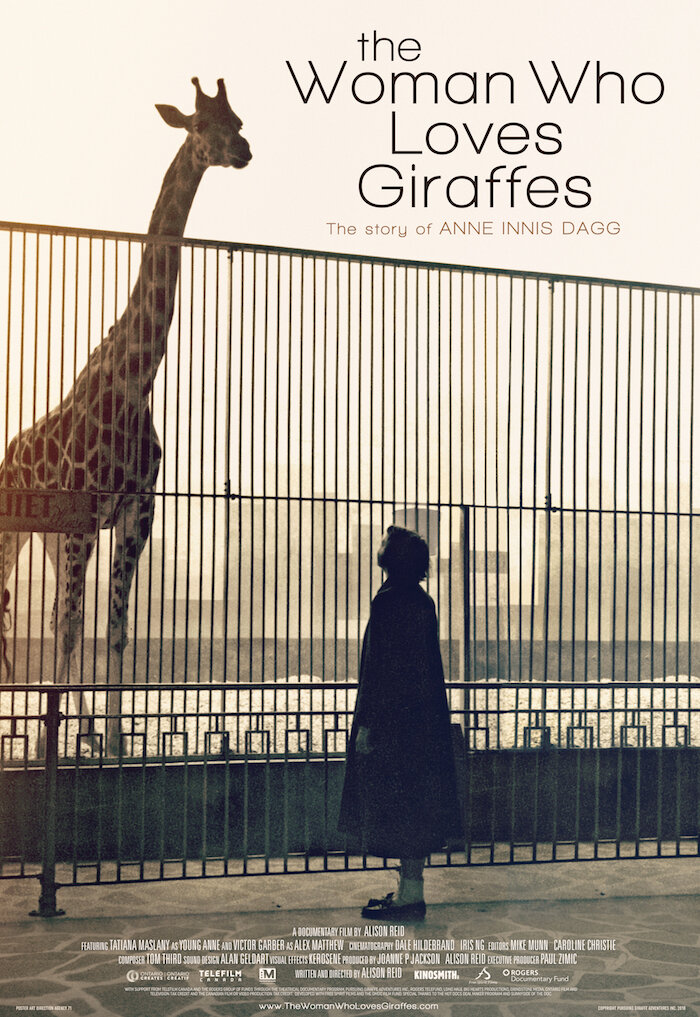
In her perfectly made documentary ‘The Woman Who Loves Giraffes’ Alison Reid paints a flawless portrait of the giraffes and the woman who is responsible for all the scientific knowledge we possess today about these incredible looking animals — the great Anne Innis Dagg. At 86 years old, Dagg is a legend, yet a subtle and quiet one who, until now, hasn’t been given all the respect and notoriety she deserves.
Chronologically, Dagg came before Dian Fossey and Jane Goodall, even in her approach to Louis Leakey, who turned down her request to work with him for her field studies on giraffes. In the synopsis for the film, they explain that “in 1956, four years before Jane Goodall ventured into the world of chimpanzees and seven years before Dian Fossey left to work with mountain gorillas, 23-year-old biologist Anne Innis Dagg made an unprecedented solo journey to South Africa to study giraffes in the wild.” Dagg did manage to find a way to pursue her research and continued to author several books about her studies, including ‘Pursuing Giraffe’ her autobiographical writings which have inspired this documentary.
Yet today, both Fossey and Goodall are much more known to the general public because, it seems, monkeys and primates are closer to man and thus more “interesting” to humans. It’s this point that Reid astutely makes in her film, that audiences — the general population at large in this case — go for the familiar and what is, how shall I say it, sexy. After all, I myself yearned for the lions on my visit to Nairobi and felt almost disappointed after only viewing some zebras and those two beautiful giraffes. It’s only now, more than twenty years later, that I realize what a special moment that was and how lucky I can count myself to have witnessed it!
Reid mixes modern interviews with Dagg and several zoologists and biologists who have crossed her path, along with archival footage that Dagg shot herself in her early years of research, as well as voiceover readings of the letters she regularly sent home — to weave together the story of a woman who was grossly overlooked for most of her life — simply because she is a woman. I broke down a few times during the film, as I could see a lot of the struggles that most of us who work in male-dominated fields face, reflected in Dagg’s struggles. She successfully balanced being a wife and a mother with her passion for the freedom of her work, and when she had to give that up due to plain ol’ chauvinism and various obstacles placed in her way, her pain felt real and very personal.
Here is this biologist, a scientist, who was denied tenure, in many cases turned down for jobs she was overqualified for and all because she is, was and always will be a woman. Wow. Take a moment to let that sink in. If that doesn’t strike a chord with every woman viewer watching this film I don’t know what could.
There were of course enlightened men dotted about the landscape of Dagg’s work in research. The first and most important, her beloved husband Ian Dagg, a physics professor, with whom she had three children. And also South African citrus farmer Alexander Matthew, who owned Fleur de Lys where she did her field research. A man reluctant at first to accept a young pretty girl in her early twenties on a farm populated by male workers, but who later became Dagg’s greatest ally. He even insisted she borrow his camera to film her encounters with the giraffes, thus helping to create some of the most unique footage in the documentary.
Today, I believe every documentary that is made becomes both a testament to the extraordinary life of its subject and a cry for human beings to do better, now that we know better. ‘The Woman Who Loves Giraffes’ is no exception, as these beautiful animals are currently at minimal numbers in the wild, less than 5,000 compared to the 28,000 alive in 1998 — incidentally, the same year I was in Nairobi! These whimsical creatures with those stunning long necks are being hunted for bushmeat by African farmers who are dying of hunger. How did we ever come to this? Some of the answers you will actually find for yourself in the film…
Dagg also powerfully advocated for women’s rights, fighting the anti-nepotism rules in Canadian universities that automatically excluded spouses of male professors from applying for a job at the same school. “According to Dagg, anti-nepotism rules, whether formal or unspoken, combined with a reluctance by universities to hire their own PhD students doubly hindered the wives of male faculty,” I found highlighted on Wikipedia.
But don’t take my word for it — about how great ‘The Woman Who Loves Giraffes’ is. As Emily Russo and Nancy Gerstman, Zeitgeist Films Co-Presidents said "this expertly made film hit all the right buttons for us: a fascinating unknown story of a remarkable woman, scientist, feminist and naturalist, which left us both furious at a career derailed, and elated at this belatedly happy outcome for Girafologist Anne Innis Dagg. We are thrilled to share her story with U.S. audiences and bring her important overlooked work back to the fore where it urgently needs to be.”
The documentary features the voices of Tatiana Maslany (Orphan Black), the divine Victor Garber (Argo, Milk, Titanic), David Chinchilla (The Expanse) and Lindsay Leese (Bomb Girls) reading letters written by young Anne, Fleur de Lys manager, Alex Matthew, Anne’s husband, Ian Dagg, and Anne’s mother, Mary Quayle Innis.
Zeitgeist Films in association with Kino Lorber acquired the U.S. rights to ‘The Woman Who Loves Giraffes’ and the film will screen starting January 10th at the Quad Cinema in NYC and February 21st at the Laemmle Theatres in Los Angeles. For more dates and additional cities, check out this website.