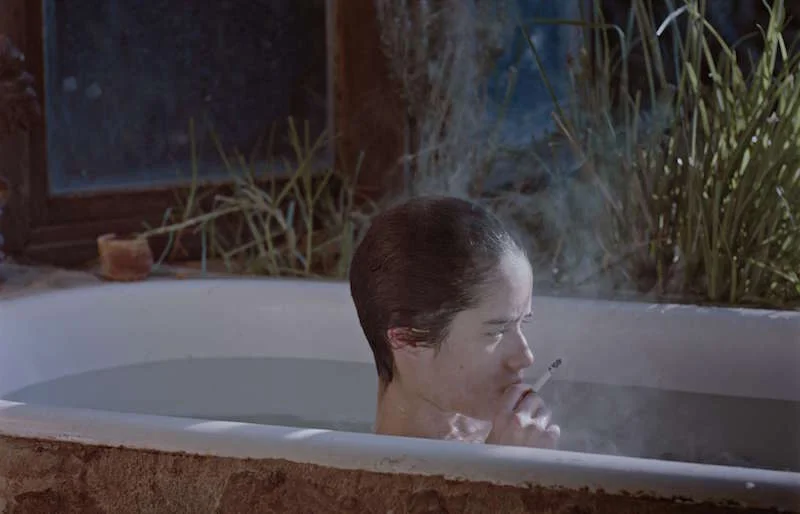
It was the film I most craved to watch at this year's Locarno Festival, and it happened to be the very first film I watched here. It didn't disappoint me!
Dominga Sotomayor's 'Too Late to Die Young' ('Tarde Para Morir Joven') is a beautiful shot, strangely evocative and perfectly soothing piece of filmmaking. Yet it somehow has stayed with me throughout the festival, a meter by which I have been judging everything else I've watched in Locarno.
Sotomayor's film tells the simple enough yet unusual tale of a teenager, Sofia (played by Demian Hernandez) coming of age in a commune on the slopes of the Andes just above Santiago, Chile and the surrounding cast of characters that accompany her journey all the way to the final climax of the film. It is accented by this etherial cinematography and cool sounds and you can't help, as an audience member, but become wrapped in nostalgia. In this film's case, unlike a Syrian filmmaker once said to me when I interviewed him for his work, childhood is a geographical place and Sotomayor brings us there to experience it along with her. It's her memories of growing up in a community very much like the one in the film.
I caught up with the cool and self assured Sotomayor in Locarno where the film screens as part of the festival's International Competition.
With all this talk of equality and wanting “50/50 by 2020,” how there aren’t enough women filmmakers in competition at that festival and the other festival, what always strikes me as fascinating is that women filmmakers usually see themselves as simply “filmmakers”. They feel they belong to a community and so I wanted to know from you what your thoughts are about this. And are we making it too big a deal?
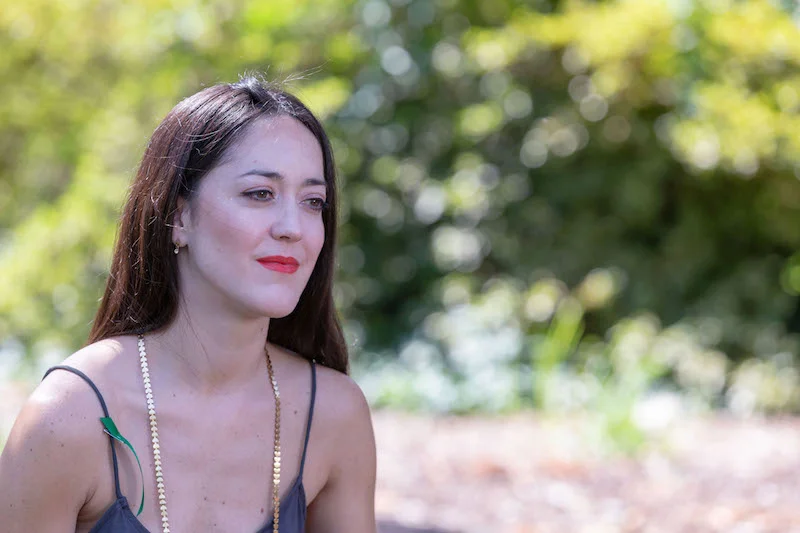
Photo: Locarno Festival / Massimo Pedrazzini / Massimo Pedrazzini
Dominga Sotomayor: As you say, I am always asked “how do you feel as a woman filmmaker, how do you feel as a Latin American filmmaker, as a Chilean filmmaker” and for me I feel I'm a filmmaker. I’m just doing what I can react to, it’s really a natural approach. But on the other hand, I’m happy that all these movements are happening because I think there is a sickness, there is a problem we have to solve and maybe this is the way to talk about it.
For me cinema is so far from nationalistic, groups or gender definitions. And for me this film is also about that, these “un-definitions” and crossing these borders.
You feel first as a human, rather than a woman.
I know your film is somewhat autobiographical and so I wanted to know from you, how was it growing up, in this very interesting and unconventional set up?
Sotomayor: For me, I had a life of contrast. I was in this very Catholic school, living in this very strange place, I think my life has been very much in contrast and kind of in an uncomfortable place which is difficult to describe. And that determined my life a lot and my work, also in terms of classes really since Chile is very classistic. I’m in the middle of this traditional family but at the same time living a very particular life. And that made me as I am, being able to live in very different situations.
I think it’s just as life is, beautiful and difficult at the same time.
If you hadn’t been a filmmaker, what do you think you would have become?
Sotomayor: I’ve been very dispersed always, I like many things. I wanted to be an architect.
It’s interesting how many filmmakers wanted to be or have been architects!
Sotomayor: My mother is an actress and I always felt I grew up in this world of theater and had artists in my family but my aunt was an architect and she was the smart one. So I wanted to be like her. Also I couldn’t imagine myself being an actress and I didn’t like it. And I like the spaces… I think it has to do with cinema a lot, also I think the work is very similar — you imagine a place.
I guess it’s this concept of building something complete from nothing, from the ground up — films and buildings.
Sotomayor: If I could paint, I would love to be painter also.
Filmmakers who, like you, also write, tap into two very diverse sides of their personalities I feel. The writer is solitary while the filmmaker has to work with people, many people. How do you reconcile those two sides?
Sotomayor: It’s what I like in filmmaking, you can be alone for many days writing and then you have to confront this group. I really like to be alone but when I’m writing I’m already working in images. So it’s not just writing, I’m building spaces. When I start writing I have these images that invade me and then I’m grouping the images and writing. I write very fast. I don’t sit at my computer for hours. I’m traveling, thinking and accumulating and then when I arrive to write I’m quite clear of what I wanted to write.
How did you choose to tint the film in those very particular hues? As much as your film hit me emotionally, the look of it has stayed with me a lot. It’s so beautiful visually.
Sotomayor: So I found these VHS tapes from when I was little. From 1991, and I found them twenty years later, it was our neighbor recording the event that happens at the end of the film. And it was very cool and the images are amazing. Quite professional. This was the starting point of the image and I actually made an exhibition of these VHS. I asked if I could make something with it.
What I like in VHS, it’s not just timeless and saturated with color, you pick some of the colors. So in the color correction with Inti Briones who is the DoP, we were really obsessed with rescuing red. Trying to get the essence of what happens with VHS so there are colors, but there isn’t much blue, we turned the blue down. As I told you before, I’m first captured by images and very obsessed with colors and framing. So I was working very closely with the art director and the DoP and I have been collaborating with them on past projects.
And you and I first met at Qumra in Doha, so I wanted to know at which point and how the Doha Film Institute came on board?
Sotomayor: I think this film exists because of this international cinema world. I’m very thankful to all the structures that made this film possible. The last we got was DFI, we applied in January but we sent a cut of two hours, without color grading or anything. And they gave us an award for post-production. It was very good and we were able to finish the film with that and they also invited us to Qumra. I think it was very special because I’d been to all these encounters before but Qumra was more human. I met people there I’ve become friends with… Also, for me it was special because even though we only showed twenty minutes of the film it was the first time we opened the project to the audience, the industry.
Finally, if an audience member can walk away with only one message or theme or even an image from your film, what would you want them to take away?
Sotomayor: Someone told me “thank you, this film made me remember things I had forgotten,” and I’m always looking to make film that don’t close, give you the space for you to complete it. I bring you this image and you can do with it what you want.