
If you google the film ‘Yeh Ballet’ you’ll find that the Wikipedia short description reads like this: “Discovered by an eccentric ballet master, two gifted but underprivileged Mumbai teens face bigotry and disapproval as they pursue their dancing dreams.” And those sort of stories are always the best kind — yet Sooni Taraporevala’s film goes one step further. Or rather several beautiful, seamless dance steps further.
As someone who had fallen in love with Taraporevala’s heartfelt way of making films through her directorial debut ‘Little Zizou’ — a childhood story taking place in the Parsi community in South Bombay — ‘Yeh Ballet’ only intensified this cinematic love story.
For one, ‘Yeh Ballet’ has at its center British movie star Julian Sands, in a role he was simply born to play. Grumpy and eccentric, with a lean body and a heart of gold Sands inhabits the role of Saul, based on real-life Israeli ballet teacher Yehuda Maor, so perfectly that one wishes… well let me get personal here, I wished I could go back to ballet class. The two other protagonists are the young dancers, Manish Chauhan playing himself, or rather a character named Nishu based on Chauhan himself and Achintya Bose playing Asif, the fictionalized version of real-life dancer Amiruddin Shah. Everyone loves a rags to riches story but when the story bring “riches” in terms of culture and a discipline like ballet that blessing feels doubly charged. No one like Taraporevala knows how to tackle stories about young adults in a way that brings their struggles out of the talked-down typical cartoon teenage characters created by filmmakers older than their subjects’ age. And she catapults them into a sphere where we, the audience feel completely immersed by the film — we almost return to the age of the protagonists and feel the emotions of finding our life path for the first time — just as they are maneuvering through it. I certainly dreamt dreams of ballet for weeks after watching ‘Yeh Ballet’. And the magic of Taraporevala’s film, the incredibly charisma of its young interpreters and the stunningly perfect Sands are all still with me more than a month later.
Sands pointed out his own attraction to the story, when I interviewed him back in May for Thrive Global. “The script, when I read it as soon as Sooni sent it to me, there was no question — absolutely committed to wanting to play Saul,” he said. He then added about ‘Yeh Ballet’, “I found the film incredibly moving you know, the poetry of it, the truth of it, and although it’s reflected from the real story, it is essentially telling the true story [of these dancers…].”
Prior to filming ‘Yeh Ballet’ Taraporevala worked on a VR documentary project which involved the two dancers, who then went on to study ballet in London and the US. She talks about that project in one of the answers below. The director and screenwriter also points to the fact that ‘Yeh Ballet’ was “inspired by” and not “based on” the true story of its protagonists. And that adds a layer of wonderful cinematic energy to the film. So all in all, for a lover of world cinema, with an extra special place in my heart for Indian culture and the city of Bombay (Mumbai now, for all you geographic sticklers) ‘Yeh Ballet’ is the perfect dance. An intimate yet grand pas de deux between truth and poetic freedom, between cinema and ballet, and between struggle and success. With an ending piece of music which will make you cry your eyes out. If not, you’re not human…
Here is a Q & A with writer/director Sooni Taraporevala. ‘Yeh Ballet’ is available for streaming on Netflix, worldwide.
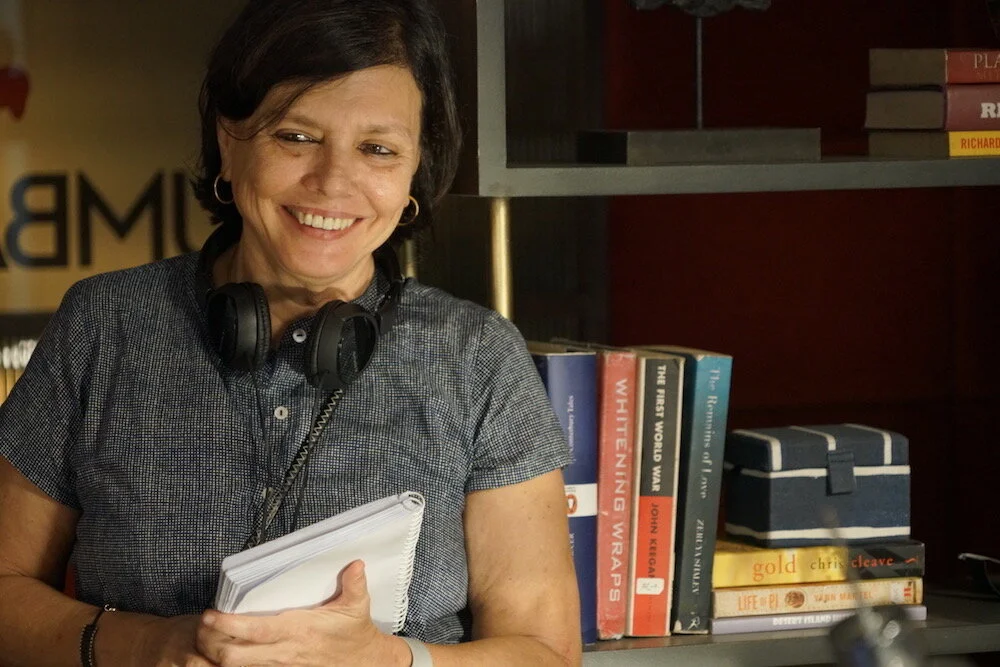
Sooni Taraporevala on the set of ‘Yeh Ballet’, photo by Supriya Kantak
I know that ‘Yeh Ballet’ in the form we can now watch on Netflix isn’t the first time you tell this story. Can you talk about how the film came to be, from the original short documentary — which was also a VR project?
Sooni Taraporevala: My son Jahan Bativala (who is now a film editor) was home in Mumbai one summer from Brown University where he was an undergraduate. He was very interested in exploring VR so I introduced him to the filmmaker Aanand Gandhi who was into VR and had a studio called Memyses Lab. Jahan started working there. He came home one day and said they wanted feature film directors to make shorts for them and would I be interested? I jumped at the opportunity –- I do believe you can teach an old dog new tricks and I am always eager to try new things. Shortly after, I met Shubhangi Swarup from Memyses, (she is now a celebrated author with her debut novel ‘Latitudes of Longing’) and she showed me the list she had drawn up of possible subjects. In that list was a story about two boys from poor families who had been discovered at being very good at ballet by a visiting Israeli/American ballet teacher. I immediately zeroed in on that. There was no question of exploring any of the other ideas. It totally fascinated and intrigued me.
I had learnt ballet as a child for many years — I was really bad at it. But I knew what a tough dance form it was, I knew how niche and elitist it was. And when I was learning ballet there were no boys learning it at all. When I first saw them dance I had tears in my eyes. I could not believe what I was seeing. Amiruddin Shah and Manish Chauhan were miles better than we ever were or could ever be. They had worn out shoes and were dancing on a hard stone floor but they were simply divine.
What were your artistic licenses in the narrative feature? What did you change and why?
Taraporevala: The film is “inspired by” not “based on” which implies certain artistic liberties. I had already made one documentary and did not want to make another –- this was a feature using all the skills I’ve learnt as a dramatist over the years. I don’t want to get into the details but I will say that it is largely based on the real story. Even the small invented parts come from a kernel of truth –- nothing was invented from thin air. I will also say that certain traits were exaggerated, like the real teacher, Yehuda Ma’or never damaged a car, but he was very sound sensitive and the chaos of India really did get to him.
Before becoming a filmmaker, you were known and celebrated as a script writer for such beauties as ‘Mississippi Masala’, ‘The Namesake’ and ‘Salaam Bombay’. What made you trade the Zen of writing for the chaos of directing?
Taraporevala: ‘Little Zizou’ was my first spec script as incredible as that may sound. All the screenplays I had written before that were commissioned. This one wrote itself in 10 days (with countless revisions later) and since it was a world I knew better than anybody else, I decided I would be the best person to direct it. I had also at the age of 50 finally found the confidence I lacked earlier.
Yes writing is the absolute opposite of directing. It’s solitary versus collaborating with 150 people everyday. With writing you always go back to edit and revise. With directing you can only keep going forward –- it’s like being on a moving train that can never stop till it reaches its destination. I love both these aspects of directing after a lifetime spent writing. I also feel that directing is being in the moment like photography is. I’ve been a photographer for longer than I’ve been a screenwriter & it calls for the same alertness to the “decisive moment”. Either you get the moment or you don’t.
Why did you wait so long between ‘Little Zizou’ (2008) and this film?
Taraporevala: Actually, I was not waiting –- I had written another very ambitious, expensive, VFX heavy screenplay I wanted to make. It took place in the present and many years into the future, and incidentally addressed many of the issues the world is facing now. I never could get it off the ground despite at one point having Irrfan Khan and Kangana Ranaut attached. I wrote countless revisions, met countless people, and it was only when I finally put it aside that ‘Yeh Ballet’ the documentary fell into my lap.
Now onto casting. In the documentary, the ballet boys play themselves. In the film only one of the dancers plays his own role, while the other you cast — beautifully I may add. Why? And how did you find your Asif?
Taraporevala: I had originally hoped and planned to have the boys playing themselves as I could not imagine ever being able to find anybody else in India who could dance like them. At the very beginning stages of the film Tess Joseph, my wonderful casting director and I had auditioned both Amir and Manish to test their acting skills. I was relieved that they were both good. The relief was short-lived. Amir got admission to the Royal Ballet School in London. It’s a very prestigious exclusive ballet school that is rigorous, fiercely competitive and exclusive. It became clear to us that there was no way Amir could both act in a movie as well as pursue his Royal Ballet training. The school, as well, were against students acting in films or doing anything outside ballet.
And so began my greatest stress –- where would I find another Amir? Tess and her team looked everywhere, in Mumbai, Delhi, Bangalore, Chennai. Nothing. And not surprisingly. The requirements were a tall order –- a boy who could dance ballet at Amir’s level, but also be able to act and dance hip hop as well. One day Yehuda Ma’or, the real teacher, who was very sweetly actively searching as well, told me about a possibility. He sent me a photo of this boy Achintya Bose whom I instantly fell I love with –- he had an afro, thick eyebrows and a wonderful smile. He was a student in one of Yehuda’s classes and was going to perform in the school’s annual day concert to which Yehuda invited me.
I went, saw him dance –- urban and jazz, met him after the show. In real life he was as endearing as in his photo. I asked Yehuda in private if he thought Achintya would be able to come up to Amir’s level after training in ballet for a few months. Yehuda wasn’t sure. Achintya was primarily a contemporary dancer whose ballet was very basic.
I so loved him I was desperate for him to work. He nailed his acting audition, was very natural in front of the camera. We put him in intensive training. His day looked like this. Wake up at 5.30, go dance and hangout with the b-boying gang in a garden in Malad, a distant suburb –- he was training in both hiphop and the language they spoke. Then to ballet training with Cindy Jourdain in the afternoon followed by the gym. And later before the shoot there was an acting workshop for him to attend as well. Fortunately for us the shoot was postponed so he had 6 months to train. He worked so hard and was so magnificent at the end of it that I call him my miracle boy.
I had quite a few miracles on this film. Another one was that I had a French prima ballerina who used to dance professionally with the Royal Ballet, here in Mumbai. Not only did Cindy Jourdain train Achintya but she also did the ballet choreography. And not only did she know ballet but she also knew film as she had acted in a dance film herself. For me it was almost as if she had been placed in Mumbai as a gift for us –- a few months after the shoot she moved to Hong Kong.
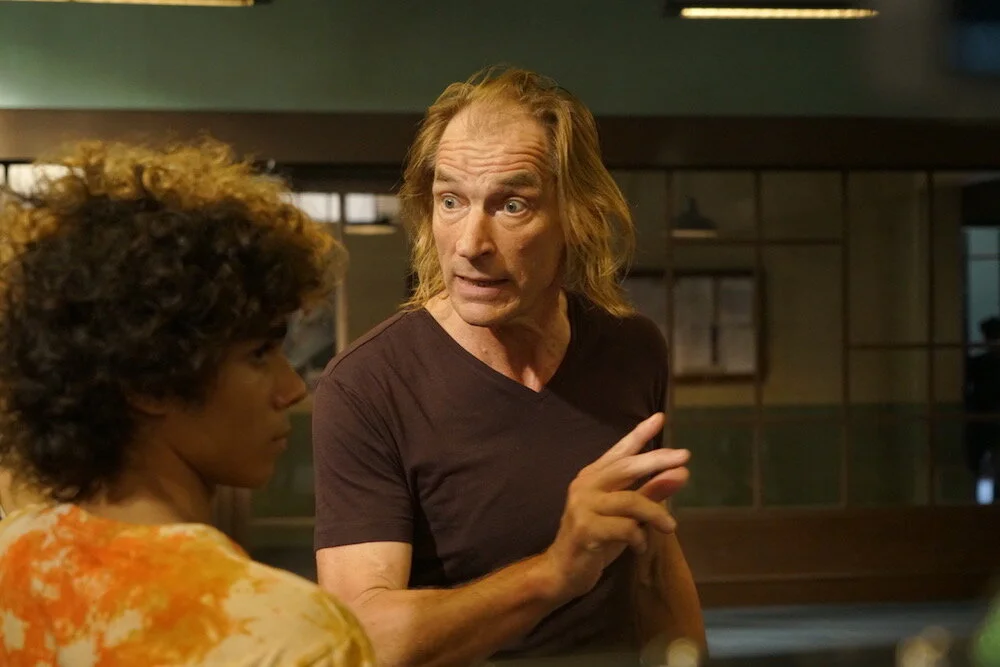
Julian Sands with Achintya Bose in ‘Yeh Ballet’, photo by Supriya Kantak
Julian Sands, in the role we agree he was born to play! What changed between the original teacher, Yehuda Maor and Saul and why?
Taraporevala: The main difference was in real life Yehuda had several years to go from being miserable in India to being at home here. In the film I had to speed it up. That’s why the parts where he was angry and discontented had to be stronger so that his arc was evident. I’m so grateful to Julian that he trusted me as a director, that he agreed so readily and was so enthusiastic from the word go. He’s so perfect in the role that I can’t imagine any other Saul now, not even Yehuda, the real teacher.
Why do you think you manage to show us this wonderful fullness of the Maximum City, in a way that only you, through your writing and in your films, can? And what does Bombay mean to you?
Taraporevala: Perhaps because I’ve grown up in Bombay which then became Mumbai. I’ve photographed the city since 1977 and have always been fascinated with its diversity, its countless layers, and its madness. Mumbai is my “jaan” [love] as the song goes — “yeh hai Mumbai meri jaan”. I love this city, and I feel very fortunate to have been born here and have a history here. I feel it will take me many lifetimes to fully explore it. Its creative potential is endless for me.
However, having said that it’s not like I haven’t written scripts or photographed in other places. I’ve written more screenplays outside Mumbai than set in the city. From writing about African-American homeless kids in LA, to legal brothels in Nevada –- I’ve adapted many books and plays like Tony Kushner’s ‘Homebody/Kabul’, Hari Kunzru’s ‘The Impressionist’ — that never got made, to Abraham Verghese’s ‘My Own Country’ which did get made by Mira [Nair] for Showtime. It’s about an Indian doctor treating the first AIDS patients in the American south.
And finally, how would you describe yourself these days? And has that definition changed from say, thirty years ago?
Taraporevala: I’m more anxious now than I was thirty years ago. I love Shahrukh Khan for this quote of his I read many years ago. He said making the decision to have a child is like making a decision to allow your heart to run around outside your body. Having kids is exactly that! It’s a crazy world our generation has bequeathed to them and it’s possibly going to get a lot worse in the future. Besides worrying about my own family, just the state of the world and all the suffering in it is also making me feel very worried, gloomy and “doomy”. I escape in work, am developing a TV series that has nothing to do with the virus or the times we are living in. I’ll leave that to other writers.