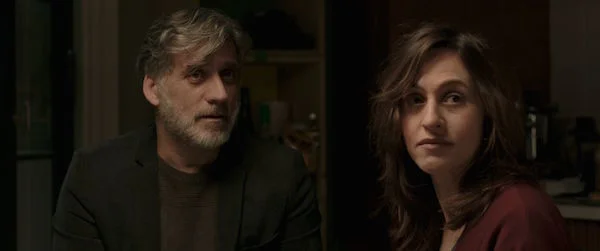
In a great film, there is always a moment when things change — that instance when the viewer is caught off guard, and left with an indelible feeling to take home. I consider it the cinematic equivalent of that famous Maya Angelou quote “I’ve learned that people will forget what you said, people will forget what you did, but people will never forget how you made them feel.” Personally speaking, a truly successful movie is one where that moment remains with me, hours later, casting a spell over my heart and soul.
Samuel Maoz’s ‘Foxtrot’ is that film. More than twelve hours after watching it at the Venice Film Festival where it is featured in the main Competition section, I’m still only barely able to process it emotionally. Even though the filmmaker created an artful, visually stunning, sonically powerful, perfectly acted, intellectually stimulating and utterly entertaining film — I can just remember how it made me feel. I doubt I will ever forget actually.
It is irrefutable that Maoz has managed to reinvent cinema in ‘Foxtrot’. The way the story is set up — how the premise of a young Israeli soldier, first presumed dead then suddenly found again for his grieving parents, is told in three parts, mixing genres, changing color pallets and music for us — is groundbreaking enough. Then visual and foreboding hints are sprinkled in there, every piece of the puzzle is put into place before our very eyes, and yet although we can kind of see the ending coming, we never expect it all. Not like that. Not the kind of frozen in your seat, thick warm tears streaming down your face, wondering if there will ever be a solution to the irreparable situation in Israel ending. No, even writing about it still gives me goosebumps.
““The film has a shot where you see a screen of a laptop with a notice of mourning and next to it a bowl with oranges. This frame is the story of my country in four words — oranges and dead soldiers.” — Samuel Maoz”
sat down with Maoz and his lead actors Lior Ashkenazi and Sarah Adler, who play the soldier’s parents with such depth, naturally imperfect humanity and undeniable chemistry. The resulting talk, I’ll admit, has deepened my love for this perfect cinematic masterpiece.
How did you come up with this story, what was the seed, the spark of the idea?
Samuel Maoz: This film is born out of a story that happened to me a long time ago. When my eldest daughter was going to school she would never wake up on time and in order not to be late she would ask me to call for a taxi. This habit cost us quite a bit of money and it seemed to be like a bad education. So one morning I got mad and told her to take the bus like everyone else does and if that’s why she’ll be late, maybe she needs to learn the hard way how to wake up on time. Her bus was line 5, and around twenty minutes after she left I heard on the radio that a terrorist had blown himself up on line 5 and lots of people were killed. I tried to call her of course but the cellular operators had collapsed because of the unexpected load. One hour later she came home, she was late for the bus that exploded — in a blink, she ran, saw it leave the station and took the next bus.
That story was the spark, but the combination of the things, at the end of the day, is an intuitive translation of my inner world, I think.
Is there a lot of you in Michael’s character? Maybe everything?
Maoz: Not everything, no. I’m not a shitty guy like him. I don’t kick dogs. But from time to time I stop myself from kicking. You know, when you come back from war, people think you have nightmares and this is the typical post-trauma… No, you can live a normal life but from time to time, you feel like you want to kill everybody and make the dogs near you pay the price. There are many weaknesses in Michael that I share with him.
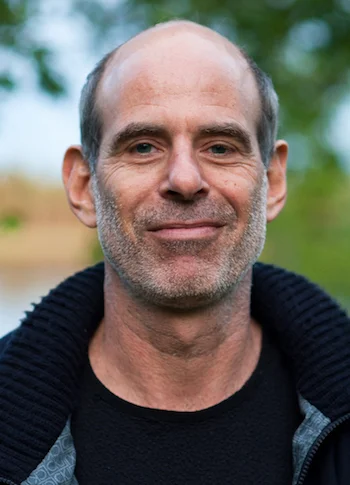
Filmmaker Samuel Maoz
How did you realize these two actors were the couple you wanted for your film?
Maoz: With Lior it was quite simple. In the beginning I told myself I wouldn’t cast him because he’s a star, lovable and then we met at some coffee shop in Tel Aviv. Before I started to talk, he said something like “listen, I know Michael, I’m in the age of Michael, I look like Michael and I understand his soul, because in you and me, there is a Michael in our souls.” But it wasn’t just what he said, he was so tuned in, passionate, it felt like electricity was dropping from him, you know and in that moment I felt that I’d found him. I realized I didn’t want to audition him even, because I didn’t want the audition to spoil that. I was so sure.
For Dafna, I auditioned many actresses, then I saw a photo of Sarah on the internet from an old Israeli film called ‘Year Zero’ she was younger, but there was something in her eyes that I told myself that’s exactly what I want to feel from her. It was a hunch, then I brought her to Israel for one day, I brought her to my apartment, took a camera and I started to shoot her and after five minutes I knew I wanted her for the role.
How did you approach your respective roles, Lior and Sarah, where you are both so connected to each other, even at times when you are not acting on screen together? How do you become cinematic husband and wife, facing such a poignant moment?
Lior Ashkenazi: We know each other for a long time, many years so when I knew it was Sarah I was so happy because I feel in some way connected to her. It was easy because I know her, and not just as a colleague. You know in Tel Aviv it’s a small city and I know her for years.
Sarah, what was in like for you, to come into this relationship?
Sarah Adler: Well, as Lior said, there was some proximity between us, even beyond the fact that we know each other. Some kind of intimacy, and also in the distances that we have. In some ways I can relate to these two people who are so far apart and having to make a long journey towards each other, to find each other again. One of the big challenges of the last part of the film was giving this sensation that this enormous void might be connectable. That you could repair it and find some kind of hope inside the most profound despair and these two people finding again some spark of love was the beginning of a new possibility of life. There are many colors because they have to go through that journey in very little time and it has to be profound too, and we have to believe that in the end those two people reconnect. We care about them.
Did you take into account for your preparation the idea that Michael is based on Samuel himself?
Ashkenazi: I didn’t know him before and when I read the script, he writes the script in a very unique way unlike other scripts. It’s written in a different format, you can see the movie when you read it. So I knew that this guy knows what he wants. It was a unique kind of shooting, I’ve never been through it before, when the take starts that goes on until the end of the material in the camera. It’s a long, long, long 27 minutes take and then he starts all over again.
Maoz: It is to turn the take into a session.
Ashkenazi: I needed to get used to it.
Actors are more used to acting in shorter spurs, so I would imagine this was exhausting…
Ashkenazi: It was exhausting.
Adler: That’s the purpose!
Maoz: When you got through emotional difficultly it’s important to get to the stage where you are just there in the moment; mine is a quiet, primitive method but it produces its fruits. And I told them, “just fly with me.”
Do you believe cinema can change the world?
Maoz: It’s a bit naive to say totally yes I think, but I hope that it can change some people’s perception. With ‘Lebanon’ I thought that if one mother won’t send her child to war maybe I managed to change something.
Adler: I don’t think cinema can change the world at all but I think that the world is made up of individuals and a little change in many individuals can add up to the growth of another type of consciousness and awaken some kind of more subtle way of thinking about subjects. People tend to think in very cliche ways and movies can help people make their point of view a little more complex, understand other sides of things and feel new emotions. But from that to changing the world is a long way.
Ashkenazi: I don’t think it can change it, but it can create debates. Especially in a place like Israel which is a small country, a movie like ‘Foxtrot’ can create a real discussion between the parties — what should we do, what should we not do. I don’t know about changing the world but certainly to talk about problems.