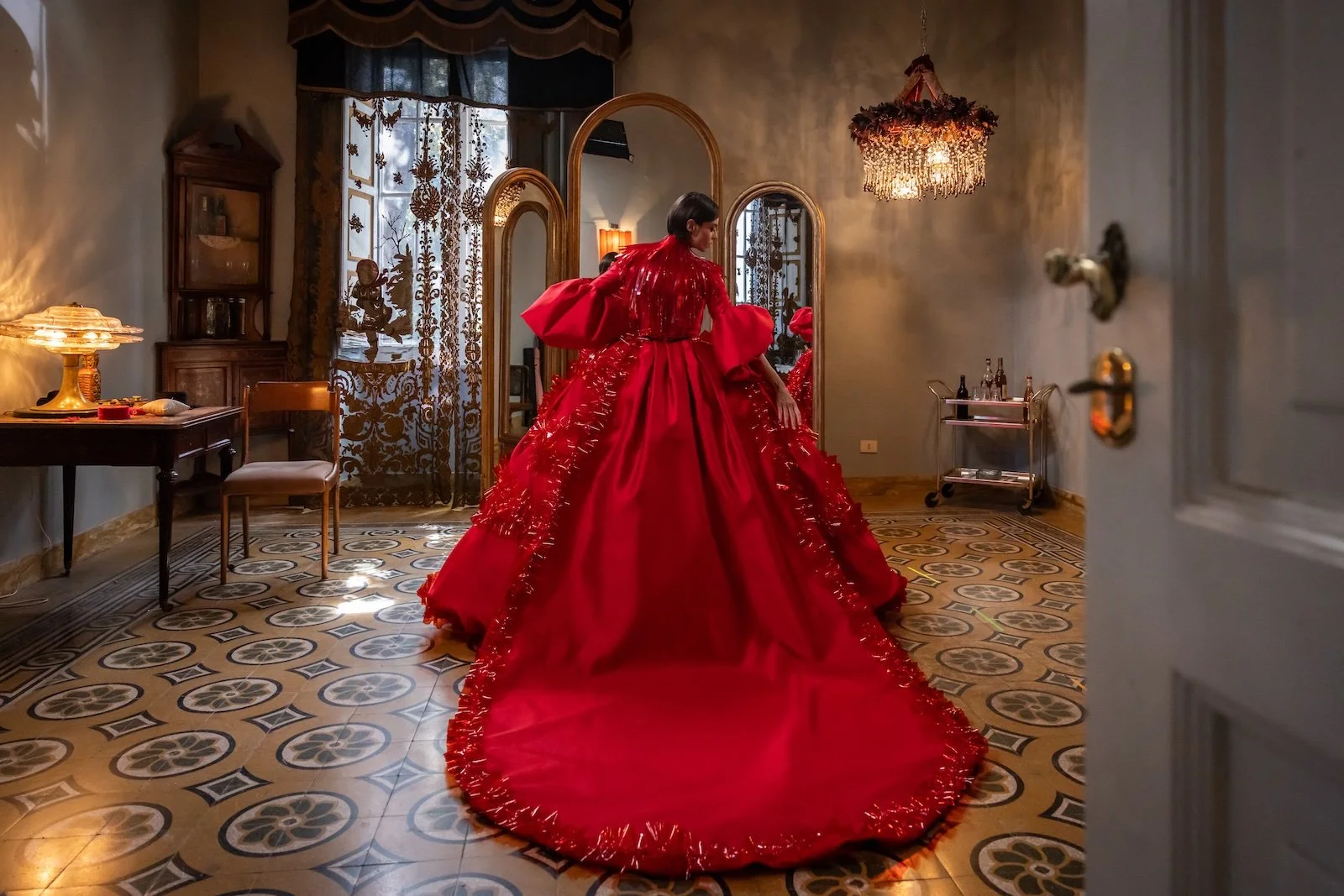
During the Turkish Italian filmmaker’s UK press tour, coinciding with the local release of his highly acclaimed latest film, Özpetek sat down with me for a short but meaningful chat, which helped explain so much about my passion for his cinema.
At the core of Ferzan Özpetek’s latest masterpiece Diamanti (Diamonds), which gets a UK release starting April 17th thanks to Vue Lumiére, there are women, lots and lots of women. In fact, the film begins with a table full of women and one man — Özpetek himself in a cameo — and ends with, you guessed it, another table full of women, along with a couple more men.
In between, Diamanti offers an extraordinary joy for the senses, the kind of story that we all wish we could be a part of in some way and the kind of costumes dreams are made of. With the help of the great costumers of the past and some of the most starry Italian stars of present, the Turkish-born filmmaker, who has called Italy home for most of his life, serves up a film that titillates, inspires and, more importantly perhaps, makes us yearn for a time gone by, when women were women and life seemed happier.
We sit down to chat in a townhouse in South Kensington, as Özpetek is here to promote his film, and to present a special screening followed by a Q&A later in the day, just a few steps away. In person, this wondrous man who has managed to create some of my favorite Italian films of the past two decades, seems kind, speaks softly and appears to have achieved an inner peace that is enviable. For our interview, he sports dark rimmed glasses, which frame his ageless face, and a black velvet jacket, and is glowing from having read a positive review published not long before I arrived.

“Maestro, I wanted to ask you about this Utopia that you’ve uncovered in your film, where women help each other and come together in sorority in the end,” I blurt out to kick off our talk. Ever since watching Diamanti, the story within a story of a costume house in Rome, where a group of women of all ages and from different social standings find their fulfillment and joy, thanks to their fellow sisters in work, I have been pondering if it could really happen, women being good to other women. As a modern and cynical journalist, my knee jerk reaction would be to say “no, never!” but Özpetek is a man of the world and of cinema so if he thinks it possible, there must be something there.
“I wouldn’t tie it to gender, this idea, I mean men too can be complicated and between a man and a woman it’s even harder,” Özpetek replies. “When I first decided to make this film with 18 actresses, everyone told me ‘you’ll have some difficulties, there could be jealousies that arise’ and instead, nothing like that happened,” he elaborates, continuing “I often say, if I had made the film with 18 men, I would have had a harder time.” Men, when they argue, can be tougher and less forgiving, the Maestro seems to think.
“Human beings are so strange, all it takes is one little thing to make an enemy, but on the opposite side of it, it also takes so little to make a friend,” he adds, wisely. While we chat, two women sit across from us unwrapping candy, whispering loudly to each other and dramatically nodding their heads… In that moment, I understand the wisdom of Özpetek’s statement.
Diamanti, the film within a film takes place in the 1970’s, in a costume house not unlike the legendary Tirelli in Rome, where costumes for Luchino Visconti’s The Leopard (Il Gattopardo) and Death in Venice (Morte a Venezia) among many others were created. In Özpetek’s film, those same wondrous works of cinema costume history occupy their own space, in the background but visible to those who know what to look for. To this fashionista-slash-cinema-lover that detail makes for an extra layer of magic, in an already mystical and outstanding film. Özpetek has filled my cinematic heart with loads of outstanding films including the 2017 Naples in Veils (Napoli velata) Loose Cannons (Mine vaganti) in 2010 and Steam: The Turkish Bath (Hamam: il bagno turco) his first, starring Alessandro Gassman in the role of a lifetime.
In Diamanti, two sisters run the costume atelier, Alberta, played by Luisa Ranieri and Gabriella, played by the phenomenal Jasmine Trinca. I don’t mean to exult the latter and diss the former, both are perfect in their roles, but Gabriella is the more likable of the sisters, until Alberta makes one move towards the end of the film that redeems her seemingly cold character and resolute manner. Various characters we get to know and love include the seamstresses in the atelier, the Oscar-winning costume designer and the director of the film within a film within a film taking place in the 1700’s, along with two actresses, one a rising cinema starlet and one a consummate theater thespian who cannot be in the same room as they dislike each other so much, all played by a variety of stars, reading like a who’s-who of contemporary Italian culture. And conspiring, as a whole, to create an intricate story with details and side events dotting the screen like the precious buttons on a 18th century brocade jacket.
Özpetek’s latest did very well in Italy, and has been exported to “104 countries”, something the filmmaker attributes to the fact that “many people remember an aunt or their grandmother who would sew and make dresses, before the advent of companies like Zara,” making the story hit home for many. “Did we lose the way a bit then?” I hear myself ask him. “Yeah, we’ve lost a lot of things,” Özpetek answers earnestly, “what gives me a lot of sadness is the use of internet and mobile phones — which on the one hand make things easier, but have also taken so much away from us.” Before retiring at night, the Maestro admits to shutting his phone off, perhaps accounting for that tranquility I noticed in him immediately.
Özpetek is on Instagram, promoting positive thinking through quotes by spiritual figures and poets alike, but also posting photos from his own life, a life he shares with his spouse, longterm partner Simone Pontesilli. That doesn’t prevent him from experiencing the kind of negativity that comes attached to social media. “People comment that I shouldn’t meddle in things, or I should go back to Turkey,” he admits, “I don’t post as a director or a famous person, but as an ordinary person — and every once in a while when people try to insult me, it makes me smile. I don’t engage.”
After the filmmaker spoke on an Italian TV show mentioning the “war” that we went through during the Covid-19 epidemic, and wondering how the little ones would ever remember the tragedy that took place in Italy, he was approached by politicians and eventually, with the support of friends like fashion designer Giorgio Armani and others, The National Day of Healthcare Workers, Healthcare Members, Assistance Workers and Volunteers was created, now celebrated on February 20th each year. It is the day when the virus was officially discovered in northern Italy. “And yet, we’ve forgotten what we went through,” he shakes his head, “we forget how many we lost and how terrible it was…”
Serving as costume designer on the beautiful Diamanti journey is Stefano Ciammitti, with whom Özpetek will work again on his next film, Nella gioia e nel dolore (In joy and in pain), still at the moment in pre-production, which will start shooting in June. “He was a student of Piero Tosi and Piero was a friend of mine, I know all about Visconti and Fellini from him — and from my days in the costume houses I learned how important details, light and colors are.”
A light moment during our conversation comes as Özpetek takes a sip of his espresso, in a pretty cup laid before him. “It’s terrible,” he whispers, “it would be hard to make it any worse than this.” I laugh, and imagine that sitting there in front of him while he chats with me hasn’t helped this little sip of bitter London coffee get any better. But then, the Maestro is used to Italian coffee, something elusive away from home, no matter how hard we try to replicate it.
There is a little boy in the film, who hides in the button room of the atelier, while his mother works, unable to provide for a babysitter. Everyone knowns he’s there, apart from Alberta, who has given the boy’s mom a final warning — no children at work. I ask Özpetek if he is based on a real person, perhaps himself or his spouse, as children? “The child is in part me, I was like him when I went to the costume houses in the beginning of my career, I didn’t want to be seen,” he admits, “I felt like dying in front of these cinema giants like Fellini, or Visconti as they were coming and going.”
So where does Özpetek’s obvious love of fashion come from? “I was in the Academy of Costume Design for six months, in Piazza Navona, because I wanted to come into cinema through something and figured costumes would be a good in,” and in the filmmaker’s eyes fashion, music and art are all part of the same beauty. He loves Balenciaga, meaning the late Spanish designer Cristóbal “a great artist who invented so much” and to whom he pays tribute in the film, along with Ciammitti, including with the stunning red dress at the center of Diamanti.
The Maestro’s films don’t traditionally premiere in festivals and that’s quickly becoming a trend that has spread now to Hollywood studio projects and beyond. “I don’t love festivals,” he says candidly, in a lower tone, “I’ve been to Cannes twice, Berlinale three times and Venice in Competition, but I don’t make films to go to festivals — I make them for the audience.” Sharing his work with people is not something he considers a commercial endeavor rather a heartfelt feeling which he calls “the biggest prize.” And he loves to premiere his work during the Christmas holidays, so he can have that personal contact, to share his films with his audience at a festive time, even if they aren’t traditional holiday titles.
And what about Netflix and the streaming platforms, how does Özpetek feel about them? “After a film has been in the cinemas, it’s OK. But not before!” He confirms about streaming. “Although, I did make one film Nuovo Olimpo for Netflix, which had 12 million viewers in 28 days and was useful because Almodóvar watched it and used one of my actors in his film.”
And that folks is the power of cinema.
Diamanti (Diamonds) opens in UK cinemas on April 17th, 2026.
Images courtesy of Vue Lumiére, used with permission.