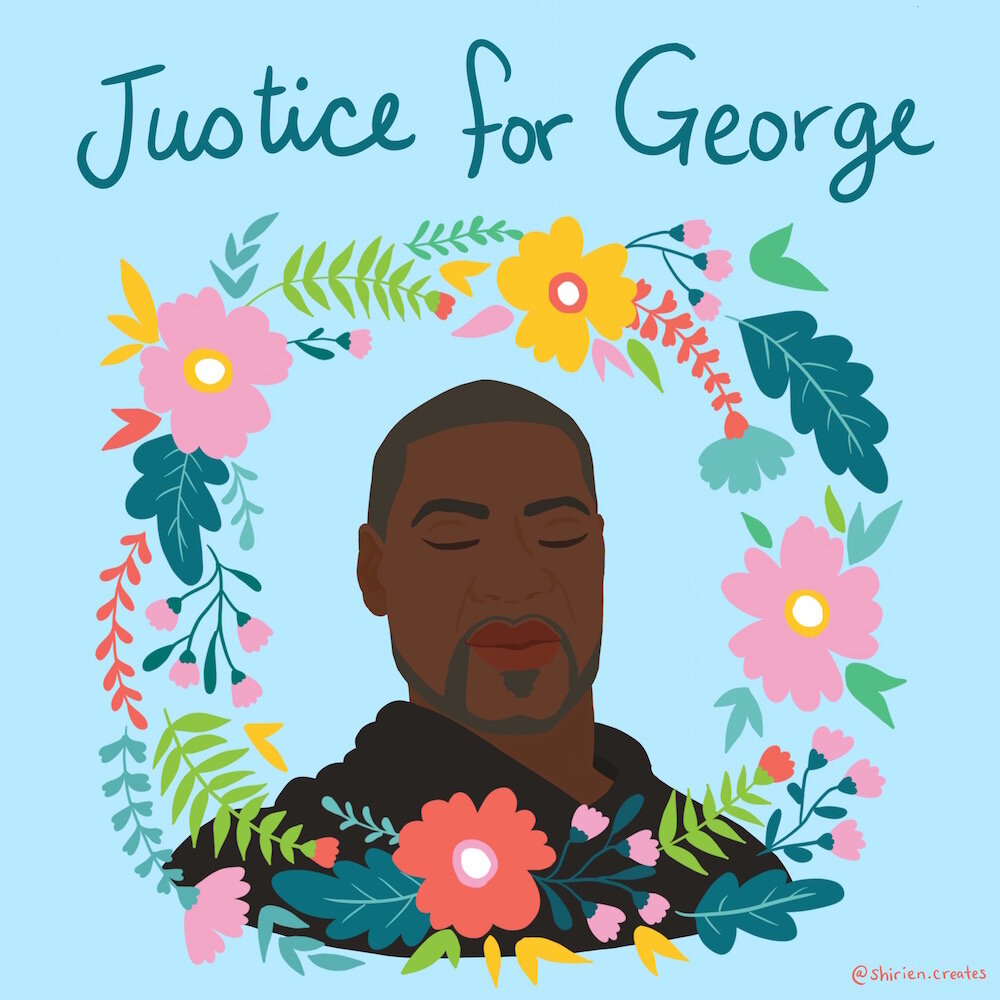
Earlier this month, I was asked to write a short piece on Shirien Damra, the Palestinian American artist whose haunting, beautiful images of George Floyd you’ve undoubtably seen shared on social media. I wrote a short enough intro for Cosmopolitan Middle East, which turned into an even shorter piece, after edits. I’d like to share the original piece, as well as Damra’s generous answers to my questions with you.
If you want to know more about Damra and her work, I suggest checking out her website and her insta account.
Imagine a better world: Shirien Damra and her artwork of change
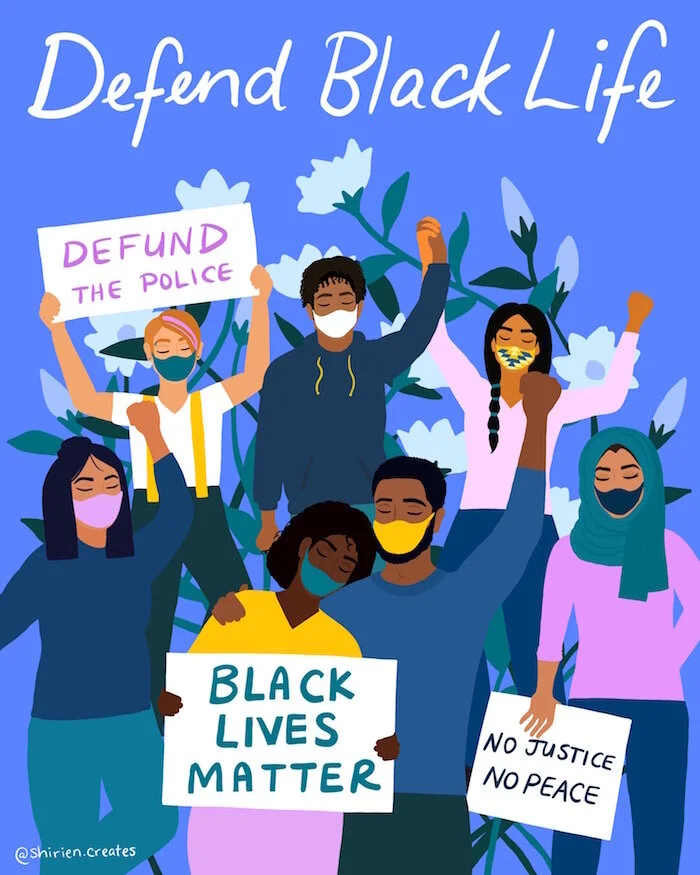
The artwork of Shirien Damra has risen like a phoenix out of the protests in support of #BlackLivesMatter, following the death of George Floyd at the hands of the police in Minneapolis. Her beautiful illustrations appear to be today’s answer to Frida Kahlo’s activist artwork, a way to point to what’s important in our world framed by color, grace and elegance.
“As someone who has done social justice work for many years, I think there are clear things we organize against,” Damra tells Cosmo ME, “but one thing that I have found we struggle with is actually imagining the things we want.” Concluding that, “art allows us to imagine the society we're building toward.”
On her Shirien Creates IG account the Palestinian-American has tackled many issues, from a personal reflection on the Holy month of Ramadan, to the more recent support of African American causes, and many nuances of social responsibility in between. “My art brings together my passion for self-care, healing, and social justice to re-envision the world I want to live in. The process of creating art is healing as is the experience of sharing and experiencing it.” Damra describes herself as a “visual designer/illustrator” and admits that “although I didn’t start out as a designer, I always felt like my parents have always been supportive of my artistic side.”
Hailing from Palestinian parents, Damra was a teenager in Chicago in the midst of 9/11, a particularly traumatic time for Arab-Americans. “Coming from a family of Palestinian refugees, I had a sense of what injustice and racism looked like through my own family’s experience,” she admits, “my experiences growing up in Chicago in a working-class immigrant family helped me see the interconnectedness between the struggles of many different marginalized communities — whether it’s Black, Palestinian, immigrant, Indigenous, etc. [and] while each struggle is unique, I learned that we don’t face oppression within our own bubbles.”
Damra’s first images of activism on social media dealt with freedom, living as a Palestinian of the diaspora and her support of the indigenous people in America. Her social media feed turned to the African American community when Damra worked “with Georgia’s NAACP chapter to create and gift an illustration for [Ahmaud] Arbery’s family,” as she pointed out in a recent piece in the LA Times on art tributes for the #BLM movement.
These days her stunning artistic revolt deals with anything from Women’s Rights, to urging people to vote, remembering the Nakba — a nod to her artistic inspiration Naji al-Ali’s Handala cartoons, she admits — and supporting the “troops” of doctors and nurses during the Covid-19 crisis. But her most emotional work undoubtably remains those portraits of African American victims of police violence like 26 year-old EMT Breonna Taylor, whose birthday was celebrated as part of the nationwide protests in the US last week.
Some last words of wisdom from Damra: “I hope to use my art to inspire others to take care of themselves and one another, and to be able to imagine and strive toward a better world.”
Now you’re ready to read her full interview below. N-joy!
What did your parents think about your decision to become a graphic designer?
I don’t consider myself a graphic designer, since I’m trained in UX/UI design as well. I just say generally “Freelance Designer” or “Visual Designer”/Illustrator.
Although I didn’t start out as a designer, I always felt like my parents have always been supportive of my artistic side. I come from a working-class Palestinian immigrant family and they were just happy I was going to college and cared about making the world a better place. In fact, I feel like I inherited my artistic side from my family. My grandfather, for example, was an artist along with other members of my family.
Do you think that being Palestinian-American helps you connect more deeply with the #BlackLivesMatter movement and why?
Coming from a family of Palestinian refugees, I had a sense of what injustice and racism looked like through my own family’s experience. As I grew older, I started learning and understanding more of how structural oppression functions and who it targets. I took my knowledge and put it into actively challenging these systems of oppression through community organizing.
My experiences growing up in Chicago in a working-class immigrant family helped me see the interconnectedness between the struggles of many different marginalized communities, whether it’s Black, Palestinian, immigrant, Indigenous, etc. While each struggle is unique, I learned that we don’t face oppression within our own bubbles -- it’s systematic and touches us all to varying degrees. Although I am Palestinian and we have our own experience of systematic racism and expulsion from our homeland, as well as facing racism and “racialized” violence in the US, I recognize the unique experience that Black people face in this country. The United States was built on the forced labor of kidnapped Africans who became slaves and 400 years later, their descendants still aren’t free from police violence and white supremacy.
Over the past few decades, Palestinian American and Black organizers have been building relationships and learning from one another. I am glad to see Palestinians and so many others protesting alongside Black communities during this moment of uprising in the U.S. It goes to show that we must support one another and stand together, and as Palestinians we also must do the work to challenge anti-Black racism within our own communities. We will not be free until we are all free.
What was the first drawing you made connecting with #BlackLivesMatter and was that the first time you’d combined your art with activism?
Art and social justice are two passions of mine that I’ve had since I was very young. I began doing art as early as elementary school and it’s something I always loved.
I started organizing around social justice issues when I became a college student at DePaul University. I started out as an art major, but eventually switched my major to sociology, and ended up getting my master’s in it. I wanted to learn more about the root of racial and economic disparities we see in this country. After graduation, I went on to do community social justice organizing and work in the field of human rights advocacy.
As I became focused on social justice organizing, art is something I had put aside for many years, but as I became burnt out and drained from advocacy work, I decided to start using art as a creative outlet and as a tool for raising awareness and inspiring action, infusing my passions for art and social justice.
My art brings together my passion for self-care, healing, and social justice to re-envision the world I want to live in. The process of creating art is healing as is the experience of sharing and experiencing it.
I created the portrait for Ahmaud when I heard the news about his death. I couldn’t get myself to watch the video of his murder, but I read more about what happened to Ahmaud and was really upset and angry. I channeled my feelings by creating an illustration for Ahmaud, as a way for myself to process the event, but also as an artistic form of solidarity with Black communities in their time of grieving. I also wanted to raise awareness of what happened to Ahmaud without sharing the triggering video of his murder. My portrait of Ahmaud was a way to spread awareness of what happened to him while honoring his memory in a dignified way.
Who are your artistic influences?
The late Naji al-Ali is an amazing Palestinian artist I admired for a long time. Growing up, I always saw images of Handala that resonated with me as a kid. The fact that Naji al-Ali was targeted for his cartoons also helped me realize just how powerful art and artists are in the push for social change. I recently made a nod to Handala in my Remember the Nakba piece. The old man in the center is supposed to be Handala as an older man.

Another Palestinian artist that influenced my work is Ismael Shammout. I loved how he beautifully centered Palestinian women in his works of art. In my own work, I often center Indigenous, Black, Palestinian and Latina women.
Micah Bazant, Molly Crabapple and Melanie Cervantes are more recent examples of artists I look up to that beautifully infuse art and social justice.
My favorite Chicago artist is Hebru Brantley, who helps amplify young Black characters in unprecedented ways. His street art has always moved and inspired me.
And what do you wish people to take away from your art?
As someone who has done social justice work for many years, I think there are clear things we organize against. We know what we don’t want. We don’t want any more Black lives targeted by police and white supremacy. We don’t want undocumented immigrants sitting in cages. We don’t want Indigenous folks from here to Palestine to continue losing their land.
But one thing that I have found we struggle with is actually imagining the things we want. Art allows us to imagine the society we're building toward. This is especially important because we are at a crucial time. Our world will likely never turn back to how it used to be before the pandemic and the uprisings happening right now.
As artists, one role we could play is allowing ourselves and others to re-imagine the possibilities. Art can be a powerful catalyst in bringing more people together to take action. I hope to use my art to inspire others to take care of themselves and one another, and to be able to imagine and strive toward a better world.